Biodiversity loss may not stay inside forests, fisheries or farms. New modelling shows it can weaken GDP, lower sovereign ratings and raise the cost of public borrowing.
For African countries already balancing debt service with health, education and infrastructure, nature protection is becoming a fiscal resilience strategy.
Nature Risk Is Becoming Credit Risk
Nature loss could make governments more expensive to finance long before financial markets fully reflect the danger.
A 2026 Nature Ecology & Evolution study connects declining ecosystem services to national output, sovereign credit ratings, default probability and debt-servicing costs across 23 countries representing 5.5 billion people.
- The researchers estimate that current rating methods may be overlooking risks in an $83 trillion sovereign-debt market.
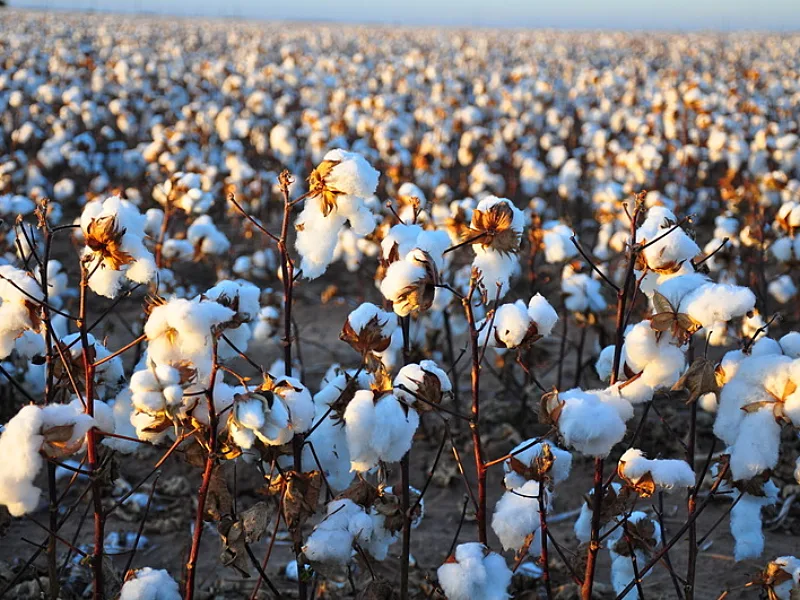
- Their central argument is simple: when pollination, fisheries and forests lose productive capacity, economies lose income and governments have less fiscal strength to service debt.
Eight African economies appear in the sample: Angola, the Democratic Republic of the Congo, Egypt, Ethiopia, Madagascar, Morocco, Nigeria and South Africa.
The implications are especially serious where borrowing costs are already high and public budgets are thin.
The study notes that many biodiversity-rich developing countries already borrow at rates two to four times higher than the United States.
An additional nature premium would therefore be evident in an unequal base, increasing the risk that countries with globally important ecosystems have the least affordable capital to protect them.
A Hidden Liability Inside Sovereign Debt
Credit ratings normally capture macroeconomic damage after it has reached GDP, debt ratios or external balances.
The study instead inserts forward-looking ecological shocks into a model of S&P-style sovereign ratings, creating a stress test for risks that current methods do not explicitly include.
The framework links three ecosystem services;
- Wild pollination.
- Marine fisheries.
- Tropical timber - from production and trade through the GTAP-InVEST model.
It then adjusts six rating variables, including GDP per capita, GDP growth, government debt, fiscal balance and external accounts.
Under a partial ecosystem-collapse scenario, wild pollination and marine catch biomass fall by 90%, while 88% of tropical forest is converted to grassland or shrubland.
The model highlights an annual global GDP shortfall of $2 trillion by 2030 against a baseline that excludes ecosystem decline.
Ecosystem Decline Moves Through National Balance Sheets
The damage is uneven because economic dependence and rating thresholds differ across countries.
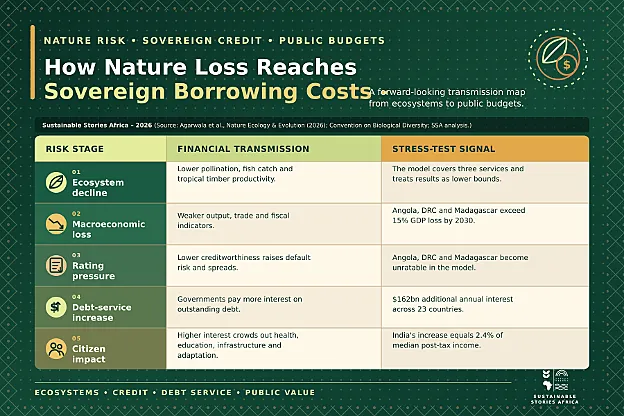
Angola, Bangladesh, the DRC and Madagascar show GDP losses exceeding 15% by 2030 under the partial-collapse scenario, with simulated ratings for Angola, the DRC and Madagascar falling below the model's lowest observed category, effectively unratable and signalling probable default in practice.
Elsewhere, smaller GDP shocks can still trigger large rating moves when a country sits near an income or credit threshold.
China and Malaysia, for instance, record modelled downgrades of 5.5 and 6.3 notches respectively, despite not having the largest GDP shortfalls in the sample.
- Across the 23 countries studied, additional annual interest payments reach $162 billion, with China accounting for $70 billion and India $49 billion.
This combined amount equals 81% of the $200 billion annual biodiversity-finance target under the Kunming-Montreal Global Biodiversity Framework, meaning delayed nature protection could impose a debt penalty nearly matching the scale of global conservation ambition.
The model also reveals why such risk can arrive abruptly:
- Ratings sit in discrete bands, so a modest shift in income or debt indicators can push a country across a threshold, producing a larger-than-expected downgrade even from an identical ecological shock.
Pricing Nature Early Can Protect Development
The findings change the case for conservation.
- Protecting a watershed, fishery, forest or pollinator habitat is not only environmental spending.
- It can preserve productive capacity, fiscal space and access to finance.
- That makes nature-positive investment relevant to finance ministries, debt offices and central banks, not only environment agencies.
Early pricing can also improve capital allocation.
- Investors could distinguish countries reducing ecosystem dependence and degradation from those converting natural capital into short-term revenue.
- Rating agencies could test forward-looking nature scenarios instead of waiting for damage to appear in historical GDP.
For African economies, the benefit is developmental.
- Avoided interest costs leave more money for electricity, transport, hospitals, schools and climate adaptation.
- Well-designed conservation finance can therefore protect both ecological assets and the public services that depend on affordable sovereign borrowing.
The choices are costly.
- Governments can cut other spending to pay interest, borrow again and postpone the pressure, raise taxes, or default.
- Each route passes part of the ecological loss to citizens.
In lower-income countries, where debt service already competes with essential services, prevention may be cheaper and fairer than fiscal repair after a downgrade.
African Institutions Need Nature-Risk Stress Tests
Finance ministries should map;
- Which sectors, exports and tax bases depend on pollination, fisheries, forests, water and soil, allowing debt-sustainability analysis to include severe but plausible ecosystem scenarios alongside exchange-rate, commodity-price and climate shocks.
Central banks and supervisors should examine;
- Sovereign spillovers into banks, insurers and pension funds, since a sovereign downgrade raising domestic funding costs can ripple through bank balance sheets and corporate credit.
- National biodiversity strategies should therefore connect conservation priorities to financial-stability and public-investment plans.
Public debt offices can start with exposure maps;
- Identifying which export revenues depend on forests, fisheries or pollinated crops, which regions face concentrated ecosystem stress, and which liabilities reprice quickly after a downgrade, guiding maturity choices, contingency buffers and investor communication before markets react.
Rating agencies and international financial institutions need;
- A consistent science-to-finance pipeline that avoids penalising countries borrowing to restore ecosystems solely for higher near-term debt while ignoring future productivity benefits.
- Better models must recognise both degradation losses and conservation gains.
Finance ministries can support this shift;
- By valuing natural capital as productive infrastructure, with budget submissions stating services protected, sectors supported and losses avoided, strengthening the evidence base for public investment and lender negotiations.
Finance instruments require safeguards.
- Debt-for-nature swaps, green or blue bonds, blended finance and payment-for-ecosystem-services programmes can help.
- However, contracts alone aren't conservation outcomes; independent baselines, community rights and measurable results remain essential.
These are scenario simulations, rather than forecasts, that cover only three ecosystem services and exclude compounding climate-biodiversity effects, making the estimates conservative lower bounds.
Still, uncertainty is no reason to wait: nature stress tests can begin now, improving as evidence strengthens.
Path Forward – Invest In Nature Before Interest Rises
African governments should integrate nature into fiscal risk registers, debt strategies and capital planning, while rating agencies decide on whether to add forward-looking ecosystem evidence to their methodologies.
The choice is increasingly financial as well as ecological: invest early in natural capital and retain fiscal space or absorb higher borrowing costs after productive systems decline.