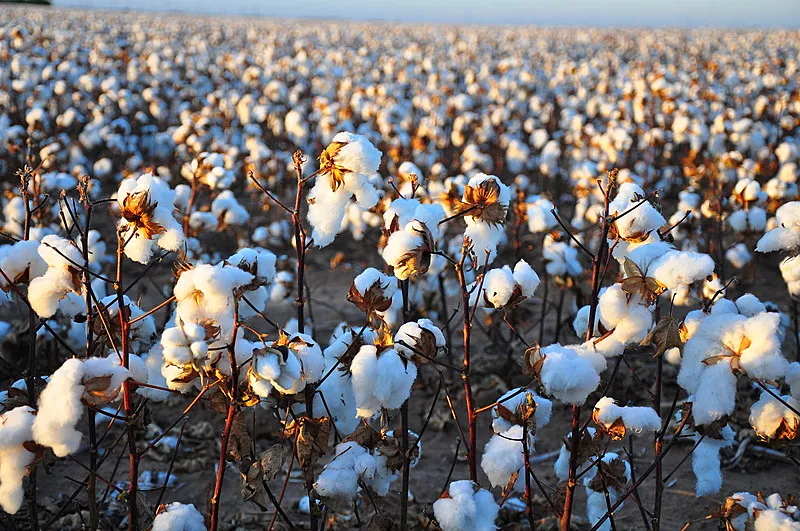
Cotton supports more than two million livelihoods in Burkina Faso, yet smallholders remain exposed to volatile prices, subsidised competitors and limited influence over domestic decisions.
A 2025 study argues that market access has not led to fair value capture, making governance, local processing and producer power the next development test.
Cotton Still Anchors Burkina Faso's Countryside
Cotton remains one of Burkina Faso's most important rural industries, even after gold displaced it as the country's dominant export.
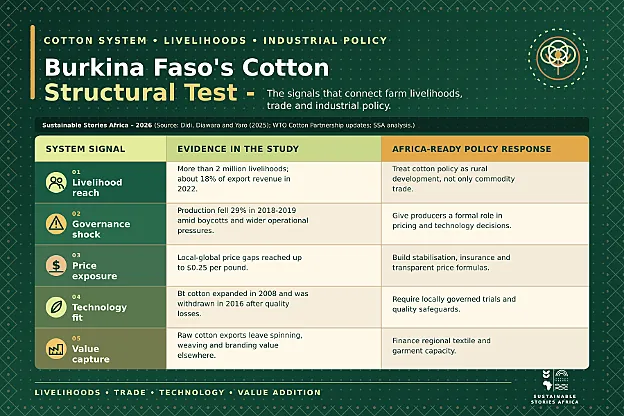
A 2025 paper by Mohamed Didi, Amadou Diawara and Fatin Yaro estimates that the crop supports more than two million livelihoods and accounted for about 18% of national export revenue in 2022.
- The scale explains why cotton cannot be judged only by its declining rank in the export table.
- Its earnings travel through farms, cooperatives, ginneries, transport and local commerce.
When producers' incomes weaken, the effects are felt in household spending, food security and employment across cotton-growing communities.
However, the paper's review of 15 academic and institutional sources from 2010 to 2024 finds that integration into global markets has also deepened exposure to price volatility, subsidy-driven competition, technology risk and domestic governance gaps.
In a country facing insecurity, displacement and climate pressure, that exposure is more than an agricultural balance-sheet issue.
- A lost season can reduce school spending, food purchases and the cash available to restart production.
- Cotton policy therefore sits at the intersection of rural stability, social protection and economic inclusion.
A Vital Crop With Fragile Returns
The paper reported cotton export earnings of $262 million in 2023.
- That figure is small beside gold; however, the social footprint of cotton is wider because production is labour-intensive and rooted in rural areas.
- This is the sector's central paradox: macroeconomic weight has shifted, while livelihood dependence remains.
Burkina Faso's cotton system is organised around SOFITEX, the state-controlled company that supplies inputs and oversees purchasing, transport, ginning and sales. Prices are set before the rainy season.
The study links farmer frustration over limited participation in pricing and other decisions to a production boycott that helped drive a 29% fall in 2018 - 2019, from more than 540,000 tonnes to about 380,000 tonnes.
The authors caution that the decline was not caused by governance alone.
- Climate variability, pests, input delays and the after-effects of ending genetically modified Bt cotton also interacted with producer resistance.
- That makes the episode a systems failure rather than a single-variable story.
It also shows why official production targets need a farmer-level delivery test. Output can recover while household margins remain weak if input debt, transport costs, quality discounts and payment delays absorb the gain.
Better data should track net farm income, not just tonnes delivered to ginneries.
Global Markets Deepen Unequal Farmer Exposure
Market access for Burkinabe cotton drew buyers in Asia and Europe, but not equal bargaining power.
- Producer prices stayed below global averages between 2015 and 2023, with gaps reaching $0.25 per pound, as smallholders competed against producers backed by public support that lowers effective costs.
This has created an uneven value chain:
- Burkina Faso exports raw fibre while higher-value activities, such as spinning, weaving, garment production, branding and retail, remain concentrated elsewhere.
- Consumer-end price gains rarely flow back to farmers, and market volatility often shifts household income faster than productivity gains can offset.
Trade-distorting support widens this imbalance.
- Wealthier markets offer producers insurance, credit and research access that smallholders cannot match, meaning even rising world prices may not translate into stronger local shares due to financing constraints and purchasing structures.
- Fairer trade demands both multilateral reform and stronger domestic negotiating capacity.
Technology posed a second dependency test.
- Bt cotton trials began in 2003, expanded by 2008, and were withdrawn in 2016 after shorter fibre length hurt quality and export prices, despite initial gains in yield and reduced pesticide use.
- The takeaway: agricultural technology isn't the problem; poor alignment with local ecology and market needs before scale-up is.
Local Processing Could Retain More Value
The opportunity is to turn cotton from a raw-export dependency into a regional manufacturing platform.
- Local ginning is not enough.
- Competitive spinning, weaving, dyeing, apparel manufacturing and logistics would create a longer chain of jobs and allow more value to remain in West Africa.
That ambition now has a regional policy vehicle.
- In March 2026, the World Trade Organisation said the Cotton Partnership for the C-4+ countries, Benin, Burkina Faso, Chad, Mali and Côte d'Ivoire, aims to mobilise $5 billion over ten years and generate $6 billion in value-added products.
- The initiative is moving from diagnosis towards implementation, with blended finance and risk-mitigation tools expected to support investment.
Success, however, should be measured beyond factory announcements.
- Governments and financiers need indicators for farmer income, local procurement, women's employment, energy and water use, traceability, export diversification and the proportion of lint transformed within the region.
Environmental performance belongs inside the industrial plan.
- Cotton expansion can increase pressure on soils, water and chemical use, while hotter and less predictable seasons raise production risk.
Investment should support soil health, integrated pest management, water efficiency, climate information and seed systems that protect fibre quality without locking farmers into unsuitable technologies.
Reform Must Reach Farms And Factories
Domestic governance must come first.
- SOFITEX and producer organisations should publish price formulas, input costs and quality deductions in accessible formats.
- Farmer representatives need meaningful voting power in pricing, varietal selection and dispute resolution, rather than consultation after decisions are made.
Risk-sharing tools are equally essential.
- A transparent stabilisation fund
- Weather and price insurance
- Warehouse finance and cooperative credit could reduce the transfer of every shock to smallholders.
This is provided these instruments remain independently governed to avoid becoming opaque subsidy channels or new debt sources.
Industrial policy should then link;
- Farms to factories through dependable energy, transport, water efficiency, technical skills, quality standards and offtake contracts.
Globally, Burkina Faso can continue working through the Cotton-4 and wider developing-country coalitions to challenge trade-distorting support and improve access to development finance.
The study itself is a narrative review, rather than a new farm-level fieldwork, so its figures and causal claims should be read as a synthesis guiding policy questions, pending fresh household surveys and value-chain data to test who gains, who bears risk, and which reforms deliver durable income improvements.
That evidence agenda requires transparent baselines: annual reporting should reconcile farm-gate prices with export receipts, disclose support programme costs and beneficiaries, and publish gender- and region-disaggregated livelihood outcomes.
Path Forward – From Raw Exports To Shared Prosperity
Burkina Faso's next cotton strategy should combine farmer voices, transparent pricing, locally tested technology and protection against severe market shocks.
Those reforms would strengthen the sector before new investment scales.
Regional processing offers a larger prize: more jobs, more export value and less dependence on raw commodity prices.
The measure of success is whether smallholders capture a fairer share of the value they create.