IRENA says Francophone West Africa must move beyond counting electricity connections and start measuring whether decentralised renewable systems can keep health, water, food and warning services operating during climate stress.
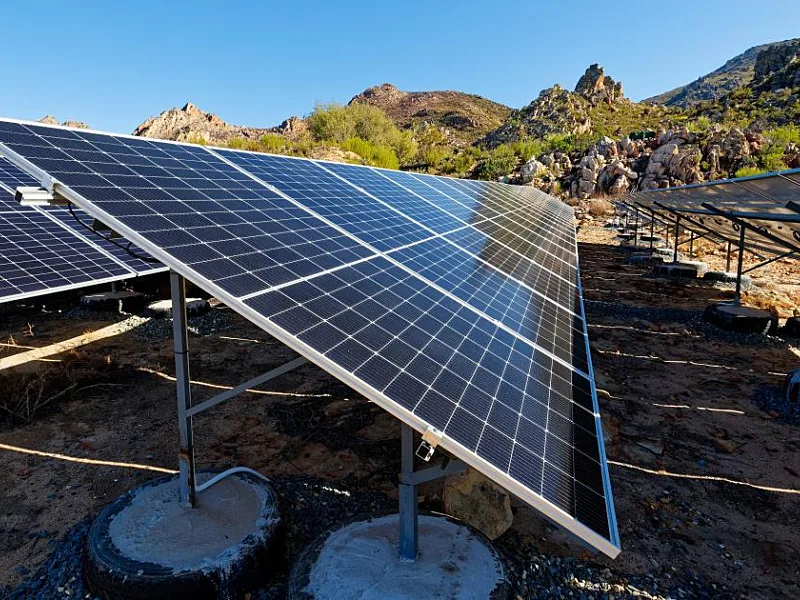
The gap is stark: most adaptation services require Tier 3-4 capacity and Tier 4-5 availability or reliability, while the region's dominant solar home systems typically deliver only Tier 1-2 service.
Electricity Access Is Now Adaptation Infrastructure
A solar connection is not automatically a climate-resilience asset. Its value during a heatwave, flood or drought depends on whether it can run a fan long enough, keep vaccines within temperature limits, pump drinking water when supply is disrupted or power an early-warning message when the grid fails.
That is the central argument in IRENA's Powering climate resilience in Francophone West Africa. Covering Benin, Burkina Faso, Côte d'Ivoire, Guinea, Mali, Niger, Senegal and Togo, the report reframes electricity as an enabling condition for adaptation.
The question is not simply whether a household, farm or clinic is connected, but whether the service has enough capacity, availability and reliability to protect essential functions under stress.
This shift matters because climate pressure and energy poverty overlap.
- The Sahel has warmed by 1 - 3°C since the mid-1970s. Days above 40°C could rise from roughly 60 a year to nearly 200 by the 2090s.
- Mali recorded 48.5°C in April 2024
- Drought affected about 10 million people across Burkina Faso, Mali and Niger in 2022
- Floods displaced roughly 710,000 people and killed more than 200 in Niger in 2024.
Climate Hazards Expose Fragile Essential Services
Electricity access across the eight-country region was only about 50% in 2023, compared with nearly 92% globally.
- Urban access averaged 84%, while rural access was about 30% and fell to around 10% in Niger and 2% in Burkina Faso.
Those numbers identify where vulnerability is concentrated, but they still do not show whether connected users receive adequate service.
IRENA estimates that the region had approximately 178 megawatts of installed off-grid renewable capacity in 2024, around 13% of Africa's off-grid total and about 1% of the global total.
That capacity is growing, especially through solar; however, a small home system designed for lighting and phone charging cannot be assumed to support a refrigerator, an irrigation pump, a cold room or a health facility.
The report therefore applies the Multi-Tier Framework, which grades service rather than connection status. Capacity is only one attribute.
- Availability asks how many hours electricity can be used, including during the evening or working day.
- Reliability asks how often and how long supply is interrupted.
The weakest attribute can determine whether an essential service succeeds or fails.
Connections Alone Cannot Deliver Climate Resilience
Six services illustrate the point:
Cooling and ventilation, vaccine refrigeration, cold storage for food, irrigation, drinking-water pumping and communication-based early warning.
- Most require Tier 3-4 capacity, above basic household access.
- Cold chains and water systems need near-continuous Tier 4 - 5 availability.
- Early warnings may use little power; however, they require Tier 5 availability and reliability because a short interruption at the wrong time can erase the benefit.
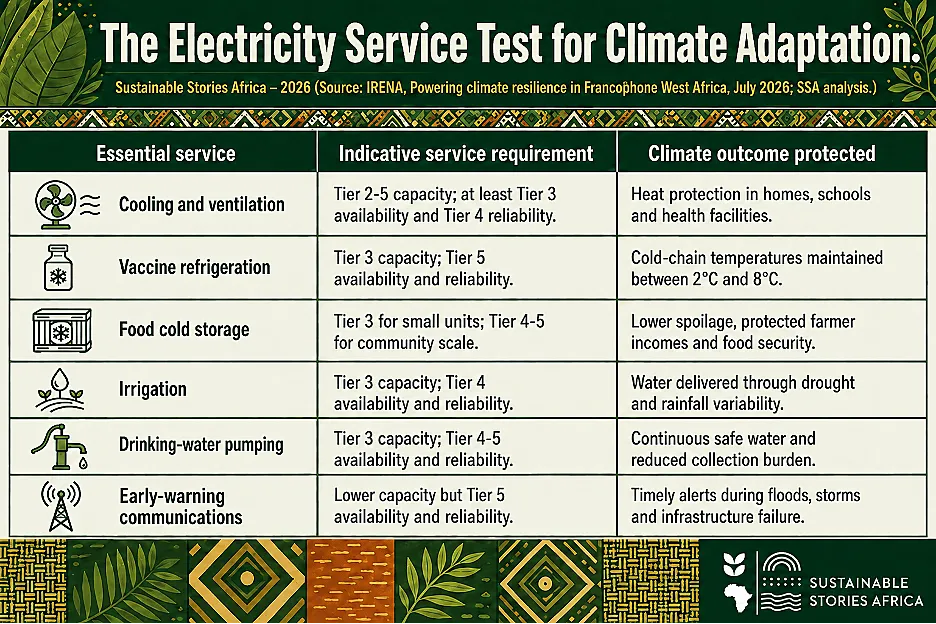
Vaccine refrigerators generally require Tier 3 capacity; however, maintaining temperatures between 2°C and 8°C pushes availability and reliability to Tier 5.
Community cold rooms typically require Tier 4 capacity and may need Tier 5 for larger volumes.
Irrigation and drinking-water pumps can sit at Tier 3 capacity, while dependable service under drought conditions requires Tier 4 availability and reliability, with Tier 5 preferable in severe-risk locations.
This is where current deployment falls short.
- Solar home systems dominate and usually perform at Tier 1-2. Mini-grids and direct-service systems - such as solar pumps, irrigation and cold-chain solutions fit adaptation needs better.
However, project reports commonly count systems, connections or installed watts rather than uptime, temperature stability, water delivered or warning-system continuity.
Service Tiers Reveal the Readiness Gap
The mismatch creates two risks.
- First, a project can be declared complete even though it cannot deliver the required service.
- Second, the adaptation benefit remains invisible in national planning and climate reporting because implementers do not measure it.
Both problems direct money towards hardware rather than outcomes.
A service-based approach can change investment decisions.
- A clinic procurement would specify temperature stability, working-hour availability, battery autonomy and maintenance response rather than simply solar-panel capacity.
- A water project would define litres delivered, operating windows, drought-season reliability and fallback arrangements.
These requirements help system designers size generation, storage and controls around the actual public service.
The same logic should shape equity.
- A national average can hide villages where a clinic receives power for lighting but not refrigeration, or where a pump works during normal weather but fails during the dry season.
- Gender and livelihood impacts also depend on service quality: reliable water pumping can reduce collection time, while dependable cold storage can protect the income of farmers and traders.
Monitoring should therefore disaggregate who receives the service, when it works and what loss it prevents.
Finance Must Reward Performance, Not Installation
IRENA proposes seven actions.
- Projects should embed adaptation-relevant indicators such as uptime, continuity and temperature stability.
- Procurement should state minimum capacity, availability and reliability.
- Designs should include storage, load management, remote monitoring and structured operations and maintenance.
- Financing should reward verified service performance rather than installation alone.
Performance-based maintenance contracts are essential because resilience depends on lifecycle operation, rather than commissioning-day photographs.
National monitoring systems should document adaptation outcomes, while governments and development partners should scale models that have already demonstrated reliable service.
Regional knowledge-sharing can reduce repeated design mistakes across similar climates and service needs.
Financiers also need to recognise that higher service levels cost more but protect more value.
- A Tier 4-5 system with storage, remote monitoring and funded maintenance may look expensive beside a basic system.
- Its comparison should include avoided vaccine spoilage, reduced crop loss, reliable water access, continued health service and fewer disruptions during emergencies.
Regional Action Can Scale Proven Models
Governments should connect electrification plans to National Adaptation Plans, health, water, agriculture and disaster management budgets.
Regulators can establish service categories for climate-critical facilities.
Public procurement agencies can use common technical specifications, while results-based finance can release payments against verified service data.
Developers should disclose performance at the point of use.
Communities need defined service expectations, complaint routes and local maintenance capacity.
Regional institutions can create common metrics and share operating evidence across Francophone West Africa, giving governments and financiers a clearer basis for replication.
A regional evidence platform could record technology, service tier, climate hazard, operating hours, failures, repair times and lifecycle cost for each project type.
- That would help planners compare solar home systems, mini-grids and dedicated service applications on a common basis.
- It would also make successful local operating models visible to neighbouring countries and allow funders to price maintenance and resilience from evidence rather than assumption.
Path Forward – Measure Continuity, Fund Resilience
Francophone West Africa should stop treating every connection as equal.
Climate-ready energy policy must specify the service a system protects and the continuity that service requires.
Procurement, finance and reporting should reward verified outcomes over the system's life.
That is how decentralised renewables become adaptation infrastructure rather than equipment that disappears from attention after installation.