


Sustainability reporting becomes more useful when companies explain how risks and opportunities affect revenue, costs, assets and financing.
A preparer manual sets out a practical route from broad topics to financial evidence.
For African businesses, the challenge is to connect sustainability expertise with finance and risk management while keeping investor information clear and accountable.
Sustainability Reporting Must Explain Financial Consequences
African companies preparing investor-focused sustainability disclosures need to explain how environmental and social issues could affect their business prospects.
- A list of important topics cannot, on its own, show the consequences for cash flows, financing or capital costs.
- The assessment needs evidence linking the issue with the company's operations and financial decisions.
Financial Materiality Assessment of Sustainability-Related Risks and Opportunities is a preparer methodology manual by Dr Rames Sivadasan.
- It proposes an eight-step assessment process, examines governance and enterprise risk management, and includes an explicitly hypothetical Malaysian palm oil company.
- Its examples offer practical methods, rather than a new reporting standard.
That distinction matters for African preparers.
- Methods can help organise judgement, but the applicable standards determine disclosure requirements.
- The manual's strongest contribution is its insistence on tracing sustainability issues into financial effects and documenting the decisions made along the way.
Used carefully, that discipline can make reporting more informative for boards and capital providers.
Start With Consequences That Investors Can Assess
The manual distinguishes two questions:
- Which sustainability risks and opportunities could affect a company's prospects
- What information about them could influence investor decisions.
Keeping these questions separate helps preparers avoid assuming that every identified issue needs an equally detailed disclosure.
A label such as water stress offers little explanation.
- A company should establish which operations depend on water, how disruption could affect production, and what expenditure or other response may follow.
- The analysis then has a financial transmission channel that can be assessed against evidence.
The reporting frameworks also need accurate differentiation.
- ISSB standards focus on financial materiality.
- GRI standards focus on impacts on the economy, environment and people.
- ESRS uses double materiality, bringing together financial and impact perspectives.
The manual sometimes groups GRI and ESRS too closely; GRI's own explanation distinguishes these approaches.
Companies should build linked reporting systems while preserving each framework's purpose.
- An impact assessment can reveal information relevant to financial exposure without becoming a substitute for the financial assessment.
- Equally, a financial reporting conclusion does not establish that an issue is unimportant to affected communities.
Follow The Evidence From Risk To Disclosure
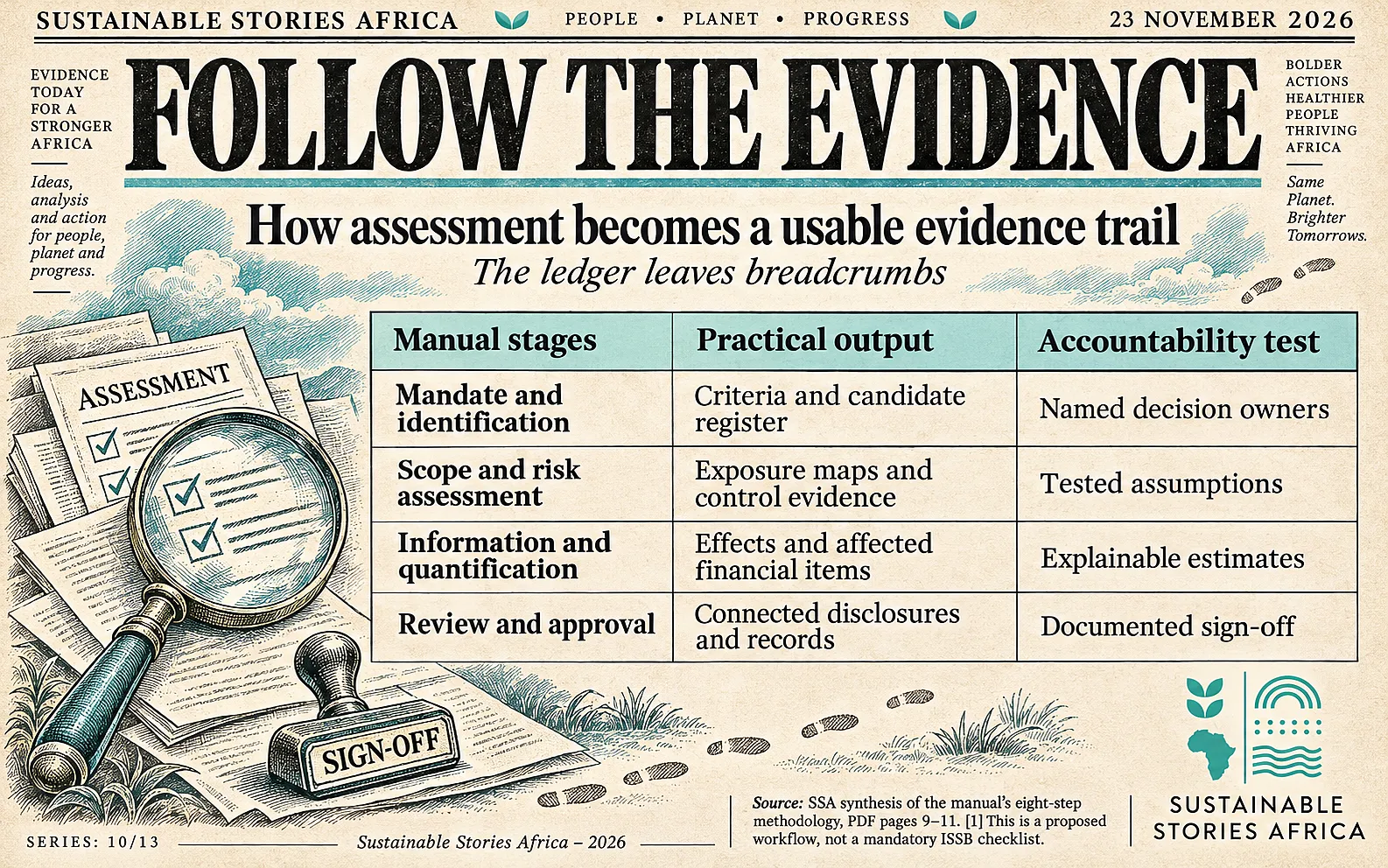
The manual's eight steps begin with an agreed mandate, time horizons and assessment criteria.
- Preparers then build a list of candidate risks and opportunities and map their location across operations, suppliers, customers and relevant financial statement items.
- This makes subsequent analysis more specific than a ranking of broad sustainability themes.
Next comes assessment before and after management controls.
- Inherent risk describes exposure without those controls; residual risk reflects the controls assumed to operate.
- The manual recommends recording the evidence for their effectiveness, reviewing combined exposures and determining what information to disclose.
- Final approval follows a review of the complete report.
An important boundary applies to the manual's use of risk thresholds.
- The IFRS Foundation's November 2024 educational material says the standards prescribe no materiality thresholds or specific identification method.
- An internal risk rating can inform assessment, but it cannot replace the test of whether information could influence capital providers' decisions.
- Information about an effectively managed risk can still be material.
For boards, the implication is practical:
- Accepting a risk within appetite does not automatically settle what investors need to know about it.
Management may still need to explain the exposure, the controls and the financial resources required to sustain them.
Financial Connections Make Opportunities More Credible
The manual's worked example uses Sawit Sejahtera Berhad, a fictional palm oil producer.
- All its figures are illustrative.
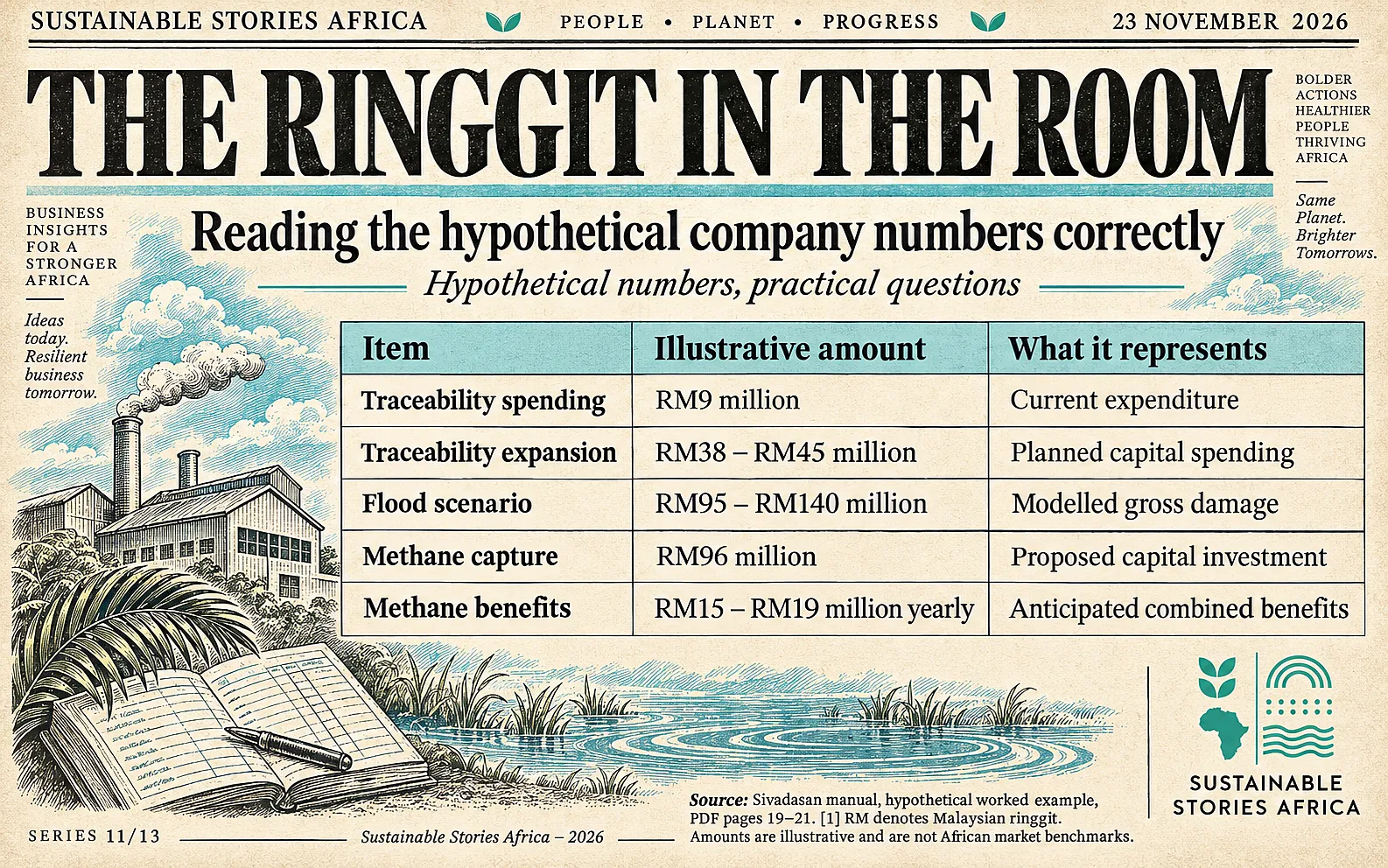
The example assigns the company RM6.2 billion in revenue, with 22% linked to European Union exports, and then examines traceability expenditure, flood exposure and methane capture.
- These are teaching assumptions, not findings about an actual issuer.
Its value lies in showing different kinds of financial information.
- Existing expenditure records what has already happened.
- Planned capital investment describes a future commitment.
- Revenue exposure indicates the business potentially affected; it does not automatically represent a loss.
A scenario range explores a possible outcome under stated assumptions.
The methane example also demonstrates why opportunities require scrutiny.
- Dividing RM96 million by the stated annual benefits gives a simple payback of roughly five to six years.
- This calculation assumes steady benefits and excludes discounting, financing and tax effects.
- It is an explanatory check, rather than an investment appraisal.
For an African manufacturer or agribusiness considering efficiency measures, the transferable discipline is to document costs, expected benefits and uncertainty.
- The Malaysian assumptions cannot be transferred directly.
- Local operating conditions, contract terms and financing arrangements must supply the evidence for the company's own assessment.
Timing should be visible in that evidence.
- An upfront investment, an annual operating expense and a possible future revenue effect are different financial commitments.
- Combining them into one headline number can obscure the decision facing management.
Showing when each effect is expected and which assumptions would change it helps readers distinguish current obligations from longer-term possibilities.
Put Finance Inside The Assessment Process
The manual recommends shared ownership across finance, sustainability and enterprise risk management.
- Finance links the analysis with budgets and financial statements; sustainability teams contribute knowledge of dependencies and impacts; operational teams test whether assumptions describe actual conditions.
- Executive review and board approval then establish responsibility for the judgement.
Preparers must retain a clear record for each significant conclusion:
- The evidence considered, the affected activity, the assumptions used and the reason particular information was included or excluded.
- This record should explain disagreements and changes, making the assessment easier to revisit when circumstances shift.
Responsibility for missing information should be equally clear.
- Assigning an owner and a review date to each significant data gap improves a practical task.
- It also helps the next assessment distinguish a resolved uncertainty from an assumption that management has carried forward.
Uncertainty needs explicit treatment.
- The IFRS Foundation explains that estimates and forecasts can remain useful when companies disclose their inputs, methods and measurement uncertainty.
- A precise figure without a credible basis is less informative than an appropriately explained estimate.
Companies should therefore identify what is known, what is estimated, and what further information would improve the assessment.
- The manual also stresses reassessment, aggregation of related exposures and an archived evidence file.
- These practices help prevent last year's conclusion from becoming an unexamined reporting habit.
For readers, the resulting report should answer a practical question:
- What could change this company's financial prospects, and how is management responding?
- Clear explanations of that linkage can make sustainability information useful in financing and oversight discussions without promising that disclosure alone will improve commercial outcomes.
Path Forward – Connects Disclosure With Accountable Decisions
African companies should connect sustainability assessments with finance, operations and risk management, while testing disclosure decisions against investor information needs.
Internal scoring should support judgement and remain open to challenge.
The priority is an evidence trail linking exposures, assumptions, financial effects and management responses.
This gives boards and capital providers a clearer basis for assessing resilience and opportunity.