

African climate investment has expanded, with new 2026 evidence showing a larger role for domestic private finance.
However, the total still masks uneven access across countries and sectors.
The test is whether financing reaches viable mitigation projects and essential adaptation measures on terms that countries, businesses and communities can sustain.
Climate Finance Must Reach Development Priorities
Climate finance is becoming a more substantial part of Africa’s investment landscape, but higher totals do not settle questions about adequacy, accessibility or results
- Funding for a commercially viable energy project and support for a community facing recurrent flooding serve different purposes.
Both matter, and they require different financing structures and measures of success.
“What Is Climate Finance?” describes resources supporting mitigation and adaptation and explains their place in climate justice and international cooperation.
- It identifies accessibility, transparency and implementation as central issues.
Two newer evidence sources deepen the African analysis:
Climate Policy Initiative’s Landscape of Climate Finance in Africa 2026, and UNEP’s Adaptation Gap Report 2026 findings concern different geographies and reporting periods, which must remain clear when comparing needs and flows.
Rising Investment Does Not Close Every Gap
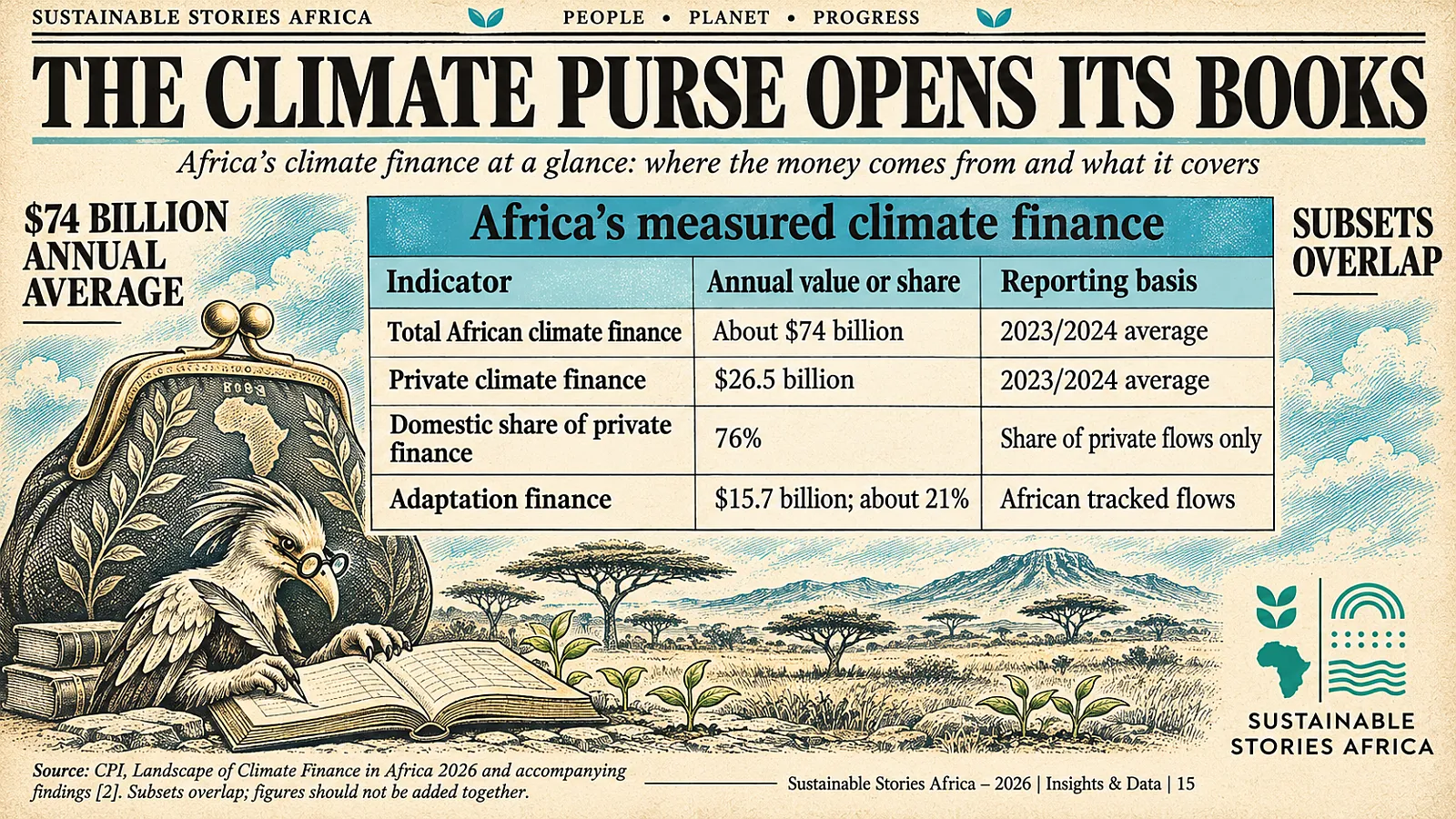
CPI’s third African stocktake puts climate finance at approximately $74 billion annually in 2023/2024.
- Private investment reached $26.5 billion, with 76% of that private funding originating domestically.
- The figures show that African banks, businesses and households are contributing materially to the transition, rather than acting only as recipients of external capital.
These are averages for the underlying reporting years, not amounts newly disbursed during November 2026.
- The distinction is essential.
- Publication dates tell readers when analysis becomes available; investment periods tell them when the measured activity occurred.
- Confusing the two can overstate the speed at which new commitments are translating into projects.
The same stocktake reports adaptation at about 21% of tracked African climate finance, or $15.7 billion a year.
- A higher overall total can therefore coexist with inadequate support for resilience.
- Sectoral composition matters because adaptation measures protecting households and public services may lack the direct cash flows that attract conventional commercial investment.
For African policymakers, the useful question is which financing gaps prevent priority action.
- A renewable developer seeking long-term credit, a municipality needing drainage and a small producer requiring climate information face different barriers.
- Treating them as one generic shortage of investment can produce instruments that serve the easiest transactions while leaving critical public needs unresolved.
Follow The Geography And Purpose Of Funding
International goals provide context but should not be presented as African allocations.
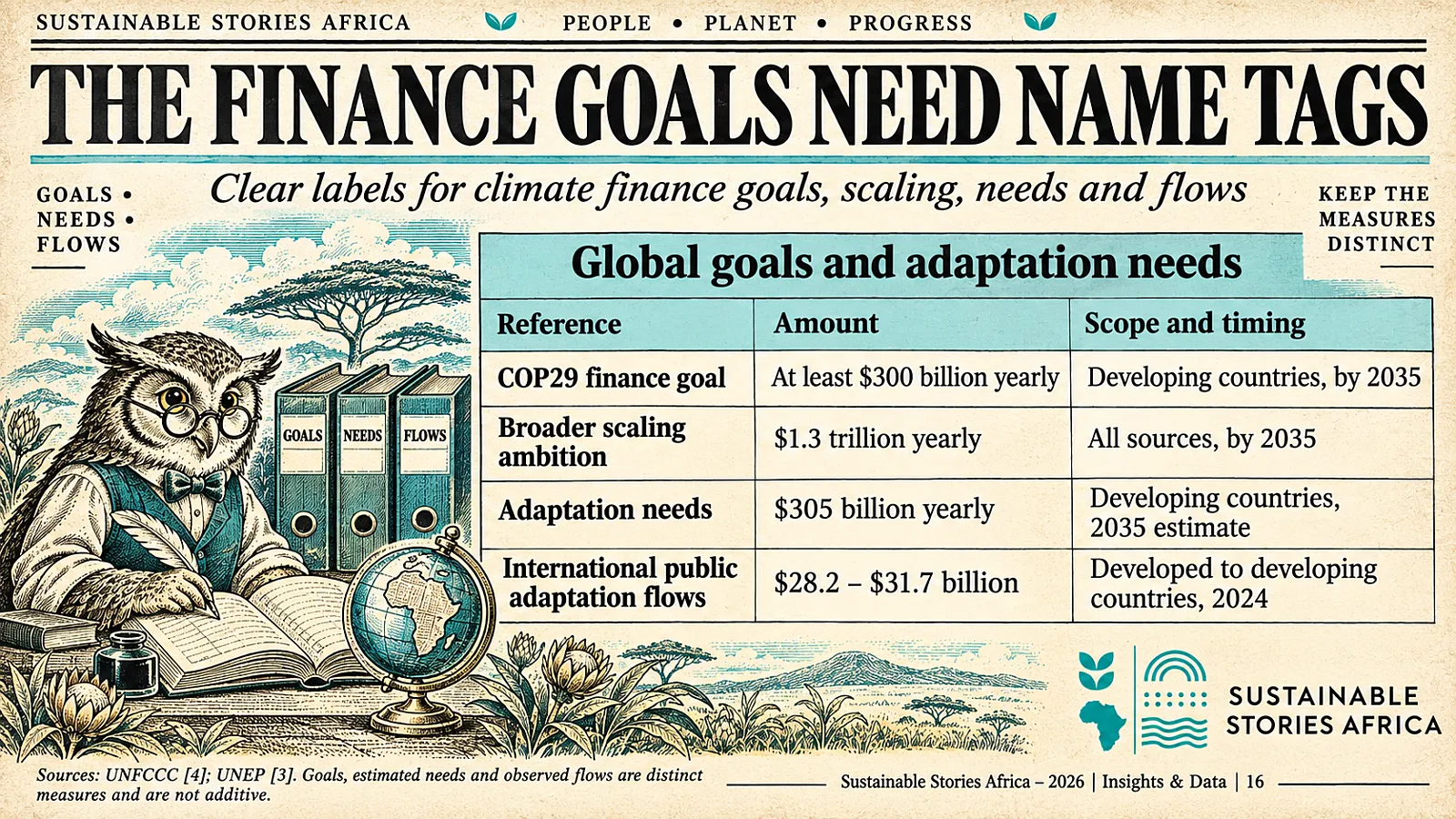
The COP29 finance decision set a goal of at least $300 billion annually by 2035 for developing countries, with developed countries taking the lead, alongside a broader effort to scale finance from all sources to $1.3 trillion annually by 2035.
Public finance can support priorities that do not generate a readily monetised return.
- A warning system or protective public-health measure may deliver substantial value without a revenue stream sufficient to repay a commercial loan.
- Appraisal should recognise these benefits while establishing a realistic budget for operation, maintenance and continued service.
Private investment has a complementary role where a viable business model exists.
- The presence of a climate benefit does not remove credit, currency or demand risks.
- Finance structures should identify which risks investors can manage and which public intervention might reasonably address
- A guarantee should solve a defined barrier, rather than simply transfer poorly understood obligations to taxpayers.
Access procedures deserve scrutiny alongside headline volumes.
- Project developers and local institutions need the ability to prepare proposals, meet evidence requirements and manage delivery.
- Improving these capabilities can expand the range of credible projects.
It should also help local priorities influence investment selection rather than merely adapting proposals to whichever funding window is available.
Adaptation Needs A Different Financial Conversation
UNEP’s 2026 adaptation assessment estimates developing-country needs at $305 billion annually by 2035.
- It records international public adaptation finance from developed to developing countries at $28.2 – $31.7 billion in 2024.
- These figures indicate a large mismatch, but their different periods mean the comparison should not be described as a precisely measured current-year funding deficit.
For Africa, this evidence supports a stronger emphasis on the terms and purpose of finance.
- A project that protects vulnerable households may require grants or highly concessional support.
- Loading repayment obligations onto communities with little capacity to pay could undermine the resilience the investment is meant to strengthen.
- Funding design should examine the beneficiary’s position and the wider fiscal implications.
Resilience benefits also need evaluation over time.
- Completing infrastructure does not establish that it performs under stress or reaches the intended users.
- Programmes should define service standards, maintenance responsibilities and ways to assess avoided disruption.
These measures can improve accountability while recognising that a project may face hazards beyond its design assumptions.
Build African Institutions Around Delivery And Accountability
Governments should assemble costed investment priorities that link national climate plans with sector budgets and local needs.
- Each priority should identify the institution responsible, the financing structure and the expected public benefit.
- A clear programme helps partners coordinate and gives citizens a basis for tracking what has been promised and delivered.
Domestic financial institutions can strengthen project assessment and develop instruments suited to local revenues and time horizons.
- This requires attention to currency exposure, regulatory conditions and the quality of underlying data.
- Expanding domestic participation should build on prudent assessment rather than assume that all locally raised finance is automatically affordable or appropriate.
Development partners should support preparation as well as construction.
- Assistance with feasibility, procurement and monitoring can make projects more executable, especially where institutional capacity is constrained.
- Procedures should be proportionate and transparent so that necessary safeguards do not become an unexplained barrier that only the best-resourced applicants can navigate.
Finally, public reporting should distinguish pledges, approvals, disbursements and completed investments.
- It should explain who received finance, under what terms and with what results. This would allow
- African institutions to assess whether rising volumes are improving development outcomes and identify where money is failing to reach the needs cited in political commitments.
Comparisons between editions of finance reports require particular care.
- CPI explains that its latest stocktake revises earlier figures to improve consistency across reporting periods.
- Analysts should therefore use the comparable series within the current edition rather than calculate growth by combining unadjusted headline figures from different publications.
- A revision in coverage or methodology is not itself a new investment flow.
The same care applies to local delivery dashboards.
- A project may combine several financiers, and one institution’s commitment may mobilise another’s participation.
- Reporting should explain how totals avoid double counting and whether figures represent finance committed, spent or leveraged.
- Clear definitions make it easier to assess the public contribution without inflating the apparent scale of resources.
Recipient institutions should also budget for the period after external support ends.
- Staff, maintenance and data systems may require continuing domestic funding.
- Showing this obligation early can prevent a successful construction phase from being followed by a service that cannot be sustained.
Path Forward – For More Useful Climate Finance
African governments should connect finance strategies to costed priorities, capable local institutions and transparent delivery.
Adaptation needs financing that reflects public benefits and limited repayment capacity.
Partners should measure progress beyond announcements, tracking terms, disbursement and sustained results.
Stronger domestic participation and dependable international support can work together when both serve clearly defined development and resilience objectives.