
Crossing 1.5°C of long-term warming would expose societies to greater damage even if temperatures eventually decline.
UNEP argues that governments must limit the height and duration of overshoot while preparing for impacts that may persist.
For African economies, the findings connect emissions policy with infrastructure choices, development finance and protection for communities facing the largest risks.
Overshoot Changes Climate Planning Across Generations
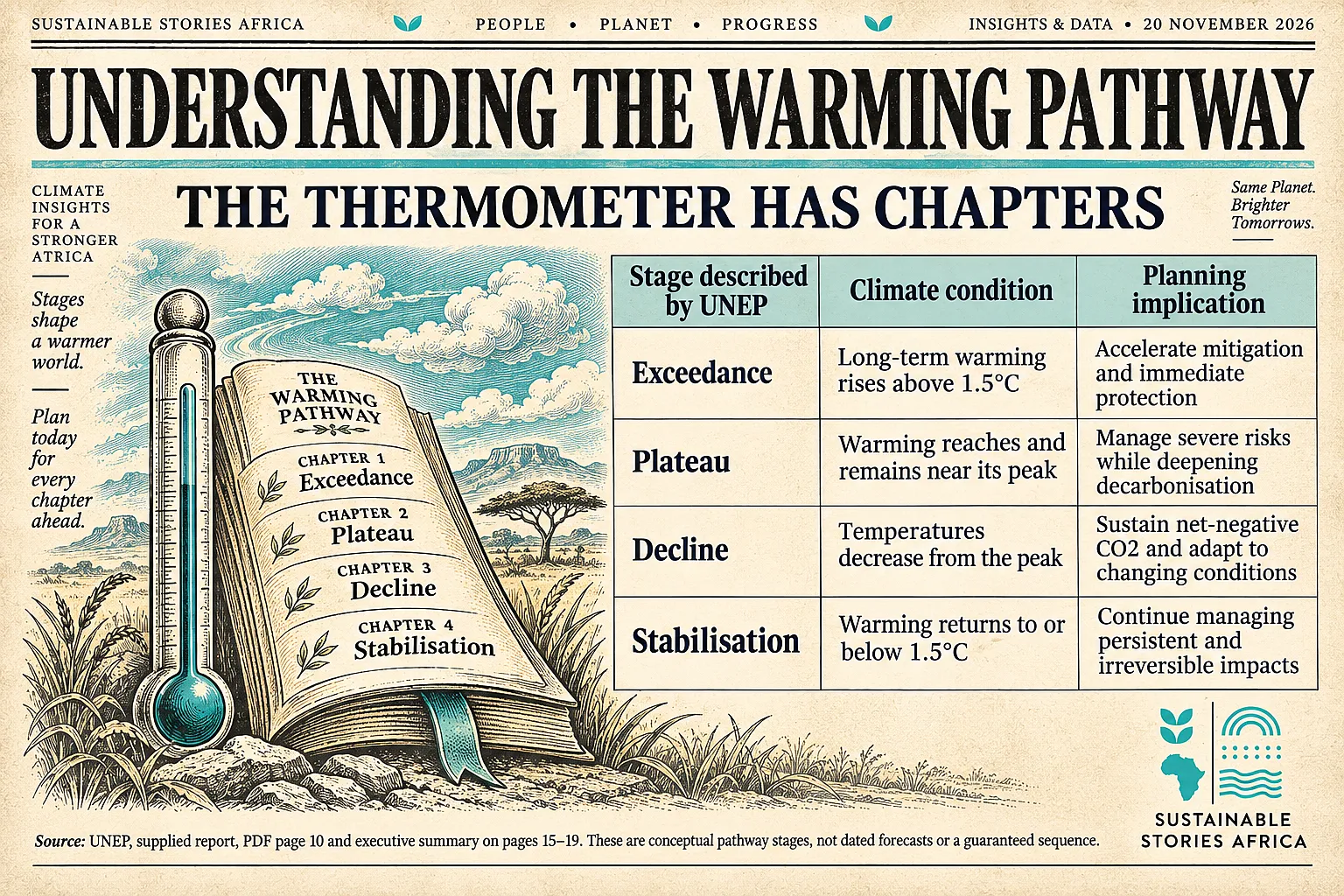
Global warming is likely to cross 1.5°C above pre-industrial levels within the next few years, and returning below that threshold is not assured, according to the United Nations Environment Programme.
- The response must combine faster emissions cuts with adaptation to intensifying and potentially irreversible impacts.
UNEP’s 2026 report, Limiting Overshoot: Navigating exceedance of 1.5°C and pathways towards return, was published in Nairobi and released on 2 September.
- It examines climate science, mitigation, adaptation and governance across an overshoot pathway in which warming rises above a threshold before potentially declining.
The report distinguishes long-term warming from a single unusually hot year.
- It concerns the multi-decadal global average, not a single annual temperature reading.
For African policymakers and businesses, this makes overshoot a question of long-lived infrastructure and public protection: decisions taken now influence both exposure during warmer decades and the options available afterwards.
Crossing The Threshold Increases Lasting Risks
Even an optimistic scenario that fully implements national climate plans and additional net-zero targets produces expected peak warming of about 1.8°C, the report states.
- This outcome depends on delivering commitments; it is not a forecast of the most likely policy trajectory.
- The difference between 1.5°C and a higher peak is consequential for ecosystems and economic activity.
UNEP describes increasing risks from extreme heat, stronger flooding, sea-level rise and damage to food and water systems.
- The scale and timing vary, but the report rejects the idea of harmless overshoot.
Some impacts may continue even after global temperatures fall.
- Species lost cannot simply return, and sea-level rise can persist beyond peak warming.
- Communities may have relocated or changed livelihoods by the time a decline in temperatures becomes possible.
For African coastal settlements, farmers and urban residents, the practical issue is whether institutions can manage changing risk over decades.
- Infrastructure built for historical conditions may become inadequate during the warmer phase.
- A later reduction in global average temperature does not automatically repair the damage or restore previous social conditions.
This creates a clear distinction between limiting warming and reversing every consequence.
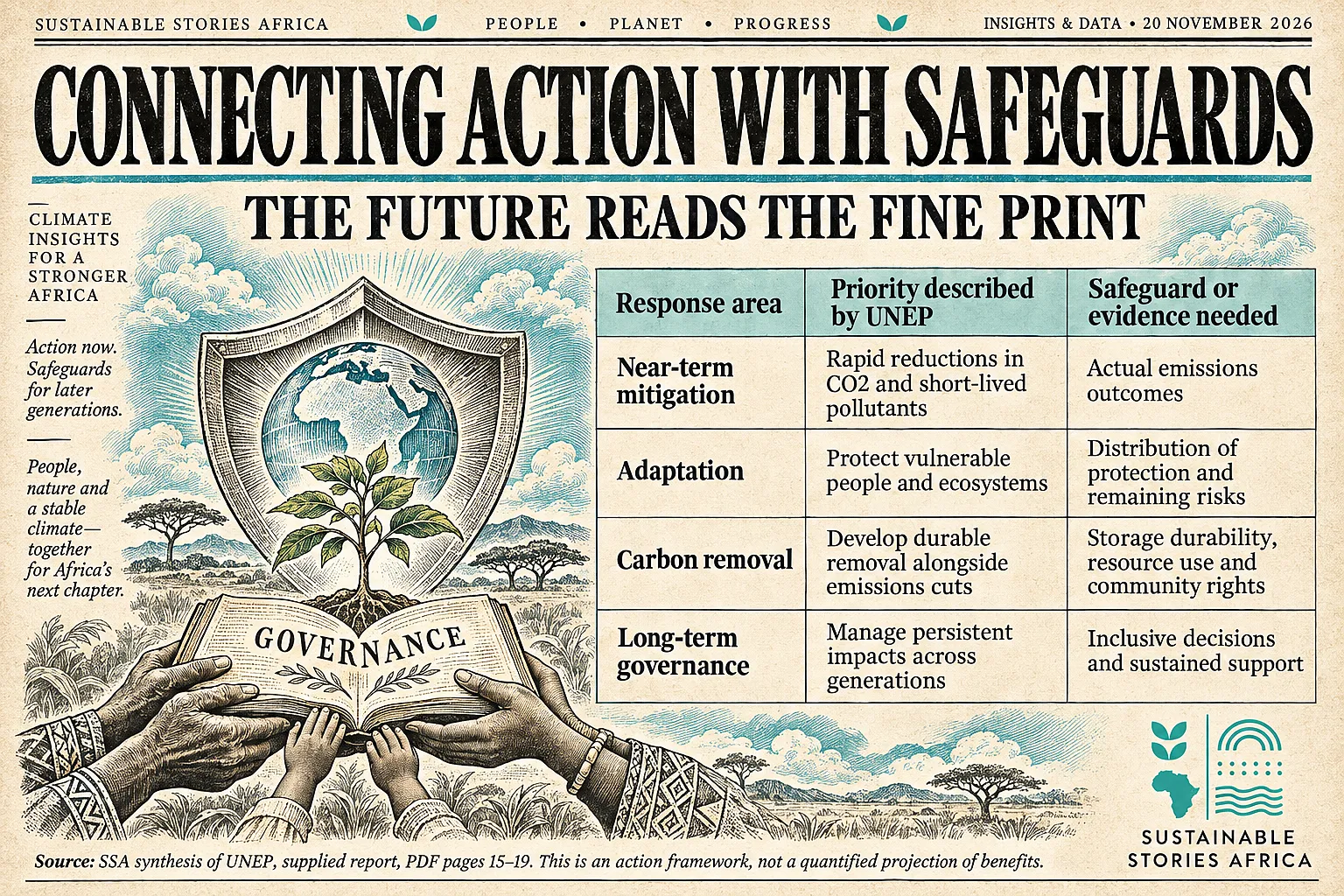
- Emissions reductions can preserve better options and avoid additional harm, while adaptation remains necessary to manage impacts that mitigation cannot prevent in time.
- Treating either as sufficient by itself would misread the report.
Carbon Removal Cannot Guarantee Temperature Recovery
UNEP identifies carbon dioxide removal as necessary for bringing warming down, alongside sustained emissions reductions.
- Conventional approaches include afforestation and ecosystem restoration, while novel approaches include direct air capture with storage and bioenergy combined with carbon capture and storage.
Their role depends on scale, durability and emissions.
- Reaching net-zero carbon dioxide broadly limits additional warming from carbon dioxide, while a sustained decline requires net-negative emissions.
- Continued emissions consume part of any removal capacity before it can reverse temperature.
The report states that returning to 1.5°C within this century becomes increasingly challenging beyond a peak of around 1.8°C.
- Carbon removal is more credible as a contributor to that return when peak warming remains well below 2°C and other greenhouse gas emissions are also reduced.
One illustration shows the scale involved: at current levels of afforestation and forest management, it would require more than a century to lower warming by 0.1°C even with zero residual carbon dioxide emissions.
- That is a conditional comparison, not an estimate that tree planting alone can reliably reverse climate change.
Land-intensive removal can compete with food production and other development priorities. Warming may also weaken ecosystems’ ability to retain carbon.
- These interactions matter for African land policy because projects need to account for existing livelihoods and the durability of the claimed climate benefit.
The report concludes that even optimistic removal expansion is unlikely to reverse more than a few tenths of a degree this century.
- Its analysis therefore strengthens the case for reducing emissions promptly, while developing credible removal approaches with safeguards and realistic assumptions.
Methane and other short-lived climate pollutants receive particular emphasis in the immediate response.
- Reducing them can help slow near-term warming while carbon dioxide cuts address cumulative warming.
Their importance does not remove the need for sustained changes across energy and land use; it broadens the set of actions that can influence the peak.
Adaptation Must Protect Essential Development Gains
Limiting peak warming reduces the severity of impacts that societies must manage.
- At the same time, adaptation can protect essential services and economic activity during the warmer period.
- UNEP presents the two efforts as interconnected across the pathway rather than sequential choices.
Urban tree cover illustrates a measure with potential benefits for both goals.
- Shade can reduce heat exposure and cooling demand, while vegetation stores carbon.
- The design still depends on water availability, maintenance and access; as such, assess benefits locally rather than assumed from the project label.
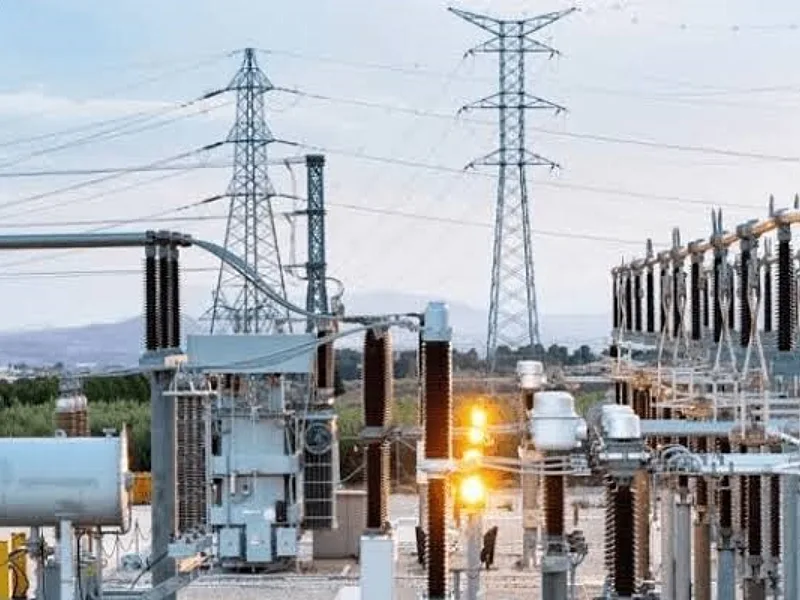
For electricity systems, adaptation includes protecting the infrastructure required for decarbonisation.
- Renewable assets and networks can themselves face flooding or extreme heat.
- Integrating climate risk into their design helps preserve the services that households and businesses rely on.
The report also calls for transformational adaptation where incremental changes cannot adequately reduce risk.
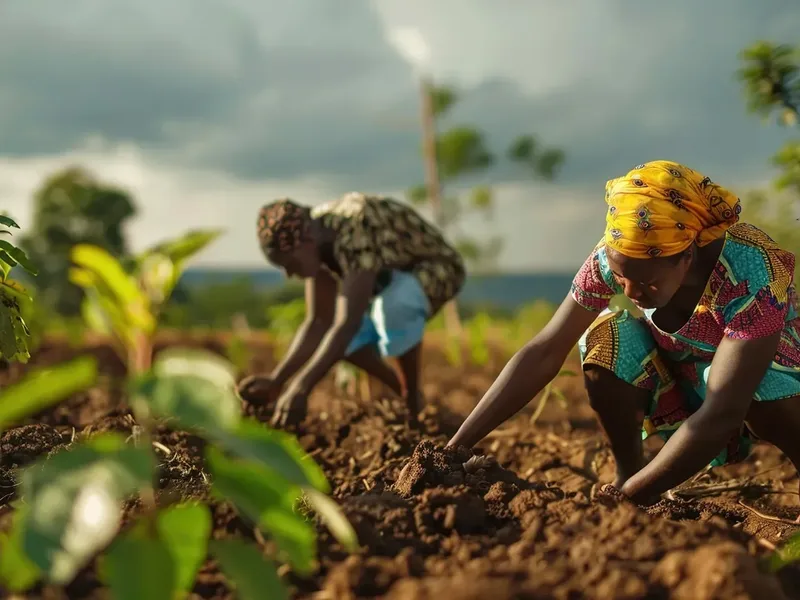
- This may involve reconsidering land use, settlement patterns or livelihoods.
- Such decisions affect rights and social relationships, making participation and financial support central to their legitimacy.
Assess benefits through reduced vulnerability and options preserved.
- A project that protects high-value property while shifting floodwater toward poorer residents can deepen inequality.
UNEP’s emphasis on equity means examining who gains protection, who bears new risks and who participates in deciding the response.
Align Climate Finance With Persistent Risks
African governments can incorporate multiple warming conditions into infrastructure and service planning, with scheduled reviews as evidence changes.
- The report favours flexible governance because risk may evolve unevenly and some changes may arrive abruptly.
- Long-term plans need revision mechanisms rather than a single fixed climate assumption.
Finance should support both immediate protection and sustained development capacity.
- Repeated disasters can divert resources into emergency response, making it harder to fund the infrastructure and institutions needed to reduce future losses.
- Investment choices should consider that interaction when judging prevention and recovery needs.
International responsibility remains central.
- UNEP argues that countries with greater historical responsibility and capacity should act fastest and with the greatest ambition.
- Countries facing disproportionate harm need meaningful participation in global decisions, as well as resources and technology to implement their own responses.
Businesses can apply the same reasoning to asset lives and supply chains.
- Climate risk assessments should consider interruptions, worker exposure and dependencies on public infrastructure.
- Carbon removal plans require transparent assumptions about storage and residual emissions, particularly where they underpin long-term corporate commitments.
Public accountability can connect these decisions to observable outcomes.
- Reporting should show changes in emissions, populations protected, and the support available where losses cannot be prevented.
- This provides citizens clearer accounts of whether climate investment reduces risk or merely transfers it between places and generations.
Planning for that support must extend beyond a conventional project cycle.
- Coastal displacement or altered livelihoods can create responsibilities that persist after construction funding ends.
- Identifying who will provide services and maintain institutional knowledge over time would make long-term resilience commitments more credible, especially where future generations inherit both infrastructure and unresolved climate losses.
Path Forward – Reduce Warming While Protecting Future Choices
Governments and businesses should act to limit peak warming while strengthening protection against impacts already developing.
African priorities include resilient services, fair participation and finance that recognises persistent losses.
Carbon removal leads to temperature decline, but it cannot justify delayed emissions cuts.
Decisions made now should preserve the possibility of returning toward 1.5°C while supporting communities that may face permanently changed conditions.