
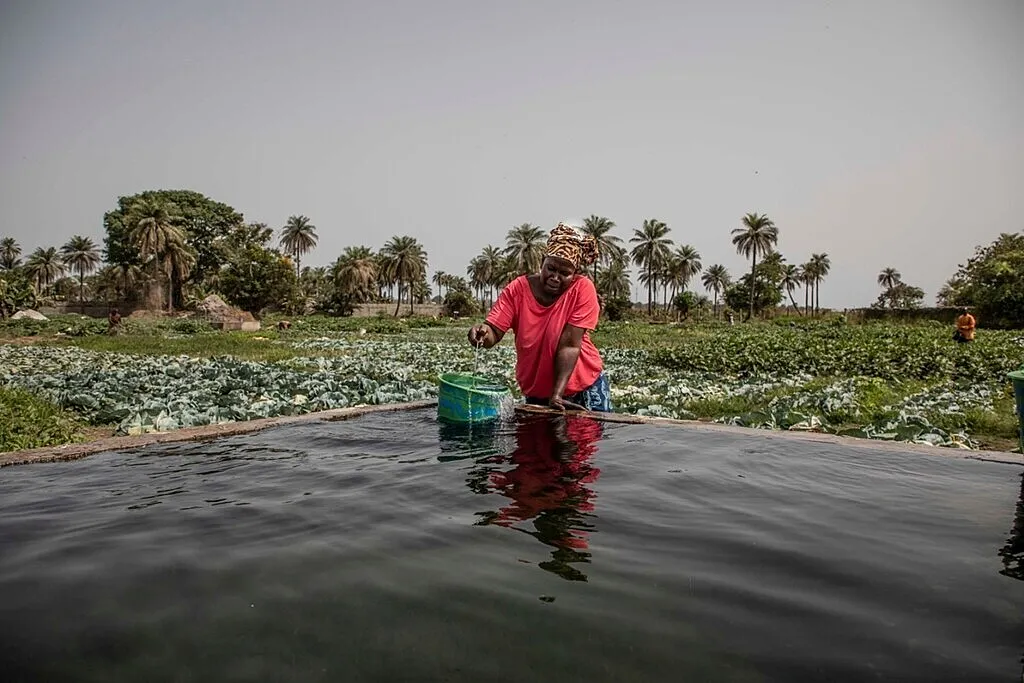
Climate communication can undermine action when it presents worsening risks as proof that every response is futile.
African communities need accurate warnings alongside credible ways to reduce harm.
Evidence of household adaptation shows that people already respond to changing conditions.
The policy challenge is to support their agency without shifting institutional responsibilities onto individuals.
Climate Risk Needs Agency Alongside Urgency
African climate policy needs to address a communication problem as well as an investment problem: the belief that worsening warming makes every protective action pointless.
- Such thinking can weaken support for adaptation precisely when public services, livelihoods and infrastructure require sustained attention.
- Acknowledging severe risks should lead to better decisions, rather than an assumption that decisions no longer matter.
“Climate Fatalism: Causes and Consequences”, distinguishes fatalism from anxiety and pessimism and argues for communication that restores a sense of collective effectiveness.
- This article applies that framing to African institutions and community priorities.
The distinction matters for editors, policymakers and employers.
- Concern about climate change does not itself demonstrate resignation.
Institutions need to understand what people believe they can influence and whether practical support exists before describing a community as unwilling to act.
Why Every Fraction Of Warming Matters
The scientific case for continued action remains strong as climate risks intensify.
The IPCC’s 2023 Synthesis Report explains that risks increase with each increment of warming.
- This finding means the consequences of different pathways remain materially different.
- A temperature milestone should not be presented as a switch that makes all subsequent emissions reductions or protective measures irrelevant.
For an African municipality, that principle has immediate implications.
- Drainage maintenance, shade, water security and warning systems still require decisions even when global mitigation is not sufficient.
- None can eliminate every hazard.
- Assess each harm that may prevent, the people it reaches, and the operating resources required to keep it effective.
The primary explainer identifies catastrophic framing and repeated exposure to disaster imagery as possible contributors to resignation.
- Its argument is useful as a communication lens, but it does not establish how common fatalism is in Africa.
- Treating a conceptual discussion as a measured continental trend would overstate the evidence.
That evidential limit should influence policy.
- A resident declining an insurance product may face unaffordable premiums, unclear terms or distrust arising from previous service failures.
- A farmer unable to change planting practices may lack seed or credit.
- These constraints call for institutional responses.
Labelling them psychological defeat can obscure the practical barrier and place responsibility on the wrong actor.
African Adaptation Already Shows Practical Human Agency
Afrobarometer’s 2024/2025 surveys across 38 countries provide evidence of reported responses to changing weather.
- 60% of respondents said their households had made at least one of five specified adjustments.
- These findings describe adaptation behaviour; they do not measure fatalism or establish that every reported change reduced vulnerability
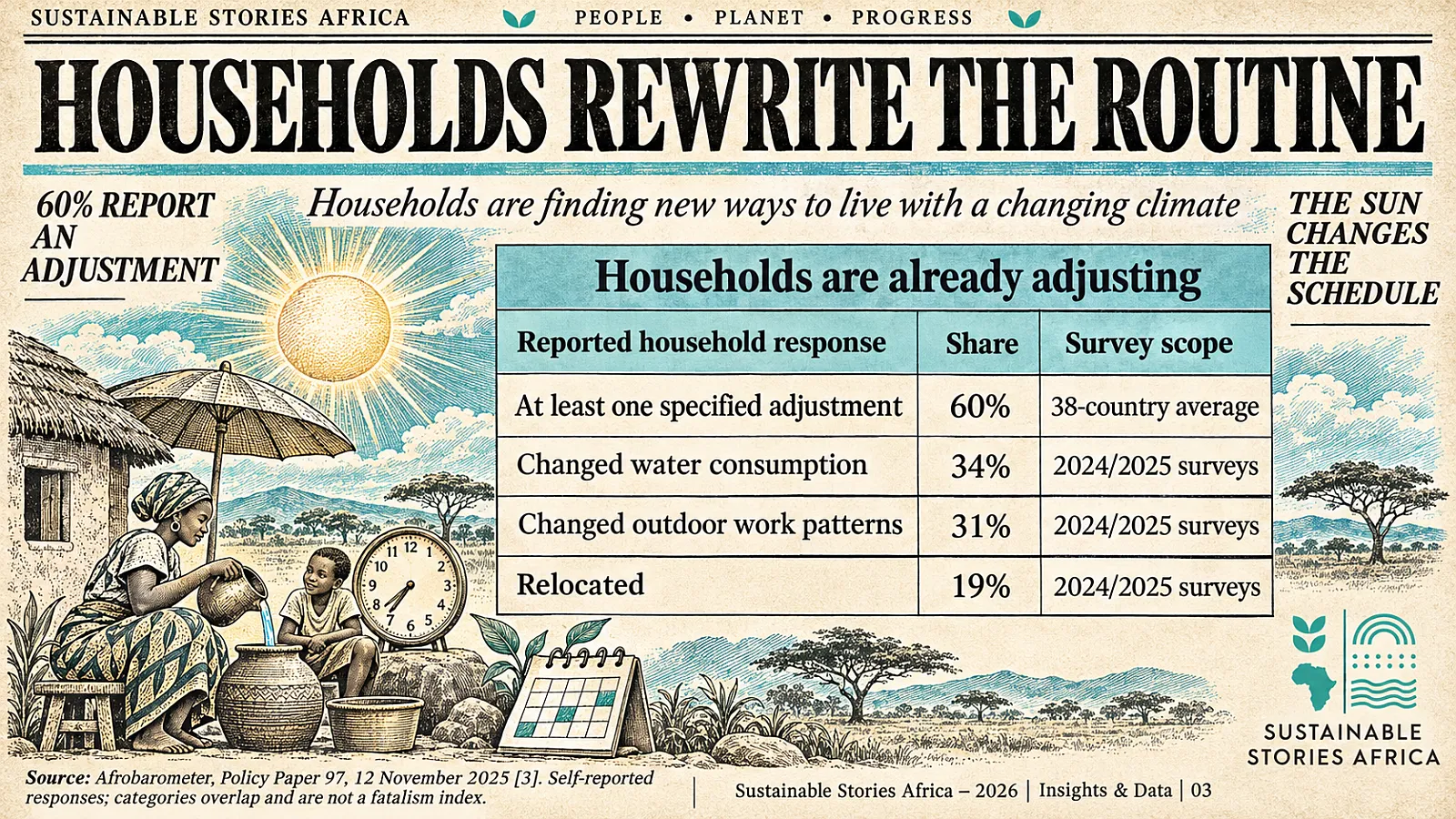
The numbers challenge a simplistic picture of passive communities.
- They also raise a harder question: are households adapting in ways that improve security, or absorbing costs that public systems should help manage?
- Moving home can be protective, but it can also interrupt employment and schooling. An adjustment is not automatically a successful development outcome.
For policymakers, the useful unit of analysis is the decision and its consequences.
- If households change working hours, authorities can ask whether water, transport and workplace arrangements support that change.
- If families relocate, local agencies should examine tenure, services and income continuity.
- his turns a survey finding into questions that can guide programme design.
African climate reporting should likewise connect visible hazards to decisions within reach.
- A flood story can examine warning lead times, drainage budgets and emergency shelter arrangements.
- This approach preserves accountability and helps readers distinguish an unavoidable exposure from a preventable failure.
It gives an agency practical meaning without promising that preparedness can remove every loss.
Building Confidence Through Visible And Fair Results
Credible hope depends on performance.
- A local authority that publishes a maintenance schedule and completes the work gives residents something concrete to assess.
- A lender that explains eligibility and pays an agreed claim creates evidence of reliability.
- Repeated promises without follow-through can make optimistic communication sound detached from daily experience.
Communication should therefore explain what an intervention can achieve, where its limits lie and how people can judge the result.
- A warning message should identify the hazard, the affected location and a feasible protective step.
- When action requires transport, cash or safe shelter, authorities should address these requirements rather than assume sufficient information.
There is also value in reporting partial progress accurately.
- A functioning water point may reduce the time needed to obtain water without resolving wider drought exposure.
- Describing that benefit precisely can support further investment. Inflating it into a complete solution risks another cycle of disappointment when conditions remain difficult.
Community knowledge can improve this process.
- Residents can identify routes that become impassable, buildings that overheat and households that need evacuation assistance.
- Institutions should explain how this information changes plans.
- Participation builds confidence when people can see a decision respond to their contribution, rather than merely seeing their attendance recorded in a consultation report.
Institutions Must Make Protective Choices More Feasible
Governments should commission locally relevant research before designing campaigns against fatalism.
- Questions should distinguish knowledge, distress, trust, perceived influence and resource constraints.
- Different responses require different interventions.
- A community that lacks confidence in an agency’s promises needs credible commitment
- A community that lacks transport during emergencies needs transport arrangements.
Editors should pair risk coverage with scrutiny of options.
- This means examining who controls a decision, what it costs and whether implementation is occurring.
- Stories about solutions should be tested as carefully as stories about failure.
- Audiences gain little from replacing exaggerated catastrophe with unverified optimism about a technology or project.
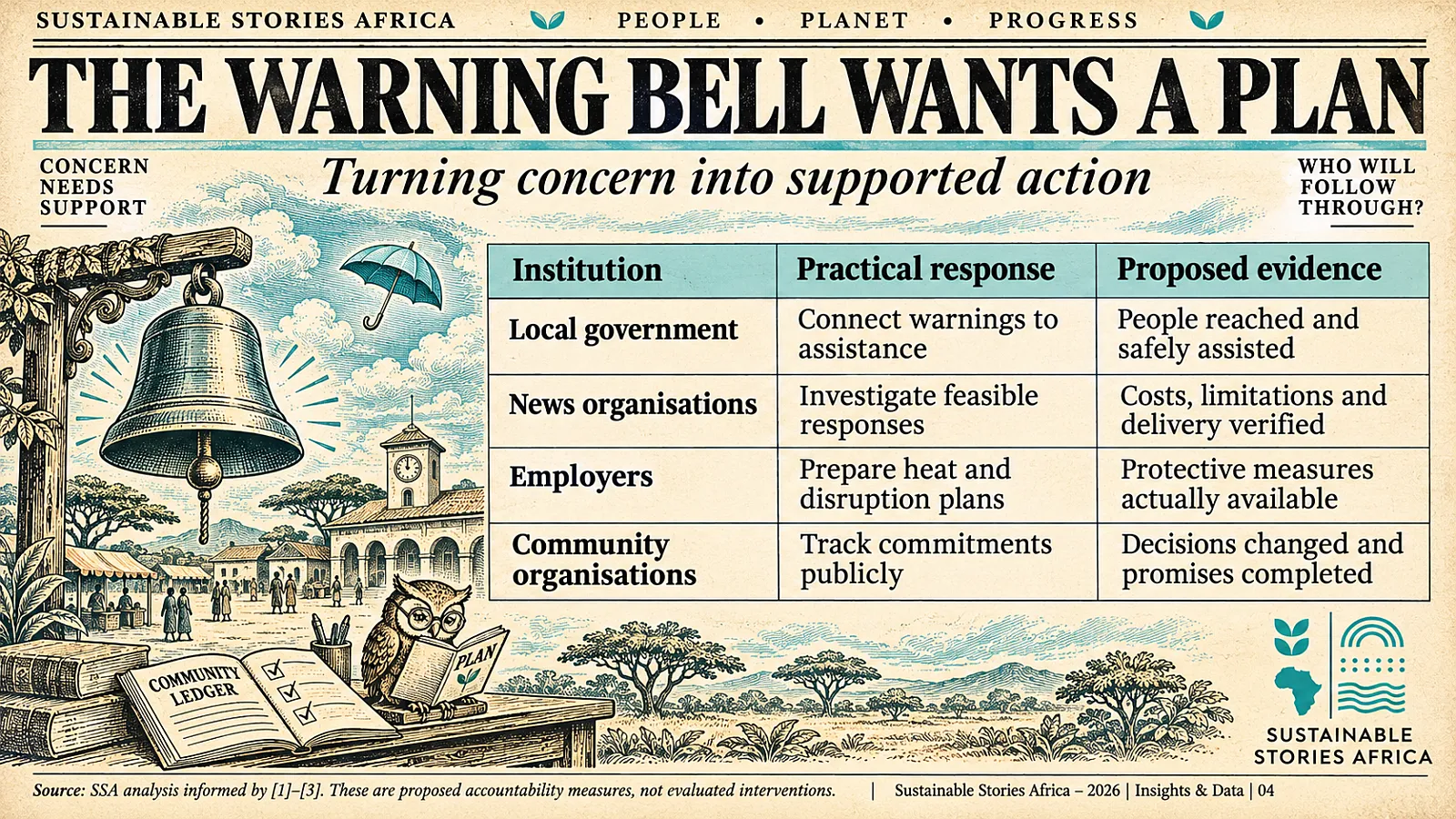
Employers and professional associations can make action concrete through operational planning.
- They should identify how heat, water disruption or transport interruptions affect workers and customers, then assign response responsibilities.
- Reviewing what worked after an event provides a more credible basis for confidence than a general statement that the organisation supports resilience.
Funders should also allow programmes to measure whether people can use the support offered.
- Attendance at a training session is a limited indicator if participants cannot obtain tools or finance afterwards.
- Evaluation should examine practical uptake and persistent barriers, while avoiding claims that an observed change in attitudes alone proves greater resilience.
Public consultation can make responsibility more explicit.
- Agencies should distinguish what households can reasonably do from what requires public infrastructure, employer decisions or international support.
- Residents should not be asked to compensate for an absent drainage system.
- Communication becomes fairer when it connects each recommended action to the actor with the authority and resources to carry it out.
Success measures should also reflect sustained engagement.
- Researchers could examine whether people understand available options, trust the response process and get assistance when needed.
- These findings would be more informative than asking only whether a campaign made audiences feel hopeful.
Confidence should rest on the ability to act and a credible expectation of institutional follow-through.
Path Forward – For More Effective Climate Communication
African institutions should communicate climate risks with scientific precision and attach clear responsibilities to protective action.
Communities need usable options, dependable services and a way to challenge failures.
The goal is informed participation supported by resources.
Honest reporting on progress and limitations can strengthen collective effort while keeping pressure on governments and businesses to deliver their share.