

Environmental claims can influence purchasing and investment, but their value depends on evidence.
A green label or distant target cannot establish what a business has changed.
African companies and institutions can strengthen trust by explaining measurement boundaries, publishing progress and distinguishing operational reductions from broader ambitions or marketing language.
Environmental Credibility Begins With Specific Evidence
African businesses seeking customers and capital through sustainability claims need to show what those claims mean in practice.
- A statement about a product, a facility and an entire company can describe very different environmental boundaries.
- Without clear definitions and supporting evidence, readers cannot determine whether an improvement is meaningful or whether important impacts remain outside the account.
“Eco-Friendly or Greenwashing?” examines misleading environmental communication, including vague language, unsupported labels and selective presentation of small improvements.
- The article argues that public scrutiny should extend beyond branding to actual performance.
The African application concerns market integrity as well as emissions.
- Buyers need dependable product information, investors need credible transition evidence and businesses making real improvements need a fair basis for comparison.
Clear claims can serve all three groups without requiring every company to promise more than it can substantiate.
Attractive Claims Can Conceal Different Environmental Outcomes
The problem often begins with an undefined adjective.
- A company may call packaging greener without explaining whether it means lower weight, different material or a better recovery system.
- These are distinct claims.
- Evidence supporting one does not automatically support the others, and a visual association with nature does not resolve the missing information.
Selective metrics can create a similar problem.
- A business may reduce emissions per unit of output while its total emissions rise.
- Both figures can be accurate.
- Reporting only the favourable measure can still give an incomplete impression if the audience reasonably believes the statement describes an overall reduction in climate impact.
This matters for expanding African industries.
- Growth in output can coincide with efficiency gains, and those gains may be commercially valuable.
- The appropriate response is to disclose both the intensity improvement and the absolute emissions trajectory.
- This allows readers to understand the achievement and the remaining challenge without treating one measure as a substitute for another.
The explainer also highlights the gap between distant pledges and practical plans.
- A target becomes more assessable when it has a baseline, intermediate milestones, assigned responsibilities and resources.
Without these details, neither a customer nor a board can determine whether current decisions are consistent with the stated destination.
Read The Denominator Before Accepting The Headline
An illustrative manufacturing example shows why boundaries matter.
- Suppose annual production increases from 100,000 to 200,000 units, while emissions rise from 200 to 300 tonnes.
- Emissions intensity falls from two to 1.5 kilograms per unit.
- The firm has become 2% less emissions-intensive, while absolute emissions have increased by 50%.
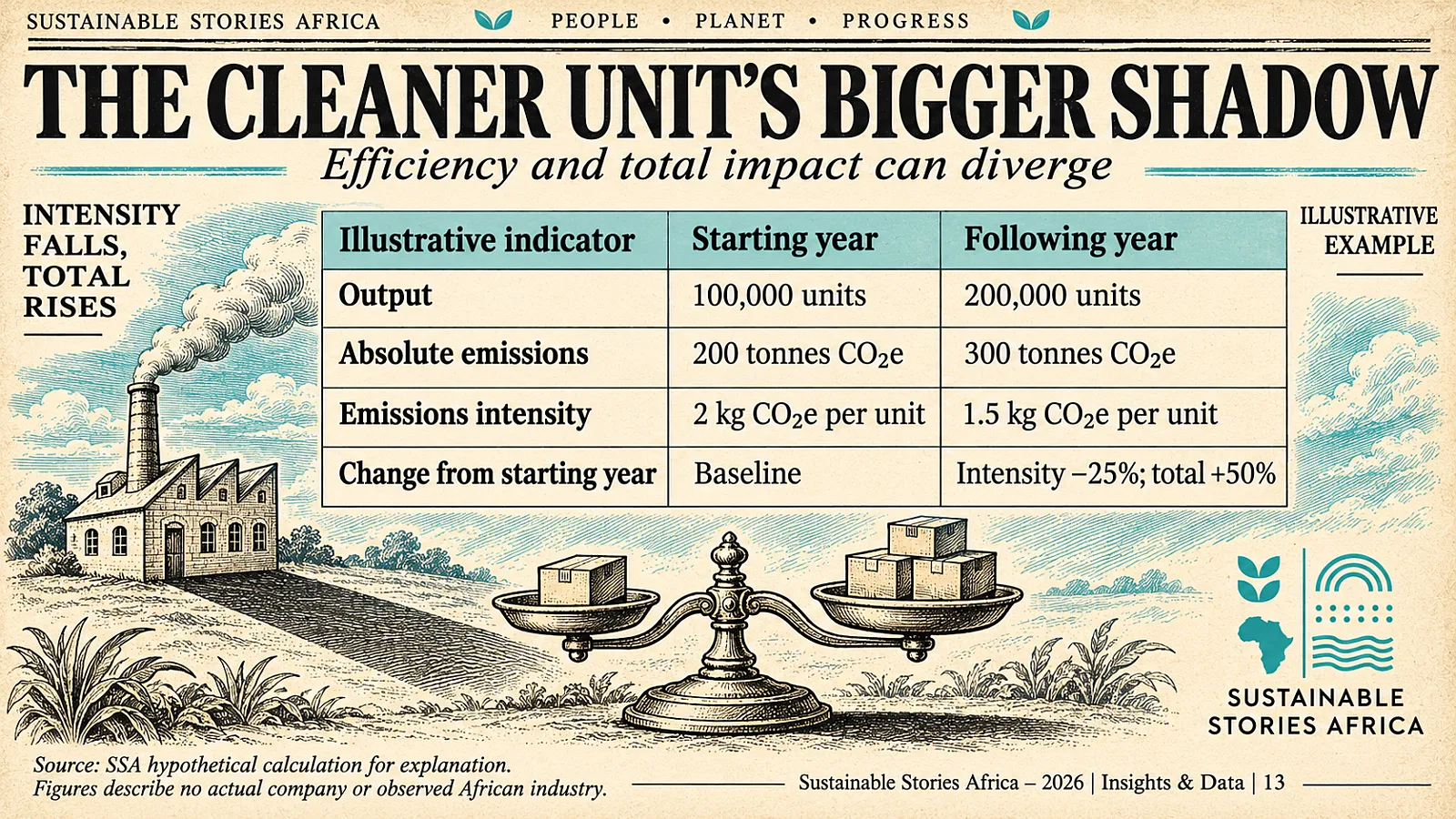
The example does not establish that efficiency improvements lack value.
- It shows why a claim must match its metric.
- A company can accurately report lower emissions per unit and explain how it intends to address absolute growth.
- Readers then have enough information to judge progress in context rather than infer an unsupported conclusion.
Comparisons also need consistent periods and organisational boundaries.
- Selling a high-emitting facility may reduce a company’s reported footprint without reducing emissions from that facility.
- A change in measurement methods may alter results without a corresponding operational change.
- Reports should explain such effects and, where appropriate, provide comparable figures so that the trend remains interpretable.
Product claims require their own scrutiny
- Recyclability depends partly on the systems available where the item is sold and discarded.
- A technically recyclable material may not be collected or processed locally.
A responsible claim should explain these conditions and avoid suggesting that a theoretical pathway guarantees recovery in the customer’s market.
Stronger Claims Can Reward Real Business Improvements
The United Nations’ Integrity Matters report provides ten recommendations for credible net-zero commitments by non-state actors.
- Its approach includes near-term targets, disclosed transition plans, alignment of advocacy and regular progress reporting.
- It also distinguishes carbon-credit use beyond the value chain from the reductions entities need to make towards interim targets.
These principles can help African boards ask better questions.
- Management should be able to explain which activities a claim covers, how the result was calculated and what investment supports further improvement.
- Sustainability reporting becomes more useful when it informs capital allocation and operational decisions, rather than remaining a separate communications exercise.
Smaller businesses need a proportionate route to credible communication.
- A firm can state a narrow, documented improvement without presenting itself as environmentally superior in every respect.
- For example, evidence about a specific material input should support a claim about that input.
- Keeping the wording within the evidence can reduce the cost and confusion associated with excessive promises.
Investors and buyers can reinforce this approach by asking consistent questions.
- Requests should identify the information needed for a decision, rather than reward the longest report or most elaborate branding.
- Comparability, traceability and clear limitations are often more useful than a large volume of unconnected sustainability language.
Put Claims Through Evidence And Governance Checks
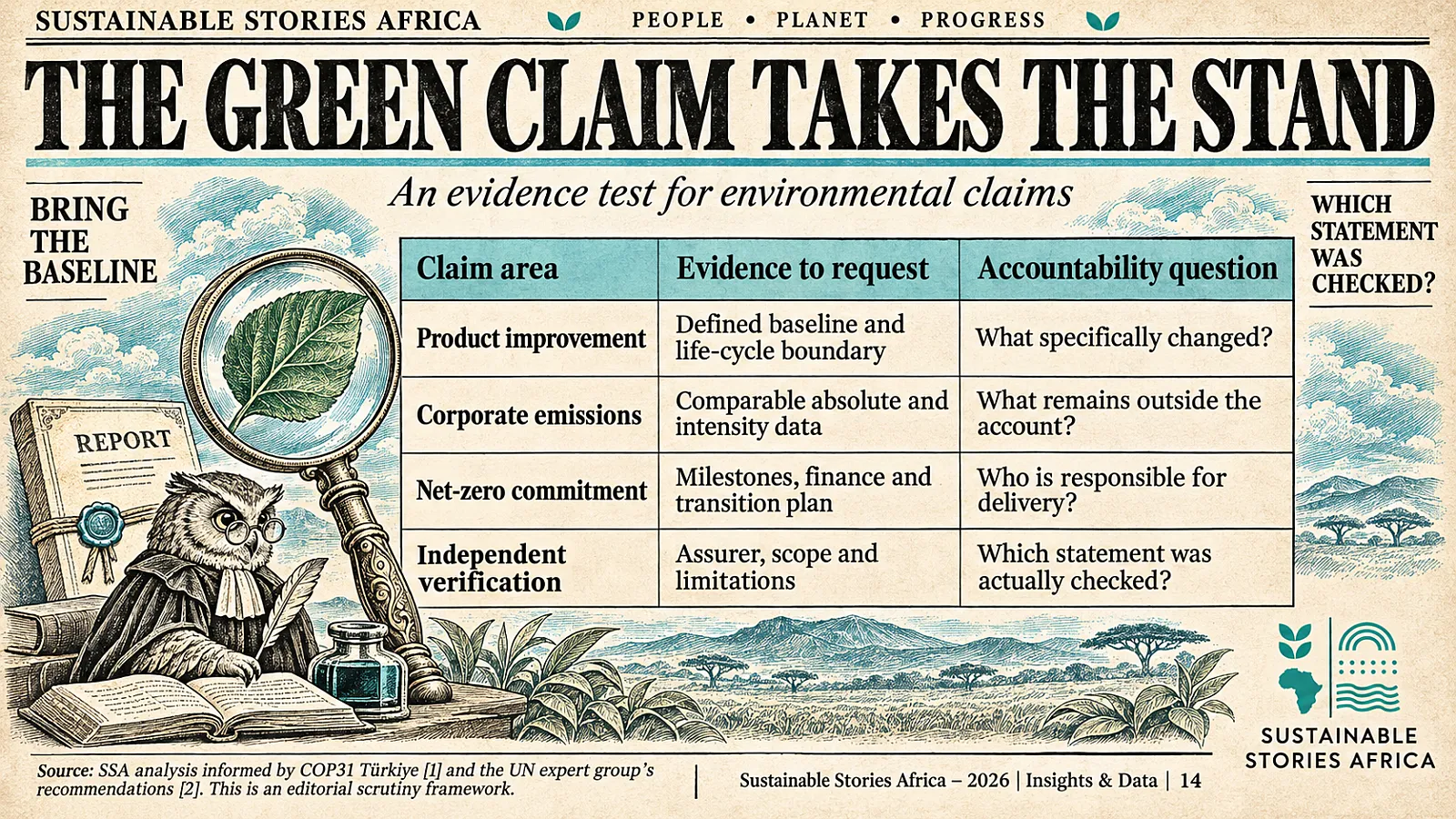
Companies should maintain an evidence record for significant environmental statements.
- It should identify the claim, supporting data, measurement period, responsible person and review date.
- If a supplier certificate supports the statement, the company should understand its scope and validity.
- Possessing a certificate does not automatically justify a broader corporate claim.
Marketing, operations and finance teams should review material claims together.
- Operations can verify what changed, finance can test investment and spending assertions, and communications can ensure wording reflects the evidence.
- Board oversight should focus on significant claims and targets, especially where they influence financing, customer decisions or the company’s strategic commitments.
Public institutions procuring goods or allocating finance should specify evidence requirements in advance.
- This gives suppliers a clearer basis for competition and reduces reliance on broad environmental descriptions.
- Where claims are disputed, assessment should examine the precise statement and available documentation rather than assume a company’s intent from branding alone.
Journalists and analysts should apply the same discipline.
- Report the improvement that can be supported, explain the boundary and identify what remains unknown.
- Corrections should be visible when a claim changes.
- Reliable communication allows African markets to recognise real progress while keeping attention on the operational decisions still required.
Financial products require equally clear boundaries.
- A lender describing a portfolio as green should explain eligible activities, exclusions and how proceeds or assets are monitored.
- Financing a qualifying project is different from establishing that an entire borrower has low environmental impact.
- Investors should be able to identify which proposition the product actually makes and how that proposition is checked.
Supply-chain claims need traceability appropriate to their scope.
- A buyer should establish whether a reported material improvement applies to the goods purchased, a supplier’s entire output or only a certified production stream.
- Documents should remain connected to the relevant transaction and period.
This practical discipline can prevent valid evidence being stretched into a claim it was never designed to support.
Path Forward – For Credible African Environmental Claims
African businesses should connect environmental statements to defined measures, comparable data and funded plans.
Buyers and financiers should request evidence proportionate to the decision being made.
Clear boundaries and visible accountability can strengthen trust and reward meaningful improvement.
The next step is to make verification part of ordinary business decisions, with progress reported accurately over time.