
Rejecting climate science can delay protective decisions, but limited awareness and disagreement over policy costs should not automatically be classified as denial.
African institutions need communication that explains the evidence, recognises economic concerns and gives citizens a credible way to influence the choices affecting their livelihoods.
Climate Understanding Requires More Than Information
African climate communication needs to distinguish between rejecting established science, lacking access to information and questioning the fairness of a policy.
- These problems can overlap, but treating them as identical risks alienating audiences and designing ineffective responses.
- Better public understanding should support informed decisions about energy, food, infrastructure and economic security.
“Why Is Climate Change Denied?” describes denial concerning warming trends, human causation, impacts and responses, and examines the influence of identity, interests and trust.
- Its framework helps explain different arguments without establishing their prevalence in African societies.
Africa’s perspective requires local evidence.
- Survey results on climate awareness can reveal a communication gap, but they cannot independently identify deliberate rejection of science.
Policymakers should preserve that distinction when interpreting data or deciding whom a campaign is intended to reach.
Scientific Evidence And Policy Choices Need Separation
The IPCC’s 2023 Synthesis Report states that human activities have unequivocally caused global warming.
- The assessment provides the scientific starting point. It does not mean every proposed tax, infrastructure project or technology choice is beyond scrutiny.
- Citizens can accept the science while asking whether a specific intervention is effective, affordable or fairly designed.
This separation matters in African public debates.
- A household concerned about transport costs may be responding to a real budget constraint.
- A worker questioning the timing of an industrial closure may need a credible income alternative.
- Answering those concerns with a general statement about scientific consensus leaves the practical issue unresolved and may deepen distrust.
The explainer argues that denial can be reinforced by political identity and economic interests, rather than simply an absence of facts.
- African communicators should treat that as a question to investigate locally.
- They should identify who produces a disputed claim, what evidence it uses and how it reaches an audience before attributing motives to a broad social group.
There is also a distinction between uncertainty and ignorance.
- Climate projections contain ranges because future emissions and physical responses vary. Explaining those ranges can improve understanding.
- Presenting all uncertainty as proof that nothing is known gives a misleading picture of the evidence and makes it harder for communities to plan around risks that are already relevant.
Survey Findings Reveal Gaps Without Measuring Denial
Afrobarometer’s Policy Paper 97 draws on surveys across 38 African countries in 2024/2025.
- It reports average awareness of climate change at 56% and climate literacy at 43%, using a definition that includes recognising a human contribution.
- These measures concern knowledge and understanding; their complements should not be labelled denial rates.
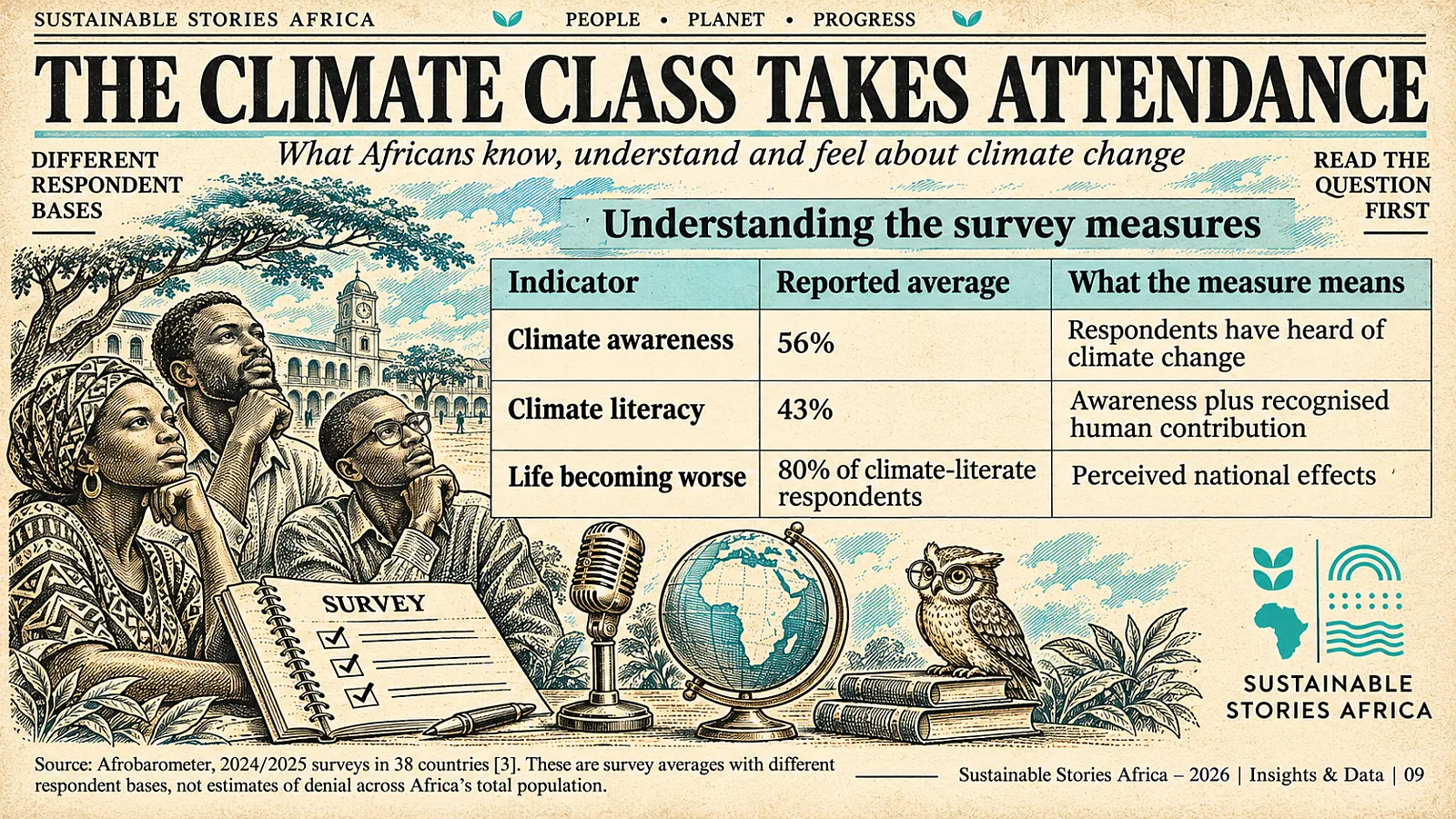
The distinction changes the communication response.
- Someone who has not encountered the term may need an accessible explanation connected to familiar weather and livelihood concerns.
- Someone who disputes human causation may need a clear account of the evidence.
- Someone who accepts warming but doubts a proposed policy needs information about that policy’s costs and likely benefits.
Survey averages also conceal local differences.
- A national campaign should examine language, access to media and the institutions audiences trust.
- It should test whether the words used in a questionnaire or broadcast correspond to how people discuss changing seasons, heat or rainfall.
- Otherwise, terminology can become a barrier between lived experience and formal climate communication.
Public agencies should resist converting a knowledge indicator into a judgement about citizens’ values.
- Awareness may reflect access to education and information as well as personal interest.
The appropriate objective is to make reliable evidence easier to understand and use, while preserving room for questions that improve public decisions.
Trust Grows When Evidence Addresses Everyday Decisions
Climate communication becomes more useful when it answers a question people face.
- A small business owner may want to compare the operating costs of power options. A farmer may need to understand a seasonal advisory.
- A municipal planner may need to assess heat exposure. Each audience requires evidence at a different scale and level of detail.
Trusted messengers can help connect that evidence to context.
- Professional associations, local broadcasters and community organisations should have access to clear source material and opportunities to question experts.
- Credibility depends on accuracy and independence, so institutions should disclose relevant interests rather than assuming familiarity alone makes a message reliable.
Communicators should acknowledge trade-offs directly.
- An intervention can offer long-term benefits while imposing an immediate cost on a particular group.
- Explaining the support available, the alternatives considered and the basis for the decision gives people more reason to engage.
- Avoiding the cost question can allow misleading accounts to fill the information gap.
There is a commercial implication as well.
- Firms making investment decisions need dependable climate information and transparent policy signals.
- Executives should distinguish evidence about physical risks from promotional claims about products or projects.
Accepting climate science does not establish that a particular investment is well designed; both scientific and commercial claims require appropriate scrutiny.
Build Public Systems That Correct Misleading Claims
African public agencies should maintain accessible explanations of core climate findings and publish the sources behind major policy proposals.
- Materials should identify what is established, what remains uncertain and which assumptions affect an estimate.
- Updating an explanation when evidence changes should be presented as normal institutional practice, with the reason for the revision made visible.
News organisations should verify claims before amplifying them.
- A statement can attract attention without representing a serious scientific dispute. Coverage should explain the weight of evidence and avoid giving unsupported assertions equal standing merely to create a balanced-looking exchange.
- Where a claim concerns policy design, journalists should test its practical arguments on their merits.
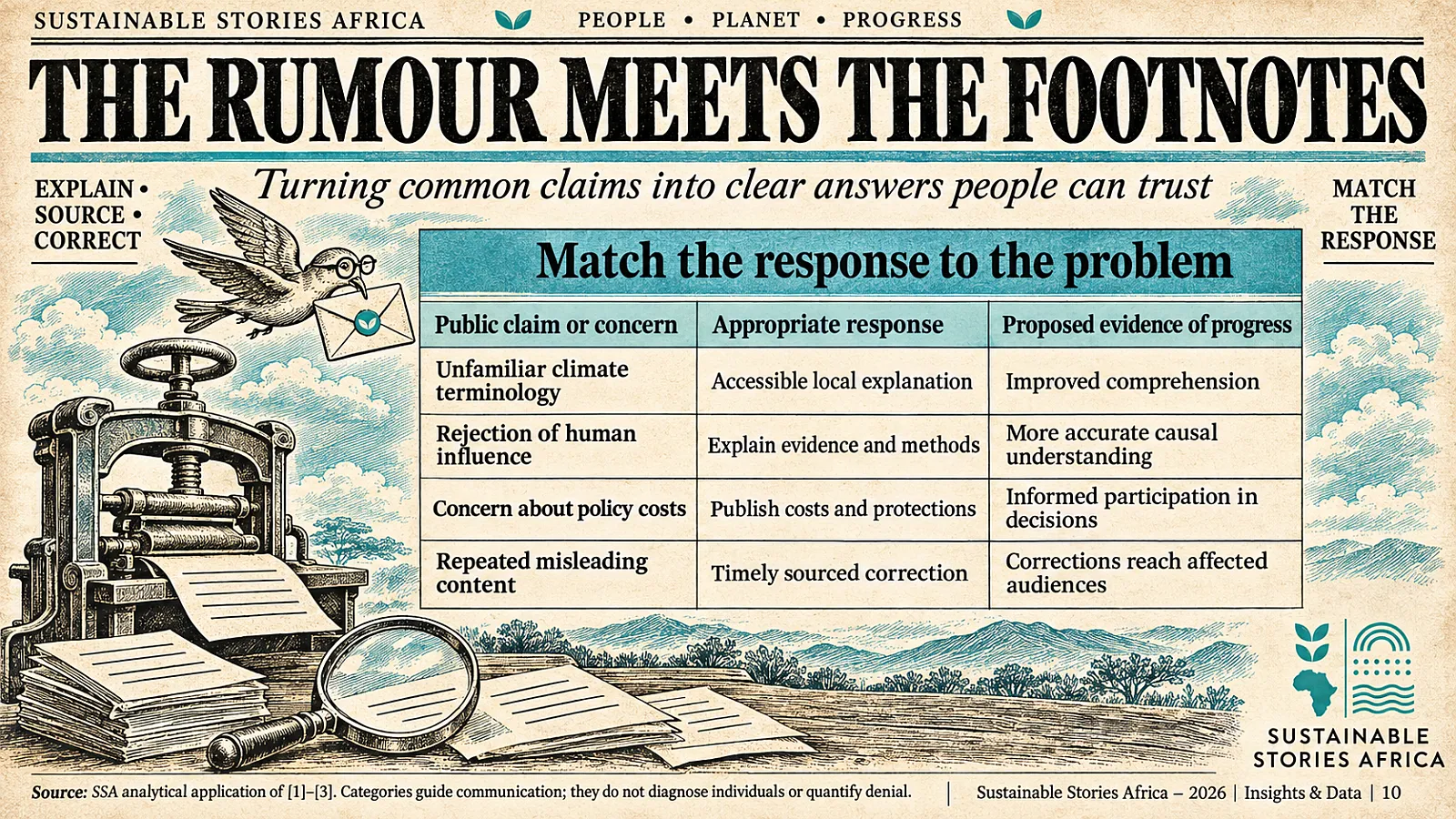
Digital campaigns should evaluate understanding rather than celebrating views alone.
- Useful questions include whether an audience can identify the source, explain the main finding and distinguish a projection from an observation.
- Agencies should also examine whether corrections reach the communities exposed to the original claim, rather than assuming publication is sufficient.
Finally, communication must be accompanied by competent delivery.
- Institutions asking citizens to trust climate advice should explain decisions consistently and account for failures. Evidence becomes more persuasive when the organisation presenting it is responsive to legitimate questions.
- This is a continuing responsibility across education, public services and economic policy.
Preparation before a controversy can also help.
- Broadcasters and public agencies should explain how to recognise a sourced finding, inspect a graph and distinguish short-term weather from a climate trend.
- These practical skills allow audiences to assess future claims with greater independence. The material should be tested for comprehension in the languages and formats used by intended audiences.
Institutions should make corrections easy to find and understand.
- A correction should identify the inaccurate claim, provide the supported account and explain why the difference matters.
- Repeating a misleading assertion prominently without that context can leave the false impression intact.
Editorial evaluation should therefore consider what a reader is likely to remember, as well as whether a rebuttal was technically published.
Path Forward – For Better African Climate Understanding
African institutions should explain established science clearly, investigate misinformation carefully and address genuine concerns about policy design.
Survey evidence must be interpreted within its definitions and respondent base.
The next step is communication tied to transparent decisions and dependable services.
Better understanding should give citizens greater influence over climate responses while strengthening scrutiny of unsupported claims.