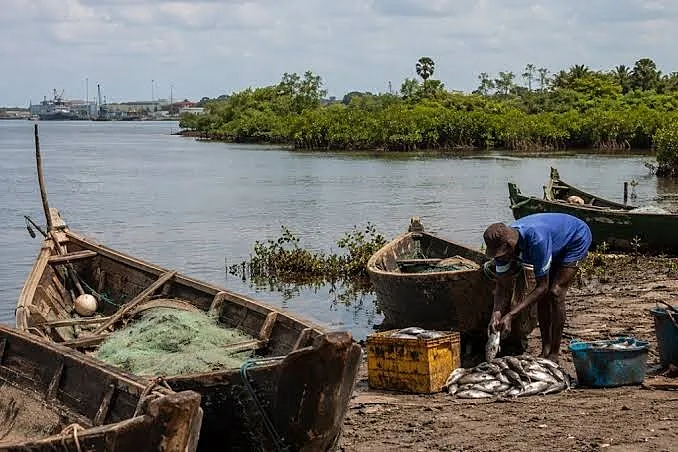
Africa’s waters support food, trade and livelihoods, but expanding ocean-related activity does not automatically make it sustainable.
Investment must preserve the ecosystems and access rights on which future income depends.
The blue economy’s development value should be measured through healthy habitats, resilient infrastructure and benefits retained by coastal and inland communities.
Africa’s Water Wealth Needs Stronger Stewardship
Africa’s blue economy presents a significant development opportunity, provided growth protects the natural systems that make it possible.
- Fisheries, ports, tourism and coastal infrastructure can generate income while competing for space and resources.
- Governments need to manage those relationships before individual projects create costs for neighbouring communities or damage the ecosystems supporting future production.
“What is the ‘blue economy,’ and why is it important for sustainability?”, defines the concept around sustainable marine-resource use, ecological health and social well-being.
- Its central argument links ocean governance with climate resilience and economic sustainability.
The African perspective extends this discussion to inland waters.
The African Union’s continental framing includes lakes and river systems alongside coastal and marine activity.
- That broader scope matters when interpreting African economic estimates and designing strategies for countries without coastlines.
Large Economic Estimates Need Careful Local Interpretation
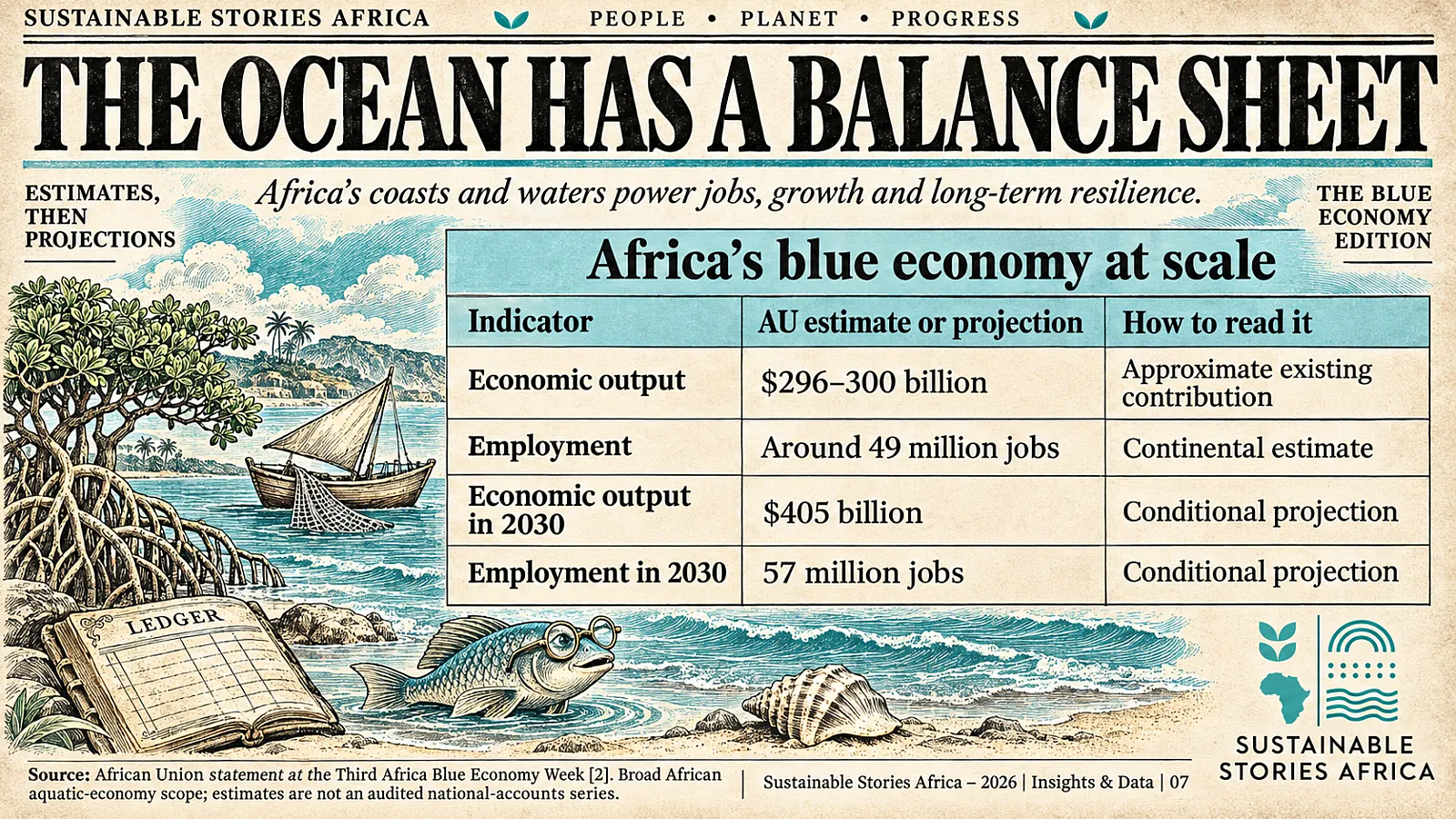
An African Union statement delivered during the Third Africa Blue Economy Week puts the sector’s economic output at approximately $296 – $300 billion and employment at around 49 million jobs.
- It projects $405 billion and 57 million jobs by 2030, conditional on sustained investment and effective implementation.
- These projections describe potential development, rather than growth already secured.
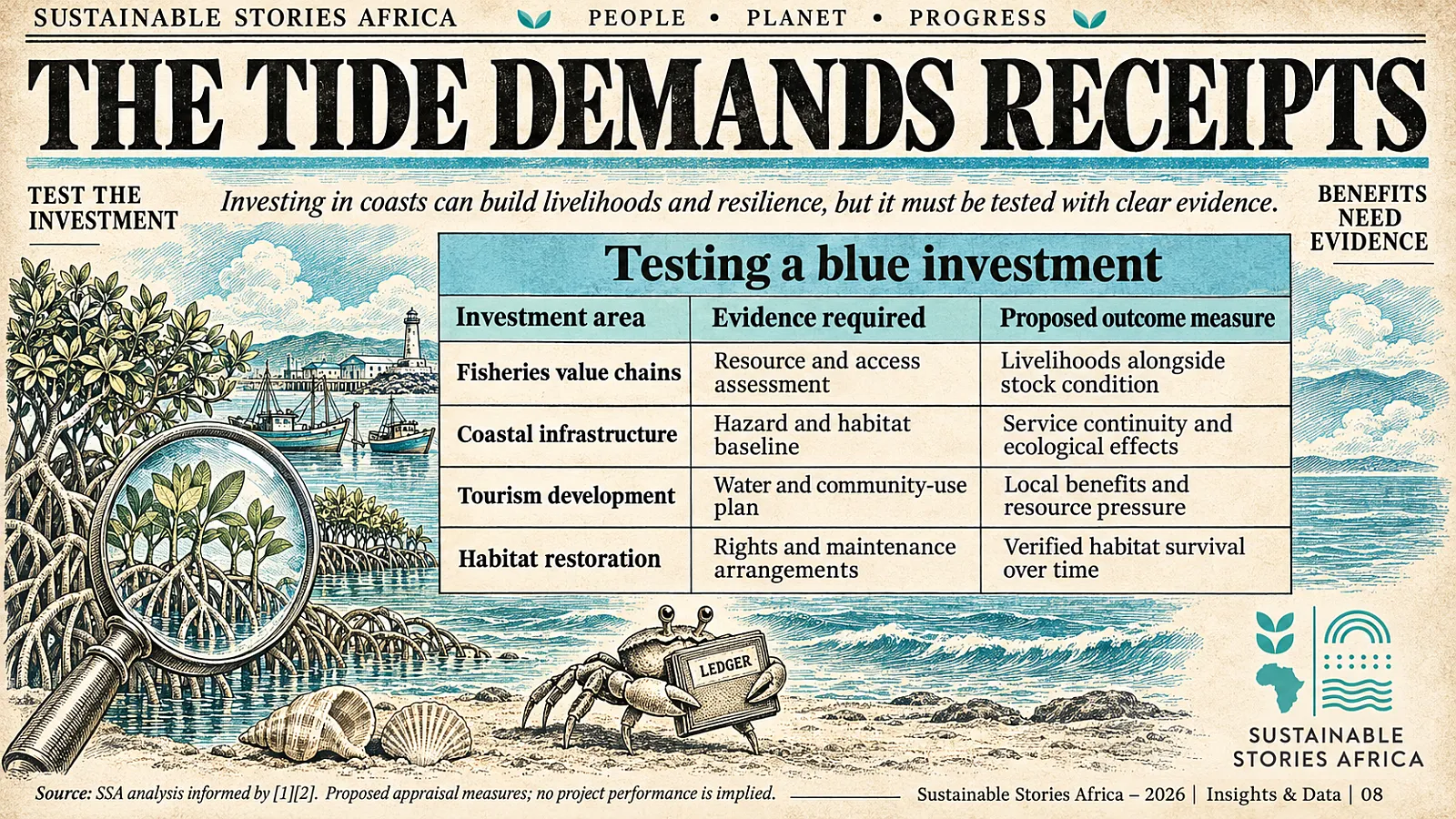
Aggregate estimates help establish scale, but they cannot determine whether a particular port expansion, aquaculture site or coastal resort is sustainable.
- A project could increase recorded economic output while reducing access to fishing grounds or degrading a habitat.
- The investment appraisal must therefore examine distribution, ecological condition and long-term operating risks alongside revenue.
The explainer identifies fisheries, shipping, tourism, offshore energy and marine biotechnology as blue-economy activities.
- These sectors have different requirements.
- A coastal tourism proposal needs to consider water demand and habitat pressures
- A shipping project needs to examine emissions, waste and surrounding land use.
Their common connection to water does not make their impacts interchangeable.
African governments should consequently avoid treating the blue economy as a single pool of bankable projects.
- They need spatial and sectoral priorities informed by ecological limits and community needs.
The question is not simply how much capital can enter an area, but which activities can coexist and which safeguards are necessary to preserve future options.
Healthy Ecosystems Support Food And Economic Resilience
The primary briefing highlights the climate role of oceans and coastal habitats, including mangroves and seagrasses.
- For African planning, the practical implication is to consider habitat condition as part of productive infrastructure.
- A damaged ecosystem can affect several economic activities simultaneously, so its value cannot be assessed solely through the revenue of the project occupying the same location.
Fisheries policy illustrates the need for joined-up decisions.
- Increasing landing capacity may have limited value if management fails to protect the underlying resource or if fish cannot reach consumers in good condition.
- Investment choices should examine the chain from resource stewardship to handling, storage, transport and market access, rather than focusing only on more extraction.
Likewise, a coastal resilience programme should assess how an intervention affects adjacent areas.
- A protective structure may serve an immediate location while changing water or sediment movements elsewhere.
- Technical evaluation, community knowledge and monitoring are necessary to identify those effects.
- hoosing an intervention because it appears visibly substantial is a poor substitute for testing its performance.
Inland systems require comparable attention.
- Water allocation, pollution and infrastructure decisions can affect communities across administrative boundaries.
- A blue-economy strategy that stops at a coastline would miss these relationships.
- Regional cooperation should make responsibilities clear and establish how information is shared when one jurisdiction’s decisions affect another’s livelihoods or water quality.
Growth Should Improve Community Bargaining And Livelihoods
A stronger blue economy could support local enterprise through better handling facilities, maintenance services and access to markets.
- However, the design of contracts determines who captures these opportunities.
- Public authorities should examine procurement, landing rights, employment terms and the affordability of facilities, rather than assuming communities benefit automatically because a project is located nearby.
Women working in processing and trade should be included in those decisions alongside vessel owners and larger investors.
- Consultation focused only on the most visible asset holders can miss people who depend on the wider value chain.
- A proposed fee or relocation should be assessed against the income and working arrangements of those affected.
Restoration can also create opportunities, but its economic claims need discipline.
- A habitat project should specify the ecological improvement sought, the maintenance period and the rights of local users.
- Expected carbon income should be distinguished from contracted or received revenue.
- Potential income from environmental markets cannot substitute for clear arrangements on ownership and benefit sharing.
For investors, this approach can improve the quality of project preparation. Identifying contested access, ecological constraints and maintenance needs early makes the risks more visible.
- It also allows alternatives to be compared before construction commits a community to a particular pathway.
Good stewardship can support investability when it reduces uncertainty through credible evidence and governance.
Finance Must Follow Ecological And Social Evidence
Governments should begin with a baseline showing ecosystem condition, existing uses and exposure to hazards.
- This baseline should inform marine or aquatic spatial planning and the assessment of individual investments.
- Where information is incomplete, authorities should identify what must be established before approvals proceed and how uncertainty will be managed during implementation.
Public finance should support essential shared capabilities, including monitoring, enforcement and reliable data.
Private projects can contribute to these systems through transparent obligations, but responsibility for public oversight should remain clear.
- A financier’s environmental assessment does not remove the need for institutions able to inspect, enforce and respond to complaints after operations begin.
African regional institutions can improve consistency by supporting compatible monitoring methods and sharing evidence across borders.
- Comparability matters for investors and communities alike. If neighbouring authorities measure impacts differently, apparent improvements may reflect reporting changes rather than better conditions.
- Definitions and reporting periods should be published with the results.
Finally, authorities should separate finance labels from outcomes.
- A blue bond or sustainability-branded fund is a financing structure; its environmental value depends on the activities financed and their verified effects.
- Public reporting should connect proceeds to specific expenditures, delivery milestones and ecological and social results, including any harm requiring corrective action.
Transparency should extend to access agreements and concessions.
- Communities need to understand the duration of rights granted to investors, the public obligations attached and how performance will be reviewed.
- Where commercial confidentiality applies, authorities should still explain the safeguards protecting public resources and the channels through which affected users can raise concerns.
Data investment should be planned as an ongoing service.
- An ecological baseline loses value if monitoring stops once finance is approved. Budgets should cover repeated observation, publication and the ability to act on findings.
- Linking monitoring to defined decisions would help authorities respond when conditions deteriorate instead of continuing a project solely because its original assessment appeared favourable.
Path Forward – For Africa’s Sustainable Blue Economy
African governments should anchor blue-economy investment in ecosystem baselines, community rights and credible oversight.
Continental economic projections should guide ambition while project decisions remain grounded in local evidence.
Financiers should reward lasting ecological and livelihood outcomes.
Protecting aquatic resources and sharing their benefits fairly would give growth a stronger foundation across coastal communities, inland systems and regional markets.