Africa is rapidly emerging as a major supplier of carbon credits; however, a significant share of the value generated by these environmental assets continues to flow outside the continent.
Experts warn that without stronger governance, domestic trading capacity, and transparent certification frameworks, African countries risk remaining suppliers of environmental commodities while global intermediaries capture the bulk of financial returns.
Africa’s Carbon Markets at a Crossroads
Africa’s rapidly expanding carbon credit market stands at a critical juncture. While the continent now ranks among the world’s top suppliers of carbon offsets, most of the financial value from these environmental assets continues to flow beyond its borders.
Analysts warn that without stronger governance and localised trading frameworks, the region could repeat the historic pattern of exporting raw value while capturing limited economic returns.
The continent’s vast natural capital, its forests, mangroves, and renewable landscapes, positions Africa as a key player in the global transition toward low-carbon development.
However, structural gaps in certification systems, project financing, and trading platforms mean African developers often rely on intermediaries based in Europe and North America. These institutions capture a significant share of the revenue before proceeds reach local communities or national treasuries.
As international demand for voluntary carbon credits grows, calls are intensifying for a more equitable model that centres African participation and ownership. Experts argue that building domestic certification capacity, strengthening carbon exchanges, and embedding transparent regulatory mechanisms will be essential to ensuring a fair distribution of benefits.
When implemented efficiently, Africa’s carbon markets could evolve from value leakage points into engines of climate finance, sustainable growth, and inclusive development.
Africa’s Carbon Credit Opportunity Expands
Africa holds some of the world’s largest untapped carbon credit potential, thanks to its vast forests, renewable energy capacity, and land restoration projects.
However, a growing body of evidence suggests that the continent captures only a fraction of the financial value generated from the global carbon credit market.
Industry experts say the imbalance stems from structural gaps in certification systems, trading infrastructure, and project financing mechanisms.
As demand for voluntary carbon credits rises among global corporations pursuing net-zero commitments, African policymakers and market actors are increasingly questioning whether the continent is receiving a fair share of economic value.
A visual analysis of the carbon credit value chain shows the economic benefits are distributed across global intermediaries, with certification agencies, brokers, and traders capturing significant portions of revenue before proceeds reach local stakeholders.
How Carbon Credit Value Leaves Africa
Carbon credits represent tradable certificates that reflect the reduction or removal of one tonne of carbon dioxide equivalent (CO₂e).
These credits are typically generated through projects such as reforestation, renewable energy development, methane capture, and land restoration.
While many African countries generate credits through such projects, much of the trading and certification infrastructure sits in Europe or North America.
This structural imbalance allows intermediaries abroad to capture a substantial share of the economic value.
According to an analysis by the Africa Carbon Market Network referenced in the infographic in the attached document, up to 70% of the total value generated in Africa’s carbon credit chain may be captured by intermediaries outside the continent.
Estimated Distribution of Carbon Credit Value
Segment | Share of Carbon Credit Value |
|---|---|
Certification & MRV systems | 30% – 40% |
International brokers & traders | 30% – 40% |
Project developers | 20% – 30% |
Governments | 5% – 10% |
Local communities | Limited share |
Total retained locally | 30% – 50% |
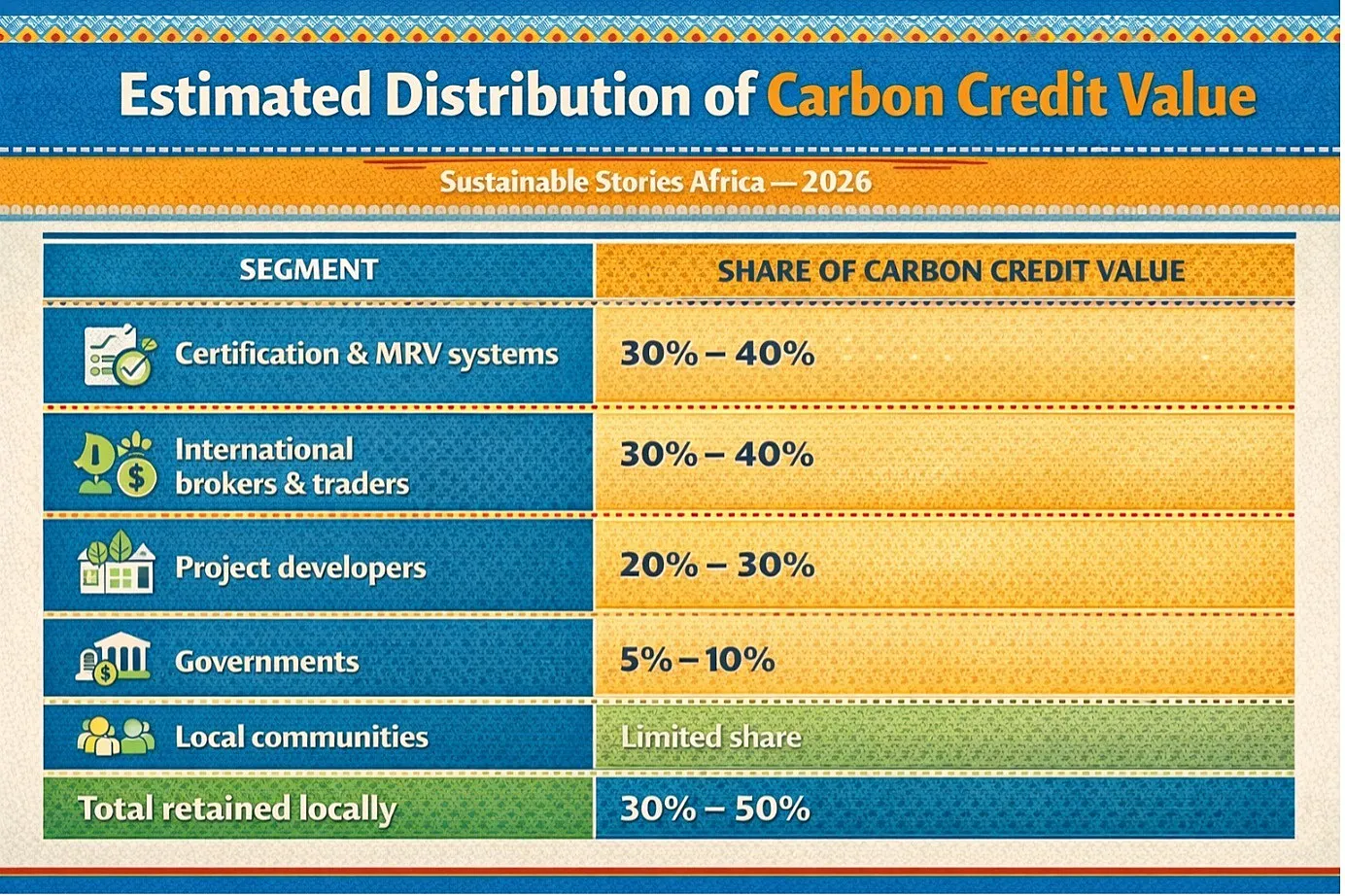
This distribution highlights the structural challenge facing Africa’s participation in global carbon markets.
Although projects originate locally, most financial flows move through global verification systems, commodity exchanges, and brokerage platforms.
Beyond financial leakage, the model can weaken incentives for local communities to participate in conservation and restoration projects if the economic benefits remain limited.
A Fairer Carbon Market for Africa
Despite these structural challenges, Africa’s carbon market potential remains immense. The continent hosts critical ecosystems that can generate nature-based carbon removal credits at scale, including tropical forests, mangrove systems, and regenerative agriculture landscapes.
The key challenge lies in ensuring that African economies capture greater value across the carbon credit supply chain.
Experts say three areas are particularly important:
- Local certification capacity – Developing African-based measurement, reporting, and verification (MRV) systems could reduce dependence on international certifiers.
- Domestic carbon exchanges – Regional trading platforms would allow African project developers to sell credits directly rather than relying solely on global brokers.
- Stronger regulatory frameworks – Clear national carbon market policies can help ensure fair benefit sharing among governments, developers, and communities.
At the same time, African governments are increasingly aligning with global climate frameworks that differentiate between carbon footprint measurement, carbon neutrality strategies, and long-term net-zero commitments.
Key Climate Terminology
Concept | Core Meaning | Strategic Role |
|---|---|---|
Carbon Footprint | Total greenhouse gas emissions produced by an entity | Measurement baseline |
Carbon Neutrality | Emissions balanced through offsets | Transitional climate strategy |
Net Zero | Emissions reduced to near zero with minimal offsets | Long-term climate objective |
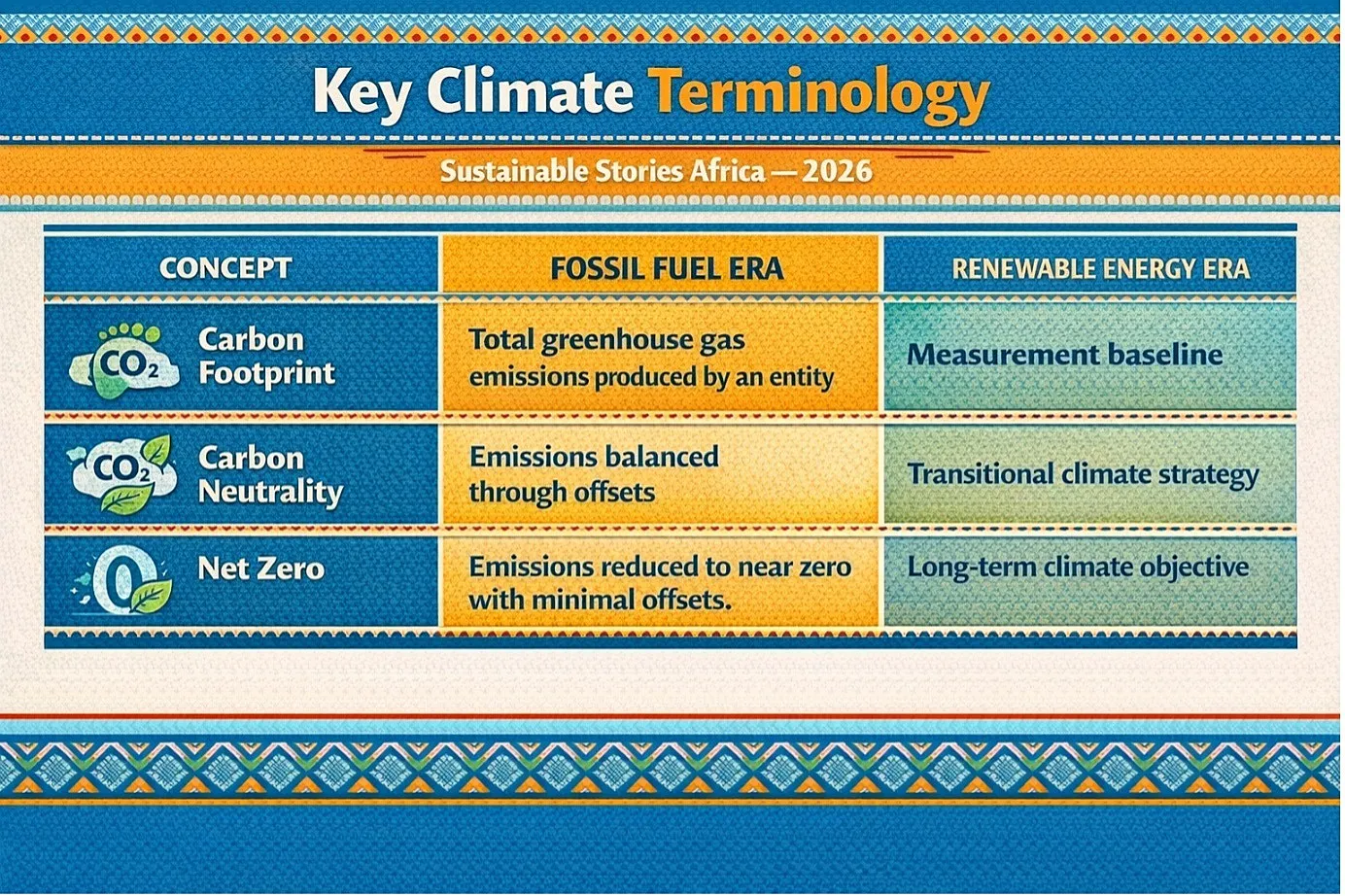
The distinctions are crucial as governments and corporations design credible climate strategies aligned with the Paris Agreement.
Building Africa’s Carbon Market Future
The global carbon credit market could exceed $250 billion by 2050, according to several climate finance forecasts.
For Africa, the stakes are particularly high: the continent possesses both large natural carbon sinks and significant demand for climate finance to support sustainable development.
Several African initiatives are already moving in this direction. The African Carbon Markets Initiative (ACMI), launched during COP27, aims to generate 300 million carbon credits annually by 2030 while ensuring that financial returns remain within African economies.
The next decade will determine whether Africa becomes merely a supplier of environmental commodities or a central player in the governance and trading of global carbon markets.
Strengthening domestic regulatory institutions, improving transparency, and building technical expertise across the carbon value chain will be critical to achieving this goal.
Without these reforms, Africa’s carbon resources could replicate the historical pattern observed in other natural resource sectors, in which extraction occurs locally, but value is commercialised elsewhere.
Path Forward – Strengthening Africa’s Carbon Market Architecture
African governments and climate institutions are increasingly advocating for localised carbon market infrastructure, including regional exchanges, domestic certification agencies, and stronger regulatory frameworks that prioritise community benefits.
By retaining more value within the continent and improving transparency across the carbon credit chain, Africa could transform carbon markets from a source of value leakage into a powerful engine for climate finance, sustainable development, and ecosystem protection.