Africa’s creators are attracting attention, but visibility is not translating evenly into dependable income.
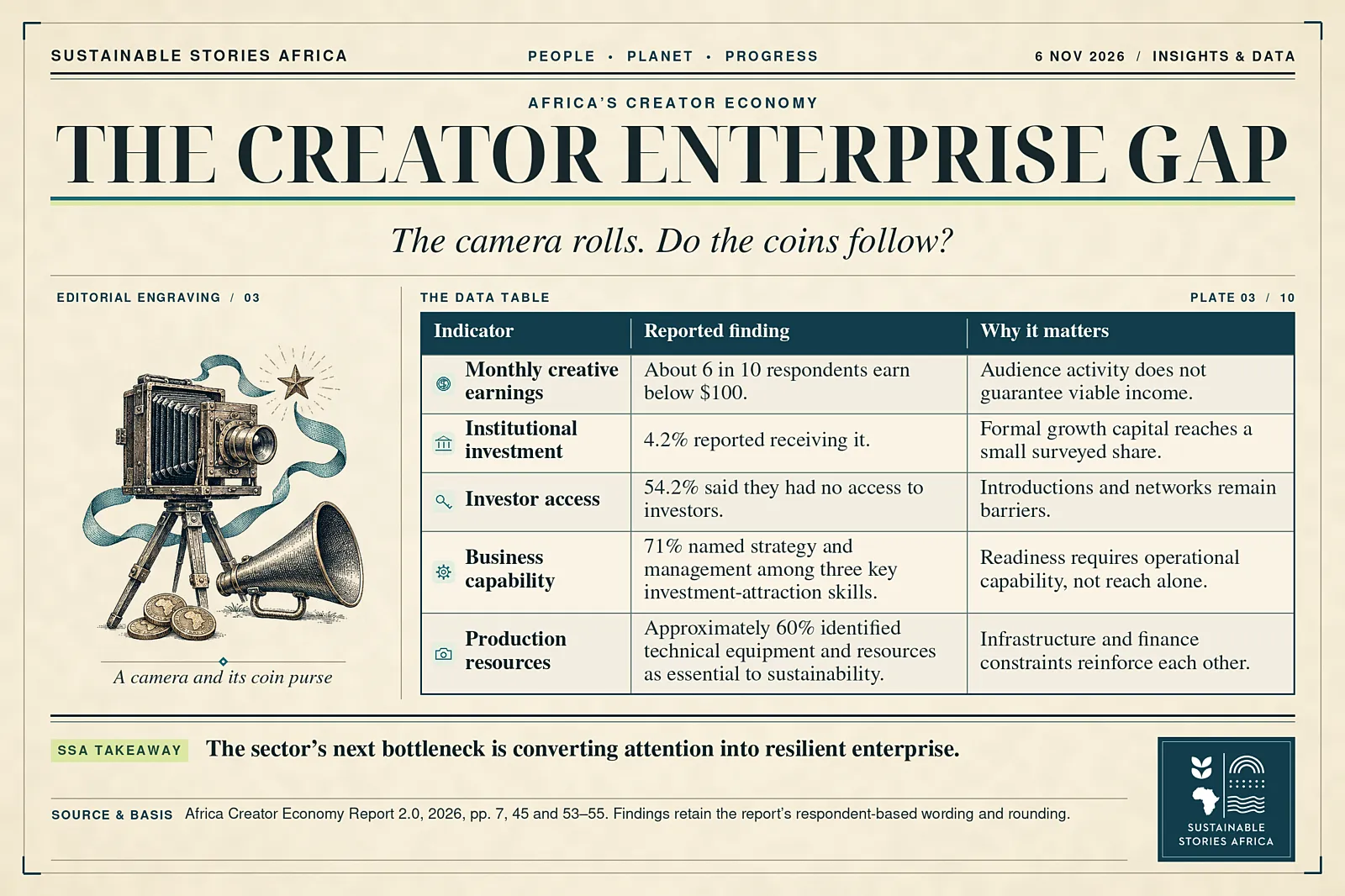
The Africa Creator Economy Report 2.0, 2026 finds that about six in ten survey respondents earn less than $100 monthly from their creative work.
The next development challenge is commercial: building the skills, infrastructure and financing arrangements that allow creative talent to become sustainable enterprise.
Africa’s Creators Need Businesses Beyond Visibility
Africa’s creator economy faces a gap between cultural influence and commercial resilience, with low earnings, irregular revenue and limited investor access constraining the creators surveyed in the Africa Creator Economy Report 2.0, 2026.
- Only 4.2% reported receiving institutional investment.
Produced by Communiqué and TM Global, the report combines survey findings, interviews and platform-level analysis.
- Its central proposition is that talent and audience growth need stronger business foundations if creators are to build enterprises, employ teams and retain the value of their intellectual property.
For policymakers, investors and brands, this moves the discussion beyond celebrating digital visibility.
- The question is whether creators can reliably finance production, withstand quiet commercial periods and develop products that audiences will buy.
The survey findings describe the respondents; they should not be read as a statistically representative census of every African creator.
Large Audiences Still Deliver Uneven Livelihoods
About 6 in 10 respondents earn less than $100 a month from creative work.
- That is the clearest indication that participation and prosperity are not interchangeable.
- A creator can publish regularly, attract engagement and still lack the cash needed to replace equipment or pay an editor.
The report also says 55.8% of creators have fewer than 10,000 followers.
- Its broader picture is an ecosystem with a large base of smaller operators and concentrated financial rewards.
- Building a viable business requires more than moving up a follower ranking.
The pressure is intensified by production costs
- Equipment, software, connectivity and support staff absorb revenue before it becomes personal income.
- Irregular campaigns make that calculation harder: a strong month does not establish a dependable annual livelihood.
The sustainability issue is therefore economic and social.
- Creators need sufficient operating stability to keep producing without relying indefinitely on unpaid labour, personal savings or income from another job.
Revenue Models Depend On More Than Platforms
Brand partnerships were the primary income source for 28.3% of respondents.
- This finding is important, but it is not a claim that sponsorship represents 28.3% of the entire sector’s revenue.
- The survey measures creators identifying a main income source, not an audited market-wide revenue pool.
Interviewees show how different models can work.
- Kenyan creator Roy Kanyi explains that brand income enabled him to build management and production support.
- Nigerian food creator Tosin Samuels, known as TSpices, describes a mix of advertising, brand deals, meal-plan sales and appearances.
She identifies YouTube as her most consistent income source because older videos can continue earning.
These accounts demonstrate possible business pathways, not average outcomes.
- They also explain why a single platform cannot be treated as the whole business.
- Discovery, recurring viewing, product sales and client services serve different commercial functions.
The report’s market map focuses on Nigeria, South Africa, Kenya and Egypt, using Modash-indexed public profiles with more than 1,000 followers or subscribers.
- These counts are platform-specific; they should not be added together as unique individual creators.
Creative Enterprises Can Build More Durable Value
The development opportunity lies in helping creators move from isolated assignments to repeatable business activity.
- A reliable production process, a useful product and a clear customer relationship can matter more commercially than an exceptional week of viral engagement.
The report argues that intellectual property, employment and locally rooted businesses should form part of the sector’s long-term promise.
- This widens the policy lens beyond influencer campaigns. Editors, designers, researchers, production crews and commercial managers can all participate in the value created around a successful creative enterprise.
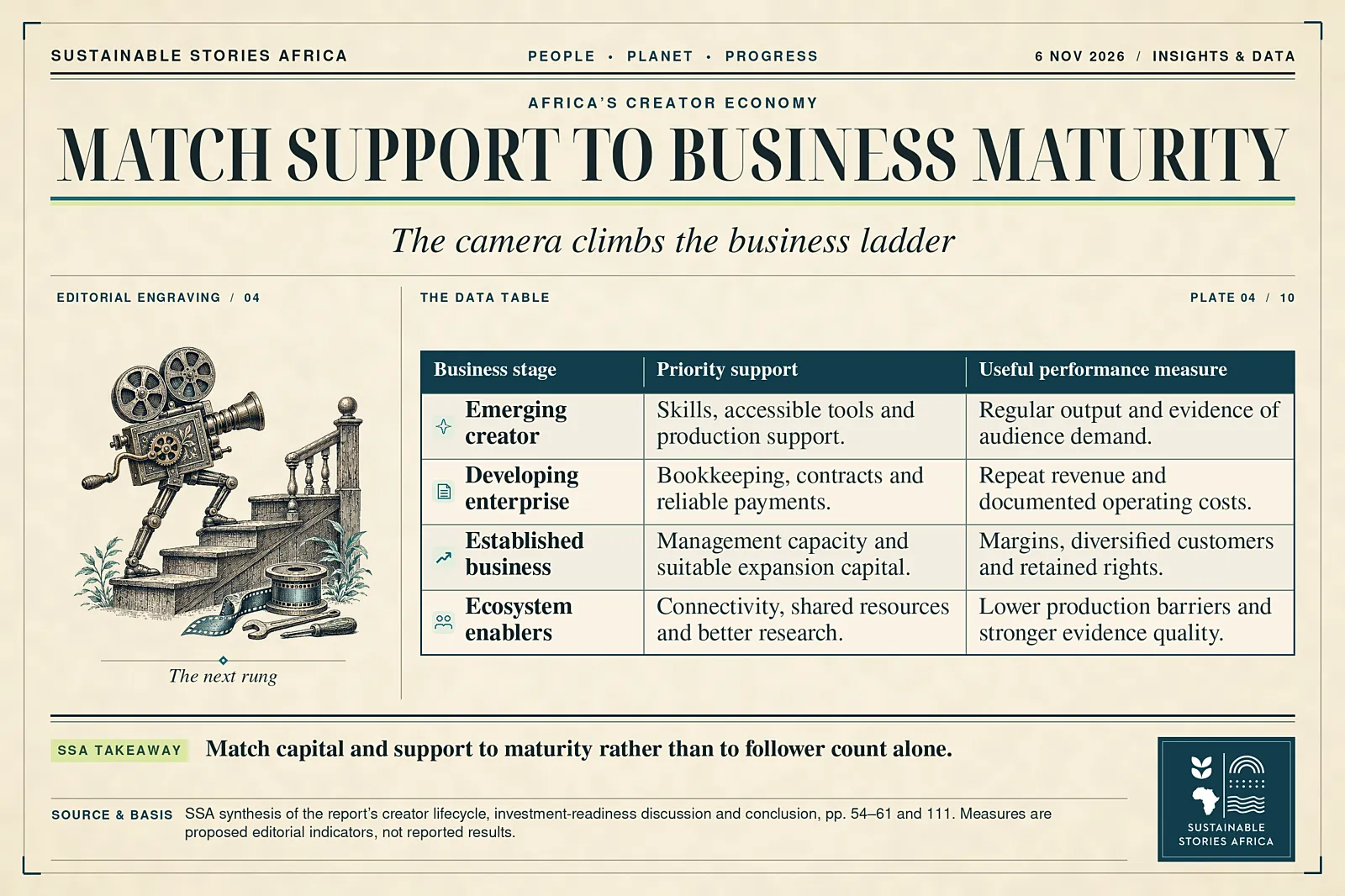
Different stages require different support.
- Emerging creators may need training, affordable production tools and fair access to distribution.
- More established operators may need contracts, bookkeeping and payment systems.
- Mature businesses with predictable revenue may be better positioned to absorb institutional investment.
This does not mean every creator should seek venture capital.
- As an editorial implication of the report’s lifecycle approach, financing should match the business model, cash-flow profile and growth ambition rather than impose one investment template on every creative practice.
The distinction between income and finance is equally important.
- A sponsorship pays for commercial work; an investment generally brings expectations about future returns or business growth.
- Treating every brand payment as expansion capital can conceal how much is already committed to delivery costs.
Creators and potential financiers need a shared account of what new money will achieve.
For example, an enterprise seeking to add production capacity should be able to explain the resulting output, the customers it expects to serve and the costs it will incur.
- This is an analytical application of the report’s investment-readiness argument, not a forecast that financing will necessarily produce growth.
It keeps the conversation grounded in a business proposition while leaving room for creative experimentation and different ambitions.
Build Commercial Systems Before Chasing Scale
For creators, the first task is to make the business legible: record income and costs, separate business finances, document contractual rights and understand which activities generate repeatable margins.
- Business registration alone does not establish these capabilities.
Investors should assess more than follower totals.
- Revenue concentration, intellectual-property ownership, production capacity and customer demand offer a stronger basis for evaluating an enterprise.
- The report’s readiness framework supports a shift from popularity as a proxy to evidence of operational maturity.
Brands can contribute through clearer scopes, workable payment terms and relationships that support planning rather than repeated uncertainty.
- Policymakers and ecosystem organisations should address connectivity, production resources, business education and payment infrastructure alongside promotional programmes.
Research quality also matters.
- The methodology describes an English-language survey, focus groups and interviews, but does not establish a representative sampling frame or disclose a respondent total in that section.
- Its phrase “all 52 African countries” should not be treated as a verified continent-wide coverage count. Language access and selection effects limit generalisation.
The appropriate response is not to discard the findings.
- It is to use them as directional evidence while building better data on creator costs, earnings, business survival and financing outcomes.
Path Forward – Turns Influence Into Enterprise
Africa’s creator economy needs better business systems alongside better access to capital.
Creators should strengthen financial records and ownership arrangements, while investors and ecosystem organisations tailor support to different stages of development.
Progress should be measured through durable income, enterprise survival, jobs and retained intellectual property, not visibility alone.
The report provides a useful starting point, but stronger, more transparent research is needed to track those outcomes.