Open data can widen access to knowledge without giving the people behind that knowledge any meaningful control.
The CARE Principles offer a framework for putting Indigenous authority, collective benefit and accountability into research and data systems.
For African institutions, their value lies in a sharper governance question: who decides how community knowledge is collected, shared and reused, and who benefits when it travels?
Indigenous Knowledge Needs Authority Not Extraction
Indigenous data governance should give communities authority over information about their people, territories and knowledge, rather than treating consultation as a substitute for control.
That is the central argument advanced by Stephanie Russo Carroll and Talia Anderson in the webinar, The CARE Principles of Indigenous Data Governance.
Published on 24 November 2021, the presentation remains a useful framework for this 6 November 2026 Insights and Data edition.
- It is not a new policy announcement.
- Its contribution is to explain how research institutions and data repositories can turn recognition of Indigenous rights into operational decisions.
The African relevance is an analytical application, not evidence that the webinar evaluated African institutions.
- For organisations working with community-held agricultural, environmental or cultural knowledge, the framework asks whether data systems protect the people whose knowledge makes research possible.
It also separates the ability to access information from the authority to determine its use.
Open Data Does Not Guarantee Justice
A dataset can be accessible to researchers while remaining difficult for the community it concerns to locate, interpret or govern.
- Carroll describes Indigenous information buried in larger collections, inadequately labelled and separated from the relationships and permissions that should accompany it.
This exposes a gap in the promise of open science.
- Making information easier to share does not settle whether it should be shared, with whom, or under which conditions.
- Nor does it establish whether a new use serves the priorities of its knowledge holders.
The speakers define Indigenous data broadly.
- It includes information generated by Indigenous peoples and information collected about them by governments, companies and researchers.
- Environmental observations, administrative records, oral histories and cultural knowledge can therefore raise related governance questions, despite their different formats.
The consequence is institutional: responsibility cannot stop at the point of collection.
- Storage, interpretation, publication and third-party reuse can each alter who benefits and who bears risk.
Four Principles Reframe Who Holds Power
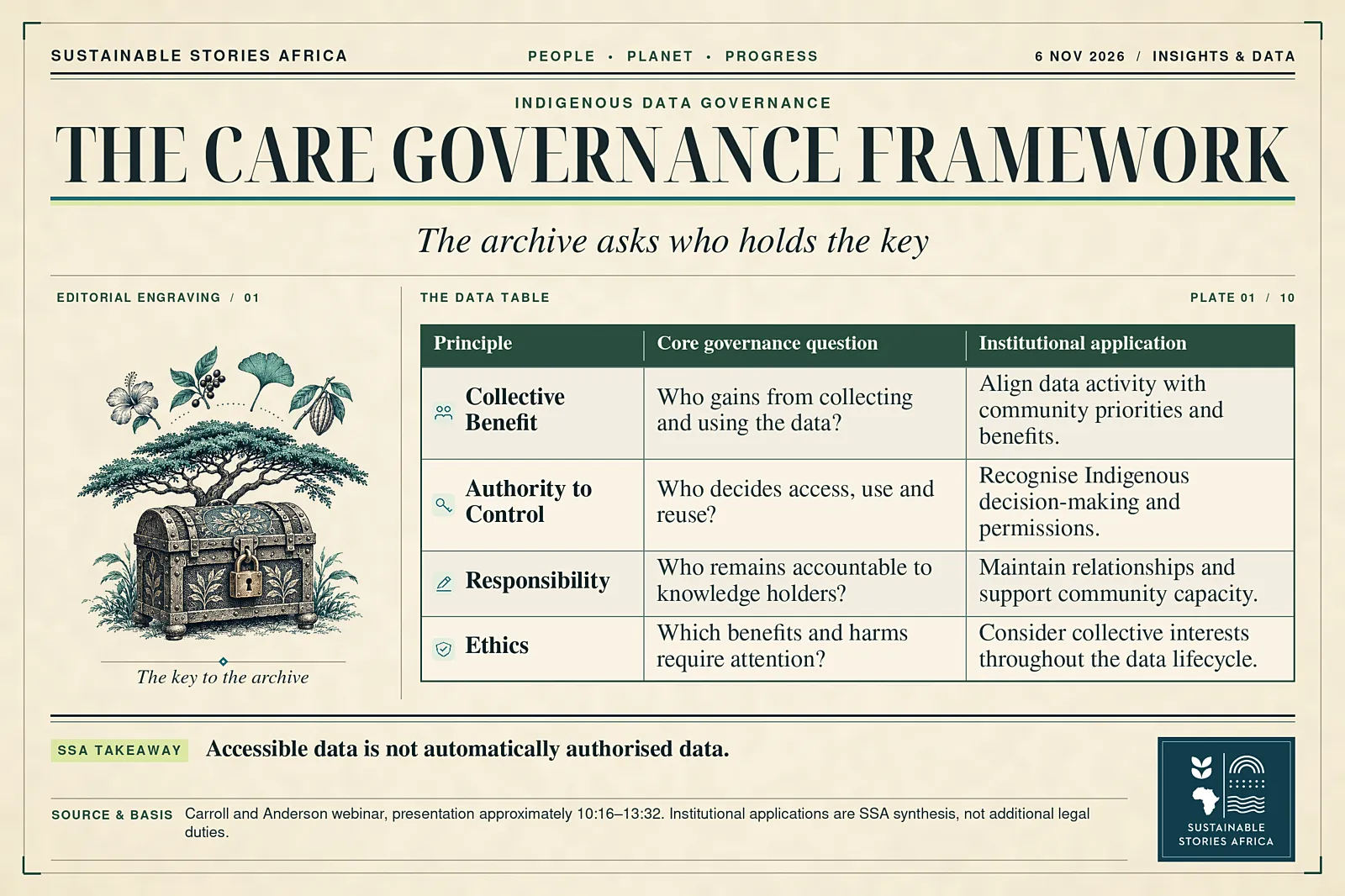
Released by the Global Indigenous Data Alliance in 2019, CARE stands for Collective Benefit, Authority to Control, Responsibility and Ethics.
- The principles shift attention from data as a technical resource to the people, purposes and relationships behind it.
They complement rather than replace FAIR:
- Findable, Accessible, Interoperable and Reusable. FAIR supports the discovery and use of data.
- CARE asks whether those activities respect Indigenous authority and deliver appropriate benefits.
This distinction matters because technical quality and ethical legitimacy answer different questions.
- A well-documented dataset can still be used outside the expectations of the people connected to it.
- Equally, recognising community authority requires investment in systems that enable communities to locate and use their own information.
The webinar presents Indigenous data sovereignty as a right exercised by Indigenous peoples and nations.
- Institutions holding Indigenous data have responsibilities; possession alone does not confer that sovereignty.
The relationship between CARE and FAIR is especially useful for institutional leaders.
- A repository may invest in search tools, standard formats and persistent identifiers because those features make data easier to discover and combine.
- CARE adds a separate set of questions about whose priorities guide that investment and which permissions travel with the information.
Neither task substitutes for the other.
That distinction also changes the meaning of participation.
- Inviting a community to comment after research terms have been fixed is different from allowing its decision-making structures to shape those terms.
- In the webinar’s account, institutional reform requires moving beyond recognition towards changes in policies and practice.
For a university, funder or agricultural research organisation, the relevant evidence is therefore not only an engagement meeting, but the decisions that community authority can influence.
Community Authority Can Strengthen Research Partnerships
The opportunity is not to close every dataset.
- It is to create conditions in which sharing happens on terms that knowledge holders understand and help determine.
- Research can then support community decision-making without assuming that unrestricted circulation is always the preferred outcome.
Anderson identifies attribution as one practical example.
- Researchers outside a community often receive the visible credit associated with datasets and publications.
- Better metadata and appropriate authorship can help recognise the people whose contributions make that work possible.
Recognition must nevertheless follow community preferences.
- Some communities may want acknowledgement; others may prefer restrictions on names, locations or other identifiers.
- Automatically naming everyone is no more community-led than automatically anonymising everyone.
For African research organisations, this suggests a useful test for partnership quality: can community representatives influence the research terms, the treatment of sensitive information and the way findings return to them?
The principle is shared decision-making, not a universal template imposed across different peoples.
Make Community Permissions Operational Across Institutions
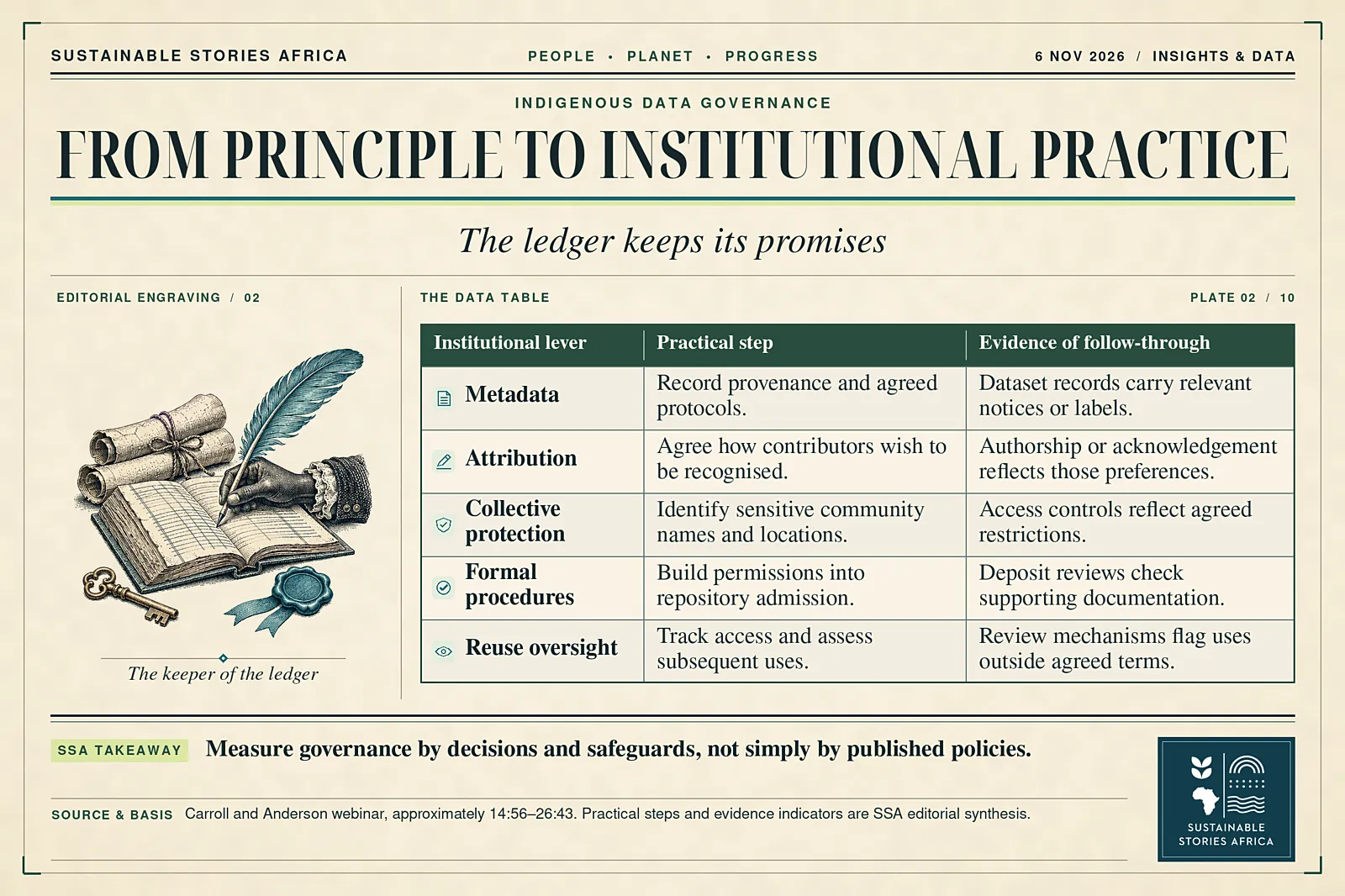
The webinar proposes five institutional shifts:
- Enrich metadata;
- Recognise Indigenous intellectual contributions;
- Protect community-identifiable information alongside personal information;
- Formalise ethical guidelines;
- Track data use and reuse.
Local Contexts notices and Traditional Knowledge or Biocultural Labels illustrate how data records can carry information about provenance, protocols and permissions.
- Notices can identify unresolved attribution or invite collaboration.
- Community-developed labels require deeper engagement; they are not an administrative shortcut for inventing consent.
Research institutions should therefore examine existing collections as well as new projects.
- Legacy datasets may contain Indigenous knowledge without adequate identification of its origins or conditions of use.
- A practical response starts with an audit, followed by relationships with the relevant knowledge holders.
Funders, repositories and publishers also have a role.
- Voluntary commitments become more credible when deposit forms, review processes and access decisions require evidence of appropriate permission.
- Tracking reuse can help identify applications that diverge from community expectations, particularly when third parties are far removed from the original relationship.
These are governance improvements, not a claim that labels alone create enforceable ownership rights.
Their effectiveness depends on institutional procedures, community authority and the legal context.
Path Forward - Requires Shared Decision Making
Institutions should begin by identifying Indigenous data in their custody, clarifying community authority and embedding agreed permissions into access and reuse procedures.
Better metadata matters, but accountable relationships matter more.
For African organisations applying these lessons, success means research that communities can shape, information they can use and benefits they help define.
CARE offers a governance framework, not a substitute for locally grounded agreements.