
Britain has finalised its regulatory framework for ESG ratings providers, setting a June 2028 start date for the main regime.
The rules focus on transparent methodologies, reliable data, governance and conflicts of interest.
For African providers serving UK users, and companies assessed by regulated firms, the immediate task is preparation, rather than assume that every ESG service is already subject to the new requirements.
Britain Sets New ESG Ratings Expectations
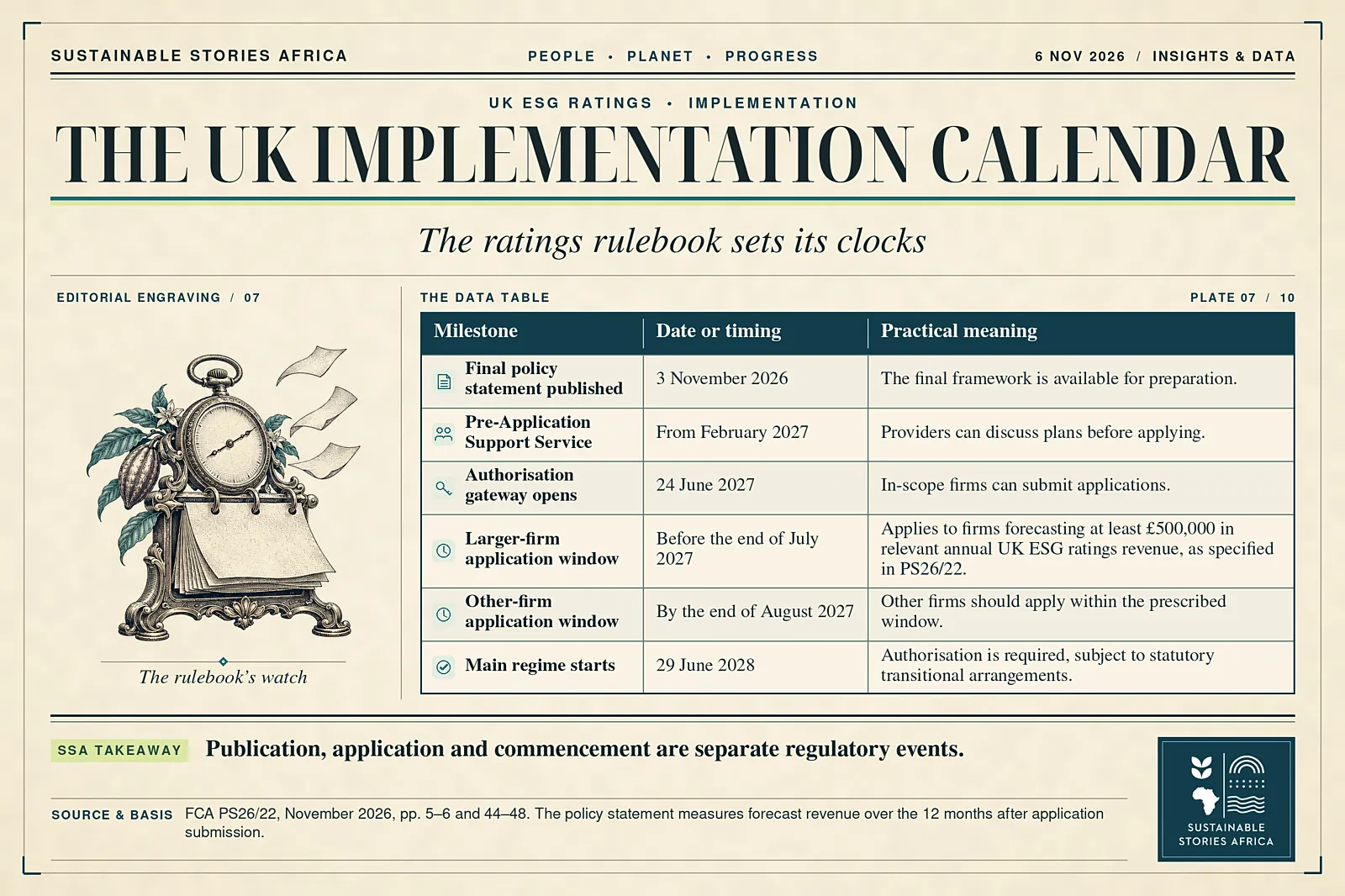
The UK Financial Conduct Authority has published its final ESG ratings regime, creating a framework intended to improve transparency, reliability and accountability in assessments that can influence investment decisions. Policy Statement PS26/22 was published on 3 November 2026.
The main regime starts on 29 June 2028, with the authorisation gateway opening on 24 June 2027.
- The distinction matters: final rules have now been published, but their principal operating obligations are not already in force on 6 November 2026.
- Certain application-fee provisions took effect on publication.
For African market participants, relevance depends on role and activity.
- An African provider making remunerated, in-scope ratings available to UK persons may need authorisation.
- An African company rated by an authorised provider occupies a different position: it may benefit from engagement and information rights without becoming a regulated ratings business itself.
Scores Influence Capital But Need Explanation
An ESG score can appear precise while leaving the user uncertain about what it measures.
- Does a higher score mean lower financial risk, stronger environmental outcomes or better performance against a selected peer group?
- These are different propositions.
The FCA says users can struggle to understand how ratings are produced, compare products or assess conflicts of interest.
- Its response is not to impose one approved sustainability methodology.
- The regulator expressly supports methodological diversity while requiring clearer explanations and stronger controls.
That approach is consequential for African issuers and investors.
- A rating’s meaning depends on its purpose, underlying information and treatment of missing data.
- Greater transparency can make those assumptions easier to scrutinise, although regulation does not guarantee any particular rating result.
The policy statement received 90 consultation responses.
- Its final framework broadly retains the proposed principles-based approach, with changes intended to improve clarity, proportionality and practical implementation.
Scope Depends On Products And Distribution
The regime covers assessments of environmental, social or governance factors expressed as scores, opinions or both, produced through an established methodology and a defined ranking system.
- Whether a product is marketed as an “ESG rating” is not decisive.
The perimeter also depends on business activity, investment relevance, territorial connections and exclusions.
- UK providers can be covered when serving persons overseas.
- Overseas providers can be covered when making ratings available to persons in the UK for remuneration received from any person.
Raw ESG data is not automatically a rating.
- The FCA distinguishes standalone numerical indicators from assessments that place information into a defined ranking system.
- A company’s emissions figure and a provider’s graded assessment of that figure are not the same product.
African consultancies, analytics firms and financial-information businesses should therefore examine actual outputs and distribution arrangements.
- A product-by-product assessment is more useful than assuming that every sustainability dashboard is regulated, or that a different product label keeps it outside scope.
Transparency Can Improve Market Dialogue And Trust
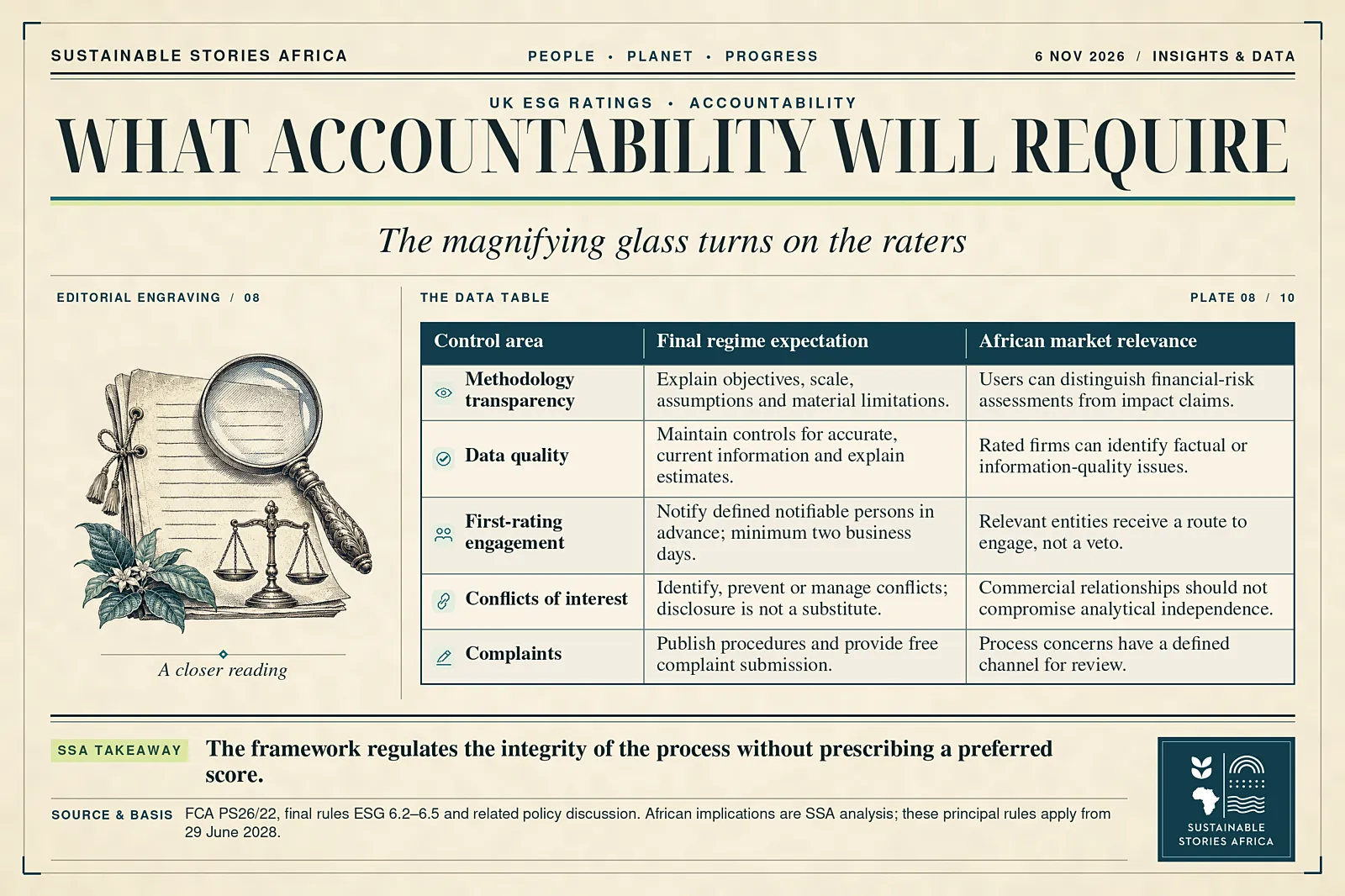
The final rules require public information explaining each rating product-line’s objectives, assessed factors, scale and methodology.
- Providers must describe key assumptions, data policies and material limitations, including relevant gaps and biases.
More detailed information goes to users and, on request, to defined notifiable persons connected with rated items.
- The rules address factors, weights, data sources, estimation approaches and the treatment of absent information.
- They do not require publication of every underlying data point.
This creates a more structured basis for questions.
- A rated company can seek to understand whether an assessment reflects outdated information, an estimation method or a difference in analytical judgement.
- These possibilities should not be conflated.
The potential benefit is a better-informed market, not universal agreement.
- Different providers may continue to produce different assessments.
- The objective is to make those differences more intelligible while protecting the integrity and independence of the rating process.
For investors using ratings, the same disclosures create a due-diligence task.
- A score should be interpreted against its stated purpose rather than treated as a universal certificate of sustainability.
- A financial-risk assessment may help answer one investment question without resolving a separate question about a company’s effects on people or ecosystems.
For African companies, that means keeping factual correction distinct from disagreement with a methodology.
- Better evidence can address an incorrect input, while understanding peer groups and factor weights can explain why a provider reaches a different conclusion.
The FCA’s approach creates information and process expectations; it does not give rated entities a guarantee of improvement.
This boundary is important if transparency is to build trust without turning engagement into commercial pressure on analysts.
Prepare Governance Systems Before The Gateway
Providers should begin with a documented perimeter review, then assess governance, resources, data controls, methodology oversight, outsourcing and conflicts.
- The FCA expects applicants to show that they are ready, willing and organised to comply on an ongoing basis.
The application-fee threshold is £500,000 in forecast annual relevant revenue, not the £250,000 originally proposed.
- During the gateway period, the published fees are currently £2,820 below the threshold and £11,260 at or above it.
- These are application fees, not the total cost of compliance, and may be updated.
Rated entities have a separate preparation task: keep evidence organised, identify appropriate contacts and understand the routes for correcting factual information.
- Before a first rating, providers must notify relevant notifiable persons sufficiently in advance, with a minimum of two business days.
- This is not a right to approve the rating or dictate its analytical outcome.
Complaints procedures must be free to use and handle qualifying complaints fairly and promptly.
- The rules generally require handling complaints raised within three years of the matter concerned.
- These arrangements should not be confused with automatic access to the Financial Ombudsman Service, which the regime excludes for this activity.
Timely applicants whose applications remain undecided at commencement can continue business under the statutory transition described in PS26/22.
- That limited route is not a general exemption from preparing or applying.
Firms with uncertain positions should obtain a case-specific legal assessment.
Path Forward – Starts With Scope Assessment
African providers should assess UK exposure now and build a preparation timetable around the 2027 application windows.
Rated companies and investors should strengthen evidence management and learn how the new disclosure and engagement rights work.
The goal is more accountable sustainability information, not uniform scores.
Clear methodologies, dependable data and effective conflict controls will determine whether the regime improves investment decisions in practice.