
Africa’s ESG challenge is no longer a shortage of commitments.
It is the difficulty of turning global standards into measurable action across markets shaped by uneven regulation, informal supply chains and scarce transition finance.
A new framework built around Olam International’s African operations proposes six steps, from strategy and governance to traceability, community engagement and reporting.
Its value lies in sequencing action, but its single-case evidence also demands caution.
Africa’s ESG challenge moves beyond promises
Across Africa, companies are being asked to satisfy investors, regulators, customers and communities with the same three-letter promise: ESG.
However, the real test is not whether a board has approved a sustainability statement. It is whether that commitment changes procurement, financing, risk controls and outcomes on the ground.
A study published in AIB Insights argues that global frameworks cannot simply be transferred into institutionally uneven markets.
It identifies weak enforcement, fragmented standards, financing constraints, limited digital infrastructure and resistance inside organisations as recurring barriers to implementation.
Using Olam International as an illustrative case for West African agribusiness, the study proposes a six-step adoption path.
- The framework is useful because it connects ambition to operations.
- It is not, however, a continent-wide verdict: the analysis relies on one company and secondary material, so other sectors and markets still need to test its assumptions.
The execution gap now defines credibility
The central warning is straightforward: an ESG pledge has little value if managers cannot explain who owns it, which issues are material, how suppliers are verified or what evidence will be disclosed.
In markets where regulation is inconsistent, and business activity is often informal, that gap can become both a sustainability risk and a competitiveness risk.
The study frames ESG as more than reporting.
- It links environmental and social priorities to corporate ethics, governance and business resilience.
- That matters because many African companies encounter ESG first through a lender questionnaire, tender requirement or disclosure template.
- If the response begins and ends with a report, the organisation may satisfy a document request while leaving the underlying risk untouched.
For exporters and companies seeking international capital, the consequences are becoming increasingly commercial.
Traceability can influence access to buyers; credible transition plans can shape financing; and community relationships can determine whether a project retains its social licence to operate.
The framework therefore treats investor confidence and local legitimacy as connected rather than competing goals.
Four constraints shape Africa’s ESG reality
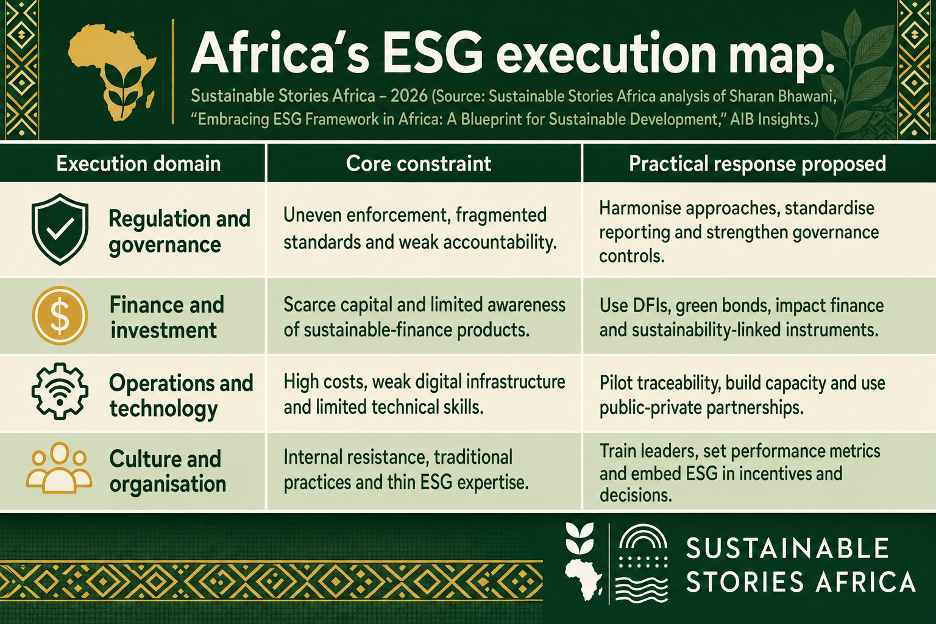
The paper groups the implementation problem into four domains.
- Regulation and governance are weakened by uneven enforcement, fragmented standards, and corruption risks.
- Finance is constrained by scarce capital, limited sustainable-finance knowledge and underdeveloped local green markets.
- Operations face high technology costs and skills gaps.
- Organisational culture can resist new controls or treat ESG as an external communications exercise.
Its proposed responses are deliberately practical: regional harmonisation through the African Continental Free Trade Area, standardised reporting protocols, policy incentives, stronger anti-corruption controls, development-finance partnerships, local green-bond markets, digital traceability, public-private technology support and sustained training.
Olam is used to show how those responses might work in practice.
- The paper points to agroforestry and regenerative agriculture, community programmes, renewable-energy investment, technology-enabled supply-chain efficiency and blockchain-based traceability.
- It also cites $500 million in sustainability-centred financing, an MSCI ESG rating and inclusion in the FTSE4Good Index as signals of finance and disclosure readiness.
Those examples should be read as illustrations, not universal proof.
Agribusiness has material issues that differ from those of banking, telecoms, mining or small-scale manufacturing.
A traceability tool that works in a cocoa supply chain may not resolve a bank’s financed-emissions challenge or a utility’s affordability problem.
Context-fit ESG requires companies to preserve the sequence while changing the metrics.
Context-fit ESG can unlock strategic value
The framework’s strongest opportunity lies in moving sustainability from compliance to management.
- Materiality directs scarce capital toward significant risks and impacts; governance assigns accountability; technology verifies claims; community engagement grounds priorities in lived realities; and finance supports projects with credible evidence and clearer use of proceeds.
This sequence can lower the cost of fragmented initiatives by connecting environmental and social programmes, reporting, enterprise risks, budgets and performance indicators.
- Manufacturers may prioritise energy efficiency and safety; agribusinesses, land, water, farmer income and deforestation; financial institutions, customer protection and financed climate exposure.
For governments and regional institutions, interoperability matters.
- Harmonisation need not impose identical laws across Africa; it needs sufficient consistency in definitions, reporting expectations and assurance to reduce duplication for cross-border businesses while preserving national priorities.
The reward extends beyond reputation: credible systems can unlock sustainability-linked capital, improve procurement eligibility, strengthen customer trust and signal disruption earlier.
Delay carries tangible costs, including stranded projects, inaccessible markets, disputed claims and community resistance.
Six steps turn commitments into systems
The roadmap begins with awareness, executive development, risk assessment and alignment with international standards.
It then embeds ESG in operations and governance, giving sustainability decision rights, controls and oversight rather than leaving it to communications.
- Companies mobilise green bonds, impact capital or sustainability-linked products, track performance and improve traceability or reporting.
- They engage communities, regulators and stakeholders to test priorities, monitor impact and build compliance through audits, disclosure readiness and alignment.
African firms can start small:
- Supplier-traceability pilots can expose data gaps before costly rollout; materiality can identify three or four useful metrics; community mechanisms can track grievances, response times and outcomes, not meetings.
Boards should ask;
- Which claims affect revenue, capital or licence to operate, who verifies data, what trade-offs arise, which indicators inform decisions, and what evidence withstands scrutiny.
The framework offers a starting architecture; however, the evidence creates accountability.
Independent assurance, sector testing and transparent reporting of setbacks are essential if it is to move beyond case-study appeal alone.
Path Forward – Build locally, align globally
African companies should sequence ESG around material risks, accountable governance, targeted finance, verifiable data and sustained community engagement.
Regional bodies and regulators can support them by improving interoperability, incentives and disclosure clarity.
The next step is for firms across sectors to pilot the roadmap, publish comparable outcomes and identify where it needs improvements.
ESG will create durable value only when global expectations are translated into locally credible decisions and measurable results.