
A survey of 182 LASUSTECH architecture students found weak ratings for studio design and indoor environmental quality, while 78.1% said poor conditions increased stress.
The study did not statistically confirm indoor quality as a mediator, but it strengthens the case for treating campus infrastructure as a wellbeing and learning issue.
Campus Buildings Are Part Of Wellbeing
For an architecture student, the studio is more than a classroom.
It is a workshop, a collaboration space and a second home during long design sessions.
When that space is hot, crowded, dim or poorly ventilated, the cost can appear in concentration, productivity, and psychological strain.
A July 2026 study surveyed 182 undergraduate architecture students at Lagos State University of Science and Technology.
It assessed learning-space design, indoor environmental quality and self-reported mental-health effects on a five-point scale, then tested relationships among the variables.
The results are a warning for universities across Africa.
Buildings are often treated as capital assets whose job ends when construction is completed.
The evidence suggests they should also be managed as health and academic-performance systems, with ventilation, lighting, acoustics, space and furniture monitored as seriously as curricula.
Seven-Hour Exposure Turns Facilities Into Risk
Exposure makes the problem urgent.
- The survey found that 58.2% of respondents spent at least seven hours a day in classrooms or studios.
- This includes 19.2% who spent more than nine hours.
- A marginal environmental problem becomes more consequential when students experience it for most of their working day.
Students gave learning-space design an overall mean score of 2.22, within the study's "disagree" range.
The four questions covered whether layouts supported learning, whether spaces were adequate, whether furniture allowed movement, and whether furniture was comfortable and ergonomic.
Each item attracted negative ratings from roughly seven in ten respondents.
Indoor environmental quality performed similarly.
- Natural and artificial lighting, ventilation, thermal comfort, noise and air quality produced an overall mean of 2.25.
- The paper interprets that as a broadly poor assessment of the studios' environmental conditions.
- This is not a clinical diagnosis, but it is a consistent occupant signal that the facilities are not supporting the work demanded inside them.
Students Score Studios Below Acceptable Conditions
The findings reveal a clear link between poor studio facilities and student wellbeing, alongside a mediation result that falls short of statistical confirmation.
Survey data show 78.1% of respondents agreed or strongly agreed that poor studio conditions increased stress (mean 4.15), while 75.3% linked learning environment quality to academic productivity and 76.4% cited overcrowding's negative impact on mental health.
Indoor environmental quality correlated significantly with mental health outcomes (r = -0.153, p = 0.039), with a regression coefficient of -0.117 (p = 0.037), suggesting worse conditions that accompany greater psychological burden.
Although the effect is modest, causation cannot be confirmed.
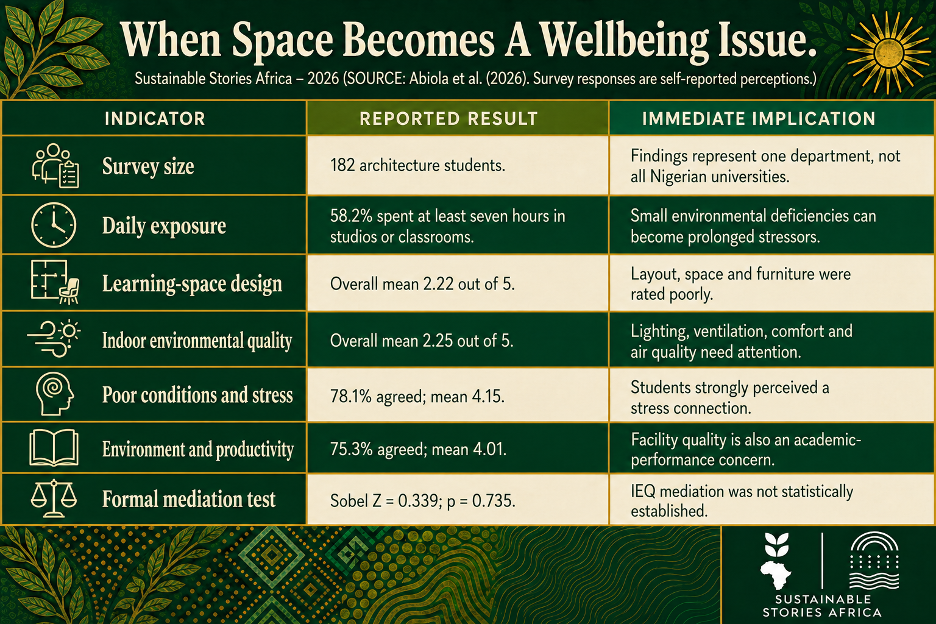
Students strongly perceived a link between design and wellbeing (mean 4.02); however, the Sobel mediation test was not significant, because the design-to-indoor-quality path was insignificant.
The authors suggest uniformly poor conditions may have limited variation, though this remains untested.
Key limitations include the cross-sectional design, single-institution scope, and reliance on self-reported data rather than sensor or clinical measures.
A stronger follow-up would integrate objective environmental readings with validated, longitudinal wellbeing instruments.
Better Rooms Can Protect Learning Capacity
The opportunity is practical because many interventions are measurable.
- Universities can assess airflow, daylight, temperature and sound; compare occupancy with usable floor area; repair fans and lighting; and redesign layouts around the actual tasks students perform.
Improvements can be prioritised by risk rather than waiting for a complete building replacement.
Better indoor conditions can support more than comfort.
- They can protect concentration during detailed studio work, reduce fatigue, make collaboration easier and improve inclusion for students who are more sensitive to heat, noise or poor air.
When facilities work, academic support and mental-health services also operate in a less hostile environment.
The study recommends 3.5 to 5 square metres per student workstation, at least 500 lux on working surfaces, improved mechanical and passive ventilation, acoustic treatment, ergonomic furniture and regular post-occupancy evaluation.
These are proposed design responses from the paper, not proof that any single intervention will solve stress.
Their value is turning a diffuse complaint into an auditable facilities agenda.
Universities Need Audits, Repairs And Support
LASUSTECH and other institutions can start with an independent indoor-environment audit covering studios, lecture rooms and laboratories.
- The audit should record occupancy, ventilation performance, thermal conditions, lighting, noise and maintenance status at different times of day.
- Results should be published with a costed repair sequence and clear owners.
Regulators and professional bodies can raise the floor.
- The National Universities Commission and Architects Registration Council of Nigeria should integrate minimum indoor environmental quality into programme accreditation, while allowing climate-appropriate passive solutions.
- Infrastructure and Capital budgets should protect routine maintenance, because failed fans, blocked openings and broken fittings can erase the performance intended by design.
Facilities action must sit beside accessible counselling and reporting channels.
- Students need a reliable way to flag environmental problems and receive support before stress becomes crisis.
- Annual occupant surveys and post-occupancy evaluations can then test whether repairs improve experience, instead of treating completion certificates as the final measure of success.
Path Forward – Make Wellbeing A Building Standard
Universities should measure the learning environments in which students learn, publish repair priorities, and link accreditation to evidence of indoor-quality standards.
Immediate maintenance can proceed while larger redesigns are funded.
Future research should combine sensors, validated mental health measures and multiple campuses.
The present study is a strong warning signal, not a causal verdict; the responsible response is to investigate quickly and improve what students experience every day.