
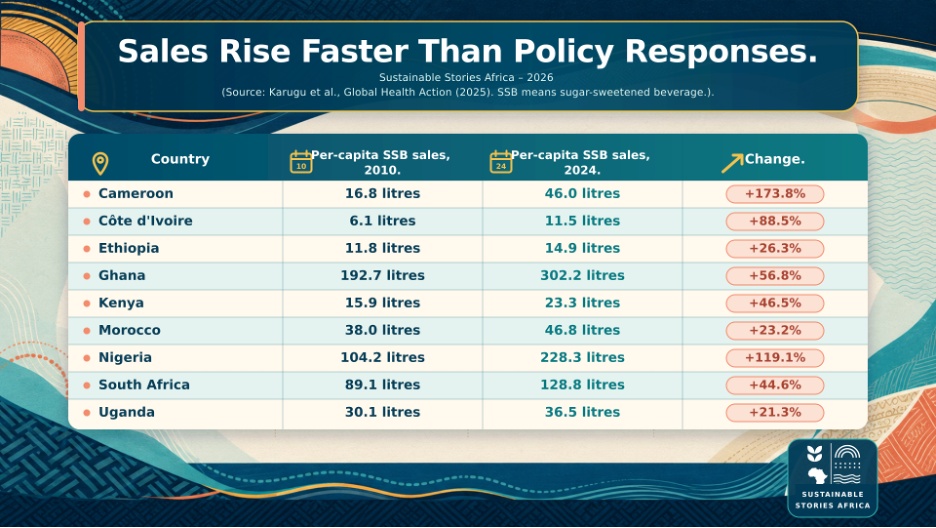
Sugar-sweetened beverage sales increased in all nine African countries studied between 2010 and 2024, with per-capita growth reaching 173.8% in Cameroon and 119.1% in Nigeria.
The ecological study does not prove individual causation.
However, its country-level associations and the continent's widening diabetes burden strengthen the case for taxes, clear labels, marketing controls and better public health data.
Africa's Beverage Market Carries Health Costs
A 15-year study of nine African countries has found that sales of sugar-sweetened beverages rose everywhere examined, and several markets recorded significant associations between beverage sales and indicators of type 2 diabetes.
Published in Global Health Action, the ecological time-series analysis covered Cameroon, Côte d'Ivoire, Ethiopia, Ghana, Kenya, Morocco, Nigeria, South Africa and Uganda from 2010 to 2024.
It combined Euromonitor sales data with International Diabetes Federation estimates and tested country-specific relationships using multivariate autoregressive models.
The findings arrive as Africa's food environment changes rapidly.
- Urbanisation, higher incomes, aggressive marketing and easier access to ultra-processed products are expanding consumer choices.
- Health systems already facing infectious disease and maternal-health pressures must also finance a growing non-communicable disease burden.
Sales Rise Faster Than Policy Responses
Per-capita beverage sales increased in all nine countries. Cameroon recorded the sharpest relative rise, from 16.8 to 46 litres per person, an increase of 173.8%. Nigeria rose from 104.2 to 228.3 litres per person, up 119.1%, while Côte d'Ivoire increased 88.5%. Ghana remained the highest per-capita market in the dataset, rising from 192.7 to 302.2 litres.
Population growth magnified the total volumes. Nigeria's sales increased by 35.77 billion litres to 53.13 billion litres, a 206.1% rise. Ghana added 5.50 billion litres and Cameroon 1.01 billion litres, with Cameroon's total volume increasing 305.7%. Every country recorded higher national sales.
This matters because 24 million adults are already living with diabetes across Africa, a figure projected to reach 55 million by 2045, according to the background evidence cited by the authors. Sugar-sweetened beverages are only one risk factor, but they are a modifiable exposure embedded in price, marketing and retail environments.
Country Trends Reveal Uneven Diabetes Links
Diabetes trends did not move uniformly with sugary drink sales.
- Prevalence rose most sharply in Ethiopia (2.0% to 3.6%), Morocco (7.6% to 11.6%) and South Africa (4.5% to 6.1%), while Ghana and Nigeria saw lower modelled prevalence in 2024, and Kenya and Uganda held stable.
- Absolute case numbers increased everywhere except Ghana, with the largest gains in Ethiopia (+1.47 million), Morocco (+1.37 million) and South Africa (+1.04 million).
Country-specific models found significant links between per-capita sales and diabetes burden in Ghana and Ethiopia, total sales volume in Kenya, and prevalence in Nigeria, Morocco and Côte d'Ivoire, underscoring how national context shapes outcomes.
The authors caution that this is an ecological study: it compares national trends, rather than individual habits, and sales figures may miss informal or home-prepared beverages.
Short data series and correlated variables also prevented reliable isolation of urbanisation and effects of GDP. These findings signal population-level risk rather than proof of direct causation.
That distinction reinforces, rather than undermines, the case for stronger evidence.
Governments need integrated surveillance to link product composition, pricing and purchasing to obesity and diagnosed disease; without it, policy will lag behind a fast-moving market.
Prevention Can Bend the Cost Curve
Preventive policy can change the food environment before diabetes, cardiovascular disease and obesity impose higher household and health-system costs.
- Taxes can reduce purchases and encourage manufacturers to reformulate products with less sugar.
- Front-of-pack warnings can make sugar content easier to understand at the point of sale.
Marketing restrictions matter because beverage preferences are formed early.
- The authors highlight advertising around schools, on television and online as channels through which sugary drinks become normalised among children and adolescents.
Kenya's 2022 demographic survey, cited in the study, found that 70.4% of women and 49% of children aged six to 23 months had consumed sugar-sweetened beverages.
Policy does not need to remove consumer choice to improve it.
- Revenue from excise taxes can support diabetes screening, primary care, school nutrition or access to safe drinking water.
- Clear standards can reward product reformulation and give responsible businesses a more predictable market.
Governments Need a Layered Regulatory Response
Governments should build packages rather than rely on one instrument.
- A well-designed excise tax should be paired with front-of-pack labelling, limits on marketing to children, school-zone protections and public education.
- Tax design must be monitored for substitution into untaxed high-sugar products and adjusted as the market changes.
Health and finance ministries need shared data on sales, product sugar content, prices, household consumption and disease outcomes.
Regulators should require transparent reporting from manufacturers and fund independent evaluation.
Researchers need longer time series and individual-level studies that can account for physical activity, obesity, healthcare access and policy differences.
Countries should also address the wider food environment.
- Affordable water, safe public spaces, healthy school meals and primary-care screening help convert information into practical choice.
- The aim is not to frame diabetes as a failure of individual willpower when commercial and urban systems shape what is cheap, visible and convenient.
Industry has a role beyond compliance.
- Manufacturers can reformulate products, reduce portion sizes and stop targeting children, while retailers can make water and low-sugar options more visible.
- Public reporting should distinguish genuine reductions in sugar exposure from marketing claims, allowing consumers and investors to judge progress on comparable terms.
Path Forward – Make Healthy Choices Easier
The evidence does not claim a simple causal line from national sales to individual diabetes.
It does show a growth in fast-growing exposure alongside serious health warning signals.
African governments should act early with taxes, clear labels, child-focused marketing controls, public education and stronger surveillance.
Prevention will be most credible when healthier options are affordable, and the impact of every policy is measured independently.