
Resource planning, estimation, budgeting and continuous control turn project spending into an early-warning system.
A budget is not cost control. It is the starting hypothesis against which scope, time, resources and risk must be managed.
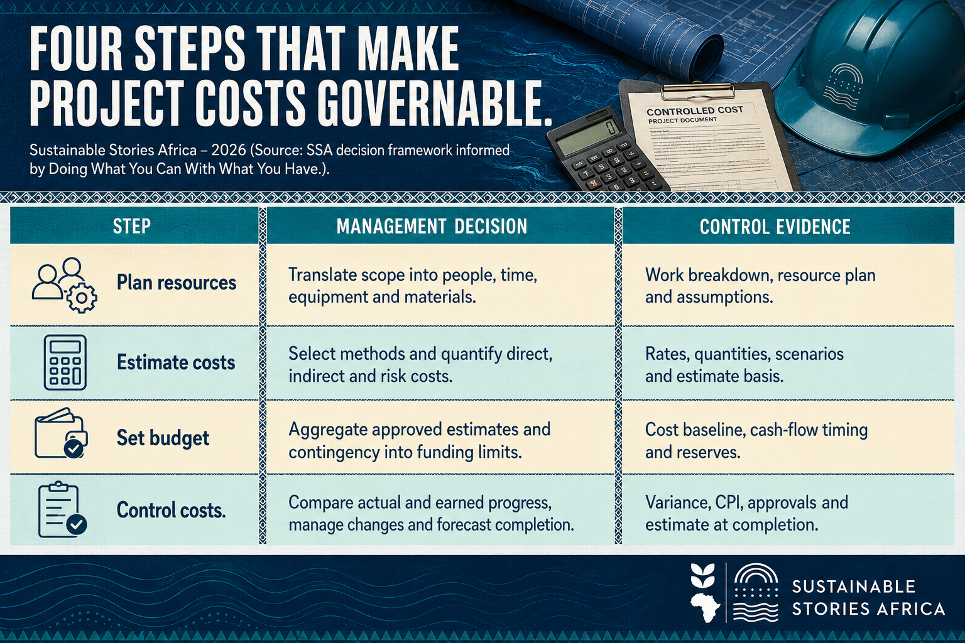
A 2026 project cost guide sets out four steps: plan resources, estimate costs, determine the budget and control spending.
For African infrastructure and growing businesses, disciplined baselines can protect scarce capital and public trust.
Cost Control Starts With Project Definition
Project cost problems often become visible when invoices exceed expectations. According to a FinPolNomics Accounting & Finance Nugget, the underlying failure usually begins earlier:
- Unclear scope.
- Incomplete resource planning.
- Optimistic estimates
- Changes made without approval.
By the time finance reports the variance, much of the cost has already been committed.
Clockify’s 2026 guide defines project cost management as the continuous process of predicting, budgeting and managing project expenses.
It organises the work into four stages: plan resources, estimate costs, determine the cost budget and control costs.
The sequence turns cost management from retrospective accounting into a management system.
This is especially important where capital is scarce, and inflation, exchange rates or supply disruption can quickly change assumptions.
- A project that overruns may delay other investments, reduce service quality or require emergency finance.
- Strong cost management therefore supports financial sustainability, delivery credibility and governance.
Resource Plans Convert Scope Into Money
A cost estimate cannot be stronger than the scope beneath it.
- Teams should break deliverables into manageable work, identify people, skills, equipment, materials, software, time and dependencies, then connect each resource to a schedule.
- The work breakdown structure provides the bridge between what must be delivered and what it should cost.
Costs should be classified deliberately.
- Direct costs relate to delivery; indirect costs support the organisation; fixed costs remain stable over a relevant range; variable costs change with activity; and sunk costs have already been incurred and should not distort future choices.
- Opportunity and contingency costs also matter even when they do not appear as ordinary invoice lines.
Historical data improves estimates, but teams must adjust for changed conditions.
Comparable projects can support analogous estimates; measurable cost drivers enable parametric estimates; defined tasks support bottom-up estimates; and three-point estimates make uncertainty visible by considering optimistic, most-likely and pessimistic outcomes.
Budget And Baseline Serve Different Purposes
The cost budget represents total planned funding, including approved reserves. The cost baseline is the time-phased, approved plan used to measure performance.
Confusing them can make a project appear healthy simply because unused contingency remains, even when core work is inefficient.
A credible baseline should be approved only after scope, schedule and estimate assumptions are sufficiently defined.
- It should show when costs are expected, not only the final total.
- This supports cash planning and makes delayed procurement or front-loaded spending visible.
Contingency should be linked to identified uncertainty, not treated as a pool for uncontrolled changes.
Management reserves can address unknown risks at programme level, while project contingency covers defined uncertainty within scope .
Governance should state who can release each reserve and what evidence is required.
Baseline changes should be rare and traceable. If every adverse variance is absorbed by rewriting the plan, the organisation loses its ability to learn from estimating errors.
Approved scope changes may justify rebaselining, but performance before the change should remain visible.
Variance Data Must Trigger Timely Decisions
Cost control compares what the project planned, what it spent and what it delivered.
Earned value management provides a structured language.
- Cost variance equals earned value minus actual cost.
- The cost performance index divides earned value by actual cost
- A result below one indicates that the project is receiving less value than each unit of cost planned.
Schedule signals matter because delays often produce cost.
- The schedule performance index divides earned value by planned value.
- Project managers should use these indicators alongside operational evidence, since poor progress measurement can make precise formulas misleading.
Reports need decision thresholds.
- Small variance may be monitored;
- A larger one may require forecast revision, scope change, recovery action or escalation.
Weekly reviews can be appropriate for fast-moving work, while monthly governance may suit larger programmes.
The cadence should match how quickly costs can become irreversible.
Forecasting matters more than explaining last month. Estimate at completion should combine actual spending, remaining scope, current efficiency and known risks.
A project can be within budget today yet forecast to overrun because commitments or productivity trends have changed.
African Projects Need Currency And Integrity Controls
Projects that depend on imported equipment or foreign-currency contracts need explicit exchange-rate assumptions and sensitivity analysis.
- Long procurement lead times, port delays, security costs and unreliable power can also affect estimates.
- Treating these factors as surprises weakens accountability.
Change control transparency is equally important.
- Every material variation should state the reason, cost, schedule effect, funding source and approving authority.
- Procurement data should connect commitments, deliveries, invoices and progress so managers can detect duplicate costs, premature payments and unexplained quantity changes.
Public projects carry a wider obligation.
- Cost overruns can reduce the services delivered for each unit of public money and erode trust.
- Publishing baselines, approved changes and completion forecasts can strengthen scrutiny where commercial confidentiality permits.
Community and environmental commitments must be costed from the start.
- Compensation, restoration, safety and stakeholder engagement are not external extras to be removed when budgets tighten.
- Excluding them from estimates creates both financial and social liabilities later.
Path Forward – Manage Cost As Evidence
Project teams should connect scope, resources, schedule, estimates and risk before approving a baseline.
Actual costs must be compared with verified progress, not invoices alone.
For African businesses and public institutions, currency assumptions, procurement controls and transparent change approval are essential.
Good cost management protects margins and budgets, but its greater value is making delivery decisions earlier, clearer and more accountable.