
Effective amendments and IFRS 18 comparative requirements force finance teams to redesign data, controls and performance communication.
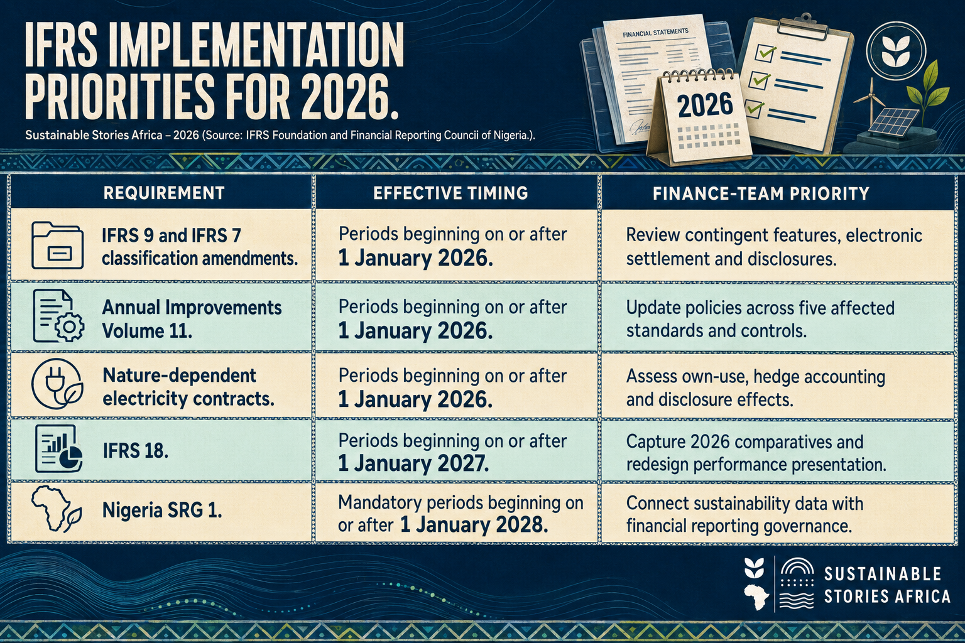
Several IFRS amendments became effective on 1 January 2026, while IFRS 18 will replace IAS 1 from 2027 and require the preceding-year comparative amounts.
That makes 2026 an implementation year, not a waiting period.
African finance teams must align accounting policy, transaction coding, systems, controls and investor communication before year-end figures become transition evidence.
Reporting Change Has Already Entered Ledgers
The financial reporting timetable changed on 1 January 2026.
Amendments to IFRS 9 and IFRS 7 on the classification and measurement of financial instruments became effective, alongside Annual Improvements Volume 11 and requirements for contracts referencing nature-dependent electricity.
At the same time, companies began generating the comparative information that will appear when IFRS 18 becomes mandatory in 2027.
This combination makes 2026 a bridge year. Some requirements apply now; others will determine how current-year information must be presented in the future.
Finance teams that wait for the 2027 reporting cycle may discover that their chart of accounts, consolidation systems and management reports did not capture the information needed to restate comparatives efficiently.
The changes affect more than compliance.
- Classification can change measurement and volatility.
- New presentation rules can alter how users see operating, investing and financing performance.
- Disclosures around management-defined performance measures will require companies to reconcile the metrics used in public communication with audited financial statements.
Financial Instruments Need Fresh Classification Reviews
The IASB’s May 2024 amendments to IFRS 9 and IFRS 7 address financial liabilities settled through electronic payment systems, contractual cash-flow characteristics and related disclosures.
The Board specifically responded to the growth of loans with environmental, social and governance-linked features.
Entities should identify instruments with contingent features and test whether contractual payments remain consistent with the standard’s classification requirements.
The exercise should include loan books, investments, supplier finance and treasury arrangements, not only instruments labelled as sustainable.
Annual Improvements Volume 11 also amended IFRS 1, IFRS 7, IFRS 9, IFRS 10 and IAS 7.
Individually, annual improvements may appear narrow, but they can affect policy wording, disclosure checklists and consolidation or cash-flow processes.
A controlled implementation register should state the owner, affected accounts, and systems, transition method and audit evidence for every amendment.
IFRS 18 Reshapes Corporate Performance Communication Now
IFRS 18 Presentation and Disclosure in Financial Statements is effective for annual periods beginning on or after 1 January 2027, with earlier application permitted.
It replaces IAS 1 and focuses particularly on the statement of profit or loss. The standard introduces defined categories and requires subtotals intended to improve comparability.
It also brings discipline to management-defined performance measures, subtotals of income and expenses used in public communications outside the financial statements that meet the definition.
Companies will need transparent disclosures and reconciliations. Measures used in investor presentations, annual reports and earnings releases should therefore be inventoried now.
The operational challenge is mapping.
- Transactions currently aggregated under internal reporting lines may need to be classified differently for statutory reporting.
- Companies should test their chart of accounts, allocation rules and consolidation adjustments using 2026 data, then compare the new presentation with covenants, remuneration metrics and market guidance.
Investor relations teams must be involved because the new subtotals may not align neatly with familiar alternative performance measures.
Early mock statements can reveal which explanations are necessary and prevent last-minute changes that confuse analysts, lenders or employees whose incentives depend on reported metrics.
African Markets Carry Additional Transition Risks
African groups often report across multiple currencies, regulatory systems and subsidiaries with uneven data maturity.
- Restricted currency convertibility, inflation, manual journals and older enterprise systems can make implementation more complex.
- A group-level policy is insufficient if local teams cannot produce the required data consistently.
Banks and financial institutions should prioritise the IFRS 9 amendments;
- Because classification, expected credit-loss processes and disclosures are closely connected to risk systems.
Energy-intensive companies and power buyers should examine nature-dependent electricity contracts.
Listed and public-interest entities should also align accounting changes with growing requirements for sustainability disclosure.
Nigeria’s Sustainability Reporting Guideline 1 sets mandatory adoption for accounting periods beginning on or after 1 January 2028.
Although IFRS Accounting Standards and ISSB disclosure standards are distinct, they depend on common governance: reliable data, documented judgements, control ownership, and board oversight.
Parallel implementation can reduce duplicate systems and conflicting narratives.
Smaller subsidiaries should not be left until consolidation.
Group reporting instructions need worked examples, materiality guidance and a route for local questions.
Central teams should track where spreadsheets or manual journals create control risk and prioritise remediation before comparative data is locked.
Finance Leaders Need Controlled Implementation Now
CFOs should establish a cross-functional programme involving accounting policy, tax, treasury, investor relations, sustainability, risk, information technology and internal audit.
- The workplan should cover gap analysis, data mapping, system changes, mock statements, comparative restatement, controls, training and audit engagement.
Boards and audit committees need milestones rather than generic readiness updates.
- Useful evidence includes the percentage of instruments reviewed, accounts mapped, measures inventoried, controls designed and trial reports completed.
Communication plans should explain changes in presentation without implying that accounting reclassification necessarily reflects a change in underlying economics.
External auditors should be engaged on judgements and evidence before year-end, while management retains ownership of interpretation.
Internal audit can review programme governance, data lineage and control design.
This division of responsibilities reduces the risk that implementation becomes an auditor-led exercise with weak internal capability.
Path Forward – Treat Comparatives As Live Data
Finance teams should use 2026 closes to test IFRS 18 mapping while implementing amendments already effective.
Policies, systems and controls must produce an auditable trail.
African entities should connect accounting and sustainability reporting governance, train local teams and involve audit committees early.
The goal is not only technical compliance, but clearer, more comparable communication of performance and risk.