Capital is not Africa's only energy-financing constraint. At Asharami Square 3.0 in Lagos, financiers, regulators and journalism leaders argued that domestic money can move when projects are prepared, risks are disclosed, and contracts are trusted.
The panel's message was equally direct for the media: follow the money beyond announcements.
Evidence-led reporting can expose weak links, explain reforms and show communities whether promised investment is delivering reliable power.
Africa's Energy Capital Needs Trusted Pathways
At Asharami Square 3.0 in Lagos, the answer to a deceptively simple question who is financing Africa's energy future? did not begin in London, New York or Beijing.
It began with domestic balance sheets, pension savings, state bonds and the credibility of the institutions asking investors to commit money for decades.
The panel discussions brought together Kemi Awodein, Managing Director, Investment Banking at Chapel Hill Denham; Temitope George, Chief Executive Officer of the Lagos State Electricity Regulatory Commission; and Professor Abigail Ogwezzy-Ndisika, Director of the Institute of Continuing Education at the University of Lagos. Adebiyi Olusolape, Associate Editor, Africa at Argus Media, moderated the discussion.
Their shared conclusion was clear: Africa does not face only a shortage of capital.
It also faces a shortage of investment-ready projects, predictable rules and reporting capable of testing claims against lived outcomes.
Domestic Money Exists, But Confidence Lags
Awodein challenged the assumption that transformational infrastructure must always depend on foreign finance.
Large energy projects often have dollar-based costs, making foreign capital important; however, Nigeria's domestic market has already shown that it can mobilise money at scale.
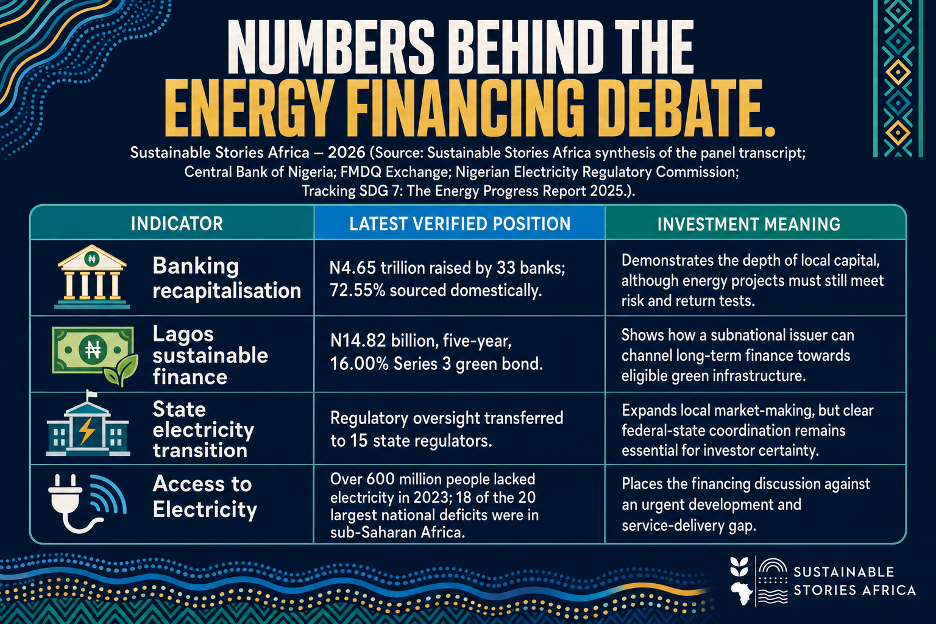
The Central Bank of Nigeria said banks raised N4.65 trillion during the 2024 - 2026 Banking recapitalisation programme.
Of that amount, 72.55% came from domestic investors. The figure does not mean the money is automatically available for energy projects, but it proves Awodein's central point: "There is money domestically."
The harder question is what makes long-term investors willing to deploy it. Awodein identified asset managers, insurers, pension funds, high-net-worth individuals and other institutions as potential holders of infrastructure-linked securities.
However, pension funds, she said, will look for governance, discipline and compliance before committing retirement savings.
Lagos State's bond programme shows how public issuers can diversify funding sources.
In February 2026, FMDQ Exchange listed the state's ₦14.82 billion five-year green bond alongside a N230 billion conventional bond.
The green proceeds were earmarked for eligible uses including renewable energy, energy efficiency, clean transport, water management and climate resilience.
The lesson is not that every project needs a green label. Credible instruments can connect sustainability priorities with local portfolios.
Bankable Projects Start Before Investors Arrive
For George, successful public-private partnerships begin with "preparation and trust." When a developer proposes a large power project, the regulator's first questions concern feasibility, evacuation, commercial assumptions and execution.
Ambition without those answers cannot become a financeable asset.
Trust is equally practical.
- Investors want clear policies, consistent regulation and confidence that contracts will survive a change of government.
Nigeria's Electricity Act 2023 has opened intrastate markets to state-level regulation, while the Nigerian Electricity Regulatory Commission has formally transferred oversight to 15 states.
- That decentralisation creates new opportunities, but transition arrangements, asset delineation and the boundary between federal and state authority must remain intelligible to investors.
Awodein added a project-level checklist: sound governance, disciplined management, identified risks, credible mitigants, independent research, external ratings and an investor story that can withstand scrutiny.
The right adviser can help, but no adviser can substitute for weak fundamentals.
Evidence-Led Journalism Can Strengthen Investment Decisions
Ogwezzy-Ndisika widened the financing debate beyond balance sheets. Capital follows confidence, and confidence depends partly on whether citizens and investors can trust the information surrounding projects.
She urged journalists to combine desk research with field observation and interviews, then triangulate corporate reports, public records and community testimony.
Her example of a multi-month energy investigation showed what this looks like in practice: water sampling, environmental testing, checks on corporate files and concession licences, comparisons between budget allocations and physical delivery, and interviews with affected communities.
The resulting evidence prompted oversight and remediation. Her point was constructive: strong journalism does not exist to close responsible businesses; it helps expose gaps that companies and regulators can fix.
This is also a warning against mistaking volume for insight. "Length does not equate depth," she said.
Energy reporting should explain what deregulation means for entry, pricing and accountability; follow financial disclosures; test how investors expect to recover capital; and connect macroeconomic policy to household experience.
Maps, photographs, infographics and primary data can make complex transactions visible without burying readers in jargon.
For energy developers, this level of scrutiny can initially feel uncomfortable.
However, independent analysis can also lower information risk, distinguish credible projects from greenwashing and make the case for investment more believable.
Clear Rules Must Outlast Political Cycles
The panel's action agenda starts with government.
- Regulators should publish clear transition maps, resolve overlaps between national and state institutions, establish maintenance expectations for ageing infrastructure and communicate how consumer protection will be enforced.
- Public authorities must also honour contracts and use dispute-resolution clauses suited to long-term commercial agreements.
George pointed to negotiation, mediation and arbitration as routes for dispute resolution without years of litigation.
- Developers must do more before entering the market: complete feasibility and evacuation studies, disclose risks, secure credible ratings where appropriate and build governance systems that institutional investors can assess.
- Pension funds and insurers, within their prudential rules, can then evaluate a broader pipeline of infrastructure and sustainable-finance instruments rather than treating the sector as automatically uninvestable.
Newsrooms have obligations too.
- Editors should fund investigations that extend beyond event coverage, while reporters should examine balance sheets, permits, contracts, project sites and community outcomes.
The Asharami Square Energy Reporting Fellowship is a great starting point in closing this capacity gap by supporting evidence-led, solutions-focused energy journalism.
Finally, the talent pipeline must broaden.
- The panel linked stronger participation by women and young people to education, purposeful use of technology, workplace safeguarding, mentorship and sponsorship.
- Energy finance and journalism both need diverse professionals who can interpret markets, challenge weak assumptions and bring overlooked community experiences into decision-making.
PATH FORWARD – Trust Must Become Africa's Financeable Infrastructure
Africa's energy finance agenda now needs three linked disciplines: prepare projects until their risks can be priced, stabilise rules until contracts can be trusted, and create instruments that match local capital with long-term infrastructure.
Developers, regulators, institutional investors and newsrooms must move together.
Transparent disclosures, credible ratings, coordinated state regulation, protected investigative budgets and inclusive talent pipelines can turn domestic savings into reliable power - and ensure communities can see where the money goes.