A Banque de France study finds that acute heatwaves and chronic warming both reduce bank lending to smaller firms, but through different sectors and time horizons.
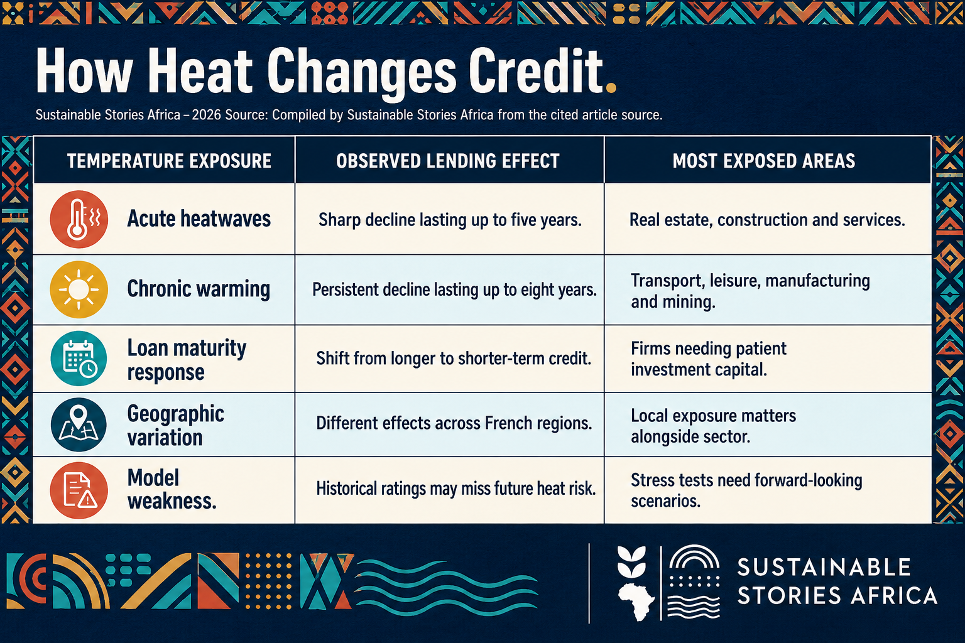
Acute shocks can depress credit for five years; chronic heat effects can persist for eight.
The findings show how physical climate risk reaches the real economy through loan supply, maturity and investment.
Heat Now Changes The Price Of Credit
Heatwaves do more than reduce productivity or strain electricity systems.
They also change the amount and duration of credit available to businesses, according to a Banque de France study showing that acute heat shocks and long-term warming significantly reduce loan growth for French micro, small and medium-sized enterprises.
The findings place temperature inside the credit channel.
Acute shocks produce sharp declines lasting up to five years, while chronic warming is associated with persistent effects lasting as long as eight years.
Different Sectors Carry Different Heat Burdens
Banque de France research director Oliver de Bandt and Université Paris-Est Créteil economist Skander Maraoui used granular risk-register data to separate acute and chronic temperature effects.
Transport, leisure, manufacturing and mining were affected by both. Real estate, construction and services were more exposed to acute heat.
Banks did not always stop lending. In some sectors they shifted portfolios toward shorter maturities, limiting long-term exposure amid uncertainty.
That response can still reshape investment: firms may struggle to finance equipment, buildings or expansion when available credit becomes shorter.
The study also challenges backwards-looking credit assessment.
Historical ratings may miss future temperature exposure, while local impacts vary, from overheated construction sites to ski economies losing dependable snow.
Better Models Can Keep Adaptation Investable
Granular climate-risk models can distinguish vulnerable firms from those investing in cooling, water efficiency, resilient buildings and business continuity.
That distinction matters because blanket credit withdrawal can worsen vulnerability by starving adaptation of finance.
The implications for Africa are significant. Heat already affects outdoor labour, agriculture, transport and urban services, while small businesses often have thinner financial buffers.
If banks shorten maturities without recognising adaptation, climate risk can become a self-reinforcing credit constraint.
Heat Finance Needs Better Evidence
Applying the French findings in Africa requires care because credit markets, firm informality and climate exposure differ.
However, the mechanism is plausible: heat lowers productivity, disrupts customers and raises operating costs, while lenders respond to weaker cash flows and uncertainty.
The businesses most affected may also have the least access to long-term finance for cooling and resilience.
- African banks can begin with portfolio heat maps using location, sector and loan tenor, then improve them as hazard and borrower data develop.
- Development finance institutions can share risk for investments such as efficient cooling, water systems, building retrofits and resilient logistics.
The policy goal should be to prevent a temperature shock from becoming a persistent investment drought.
Reward Resilience Inside Credit Assessment
- Supervisors should require scenario analysis that distinguishes acute shocks from chronic warming and reflects sector, geography and loan maturity.
- Banks should collect forward-looking exposure data and incorporate credible adaptation investment into underwriting.
- Governments and development lenders can help by improving climate data, supporting resilience standards and sharing risk for adaptation loans.
The objective should be accurate pricing, rather than indiscriminate exclusion.
Path Forward – Keep Climate Risk From Becoming Exclusion
Heat belongs in stress tests and credit models, but resilience must belong there too. Otherwise, banks may protect short-term portfolios while weakening firms’ capacity to adapt.
The better pathway is granular assessment, longer-term climate data and finance that rewards verified resilience. That approach can protect balance sheets without closing the door on the businesses most exposed to a warming economy.
Culled From: Banks lend less during heatwaves, Banque de France study finds - Green Central Banking