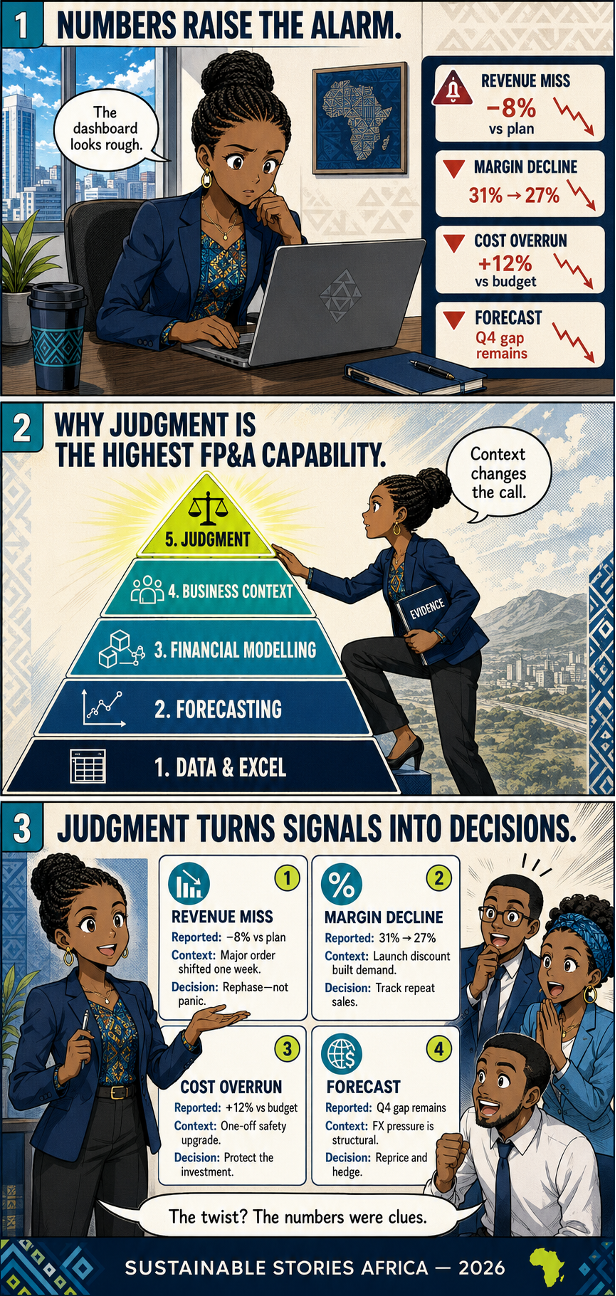
FinPolNomics argues that FP&A’s hardest skill is not Excel but judgment. Models calculate; judgment separates noise from signal, challenges assumptions and turns financial movements into decisions.
For African companies facing volatile demand, currency pressure and shifting costs, that distinction matters. Better judgment can prevent panic, improve forecasts and help leaders protect value without cutting the wrong cost or mistaking temporary disruption for structural weakness.
The Decision Gap Behind Every Number
Financial planning and analysis teams often build confidence around technical tools: spreadsheets, forecasting systems, dashboards and financial models.
These capabilities are essential because they organise information, test assumptions and make complex performance trends easier to see.
However, FinPolNomics’ capability pyramid makes a sharper argument: the most difficult FP&A skill is judgment.
- A spreadsheet can report that revenue is down, margins have narrowed, or spending is above budget.
- It cannot, by itself, decide whether the movement is temporary, structural, strategic or dangerous.
That distinction is especially important across African markets, where companies may contend with inflation, currency pressure, policy changes, logistics disruption and incomplete data at the same time.
In such conditions, judgment is not a soft extra. It is the bridge between analysis and action.
Judgment Turns Financial Analysis Into Decisions
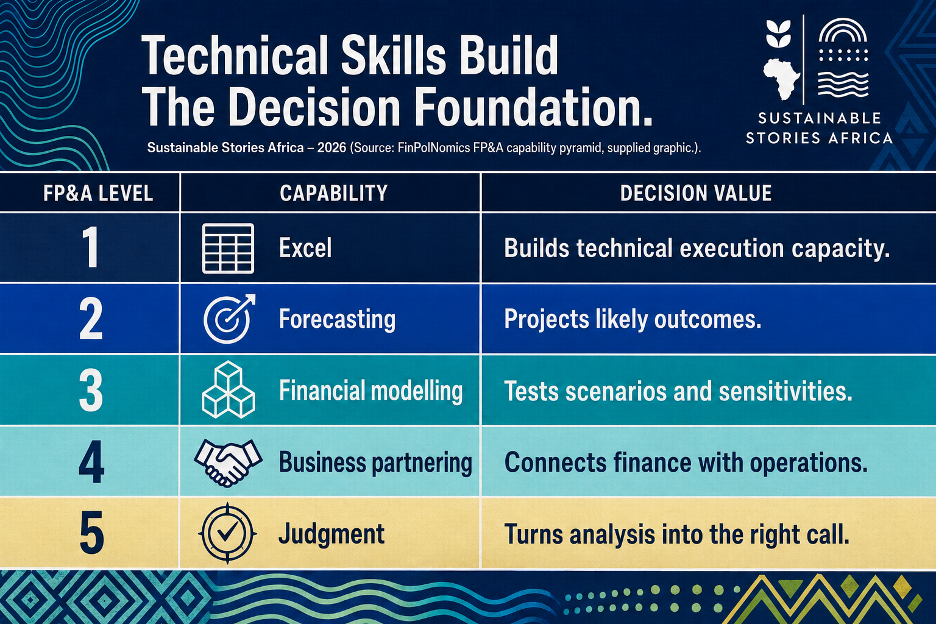
FinPolNomics positions Excel at the base of a five-level pyramid, progressing through forecasting, financial modelling and business partnering to judgment.
The hierarchy does not downplay technical competence; it shows how each capability gains value when it guides action.
Excel enables execution, project forecasting, project outcomes, and modelling test scenarios; business partnering connects financial analysis to commercial and operational realities.
Judgment integrates these layers to answer management’s question: what should happen next?
Judgment means separating signal from noise, challenging assumptions, understanding context, focusing on material issues and making sound calls amid uncertainty.
It moves FP&A beyond producing schedules towards decision support.
The framework highlights a weakness: analysts may explain variances without assessing their cause, materiality or duration.
Judgment begins where calculation ends, testing whether movements reflect business fundamentals or timing distortions, identifying outdated assumptions, and determining which response protects or creates value.
Four Cases Show Why Context Matters
FinPolNomics uses four short cases to show how context reshapes financial interpretation.
- In the first, an 8% revenue drop and falling volumes initially suggest weakening demand, but the real cause is a large customer order slipping into the next month. Judgment avoids overreaction while still confirming the order and any cash-flow impact.
- The second case sees margin fall from 42% to 38%, which could signal pricing weakness. However, this decline reflects a deliberate low-margin product launch. Finance must verify the launch economics without triggering an automatic margin-recovery response that could undermine strategy.
- In the third, marketing spend runs 20% above budget, yet drives sales 35% above forecast. The key question is not the overspend itself, but whether the return justifies the cost and whether it is repeatable.
- The fourth case involves 15% sales growth, with forecasts assuming continued momentum. Context reveals a single-time promotion ending soon, meaning the trend should not be extended.
Across all four cases, judgment corrects assumptions before optimism becomes a planning error.
Forecasts Improve When Assumptions Face Pressure
Forecasting is not the mechanical extension of recent performance. It is a structured argument about what is likely to happen and why.
The most useful FP&A professionals therefore make assumptions visible, test their sensitivity and update them when the operating environment changes.
For African businesses, this discipline can be decisive.
- Exchange-rate movements may alter imported input costs.
- Inflation may lift nominal revenue while weakening real demand.
A single-point forecast can conceal these risks.
- Policy changes can reshape taxes, tariffs or market access.
- Logistics shocks can move sales between periods without changing underlying customer appetite.
Judgment improves the forecast by distinguishing a base case from downside and upside scenarios, assigning clear triggers to each and identifying which assumptions management can influence.
It also makes uncertainty discussable. Leaders do not need false precision; they need a credible range, an explanation of the main drivers and a plan for responding as evidence changes.
Better Judgment Creates Measurable Business Value
When finance separates signal from noise, the benefit extends beyond the forecast. Management is less likely to cut a productive investment, overreact to a timing difference or treat a promotional spike as permanent growth.
Capital allocation improves because costs are aligned to outcomes, rather than judged against static budgets.
The relationship between finance and the wider business can also strengthen.
- Operational leaders are more likely to trust an FP&A team that understands customers, products and execution constraints.
- Finance, in turn, gains better information because commercial teams see it as a decision partner rather than a reporting gatekeeper.
Judgment does not remove accountability or excuse weak performance. It makes accountability more intelligent.
- A revenue delay must still be investigated.
- A lower-margin launch must meet its strategic objectives
- Overspending must generate an acceptable return
- One-off growth must be removed from the recurring forecast.
Context sharpens scrutiny rather than weakening it.
Finance Teams Can Train Decision Quality
Judgment may be difficult to automate; however, it can be developed deliberately.
- Teams can run forecast post-mortems to compare assumptions with actual outcomes, review decisions after results are known and maintain logs that record what management expected, what changed and why.
Analysts should also spend time with sales, operations, procurement and product teams.
- Business immersion gives numbers meaning.
- Scenario reviews can then test how currency, demand, pricing, supply disruption or policy changes would affect cash, margins and investment choices.
Managers can reinforce their skill by asking better questions.
- What is driving the variance?
- Is it recurring?
- What evidence would change the conclusion?
- Which assumption carries the greatest risk?
- What action is reversible, and what decision cannot easily be undone?
These questions teach analysts to communicate a recommendation, its evidence and its limits.
Forecast accuracy should be tracked but not used as a blunt scorecard. Teams should examine the direction and size of errors, identify recurring bias and distinguish controllable mistakes from genuine shocks.
The objective is learning: each cycle should improve the organisation’s ability to interpret uncertainty and respond without losing strategic focus.
Path Forward – Build Analysts Who Decide Better
FP&A leaders should invest in judgment as deliberately as they invest in models. That means combining technical training with business exposure, scenario work, decision reviews and clear accountability for assumptions.
For African companies navigating volatility, the payoff is practical: steadier forecasts, fewer reactionary decisions, better capital allocation and stronger trust between finance and operations.
Technical skills help teams analyse; judgment helps organisations decide.