
A UK board briefing shows why resilience, insurability and access to capital now belong in core governance.
Flood, heat, drought and wildfire are moving from sustainability reports into balance sheets, insurance negotiations and board accountability.
A 2026 briefing from WBCSD, Chapter Zero and CMS provides directors with a practical governance framework.
It offers African companies a warning about risks that often travel through global supply chains before appearing locally.
Climate Hazards Have Become Financial Risks
Physical climate risk becomes a governance issue when weather and nature loss affect operations, valuation, insurability, labour productivity, supply continuity or the cost of capital.
That is the message of Physical Risk and Board Accountability in the UK: The Cost of Inaction, published in June 2026 by the World Business Council for Sustainable Development with Chapter Zero and law firm CMS.
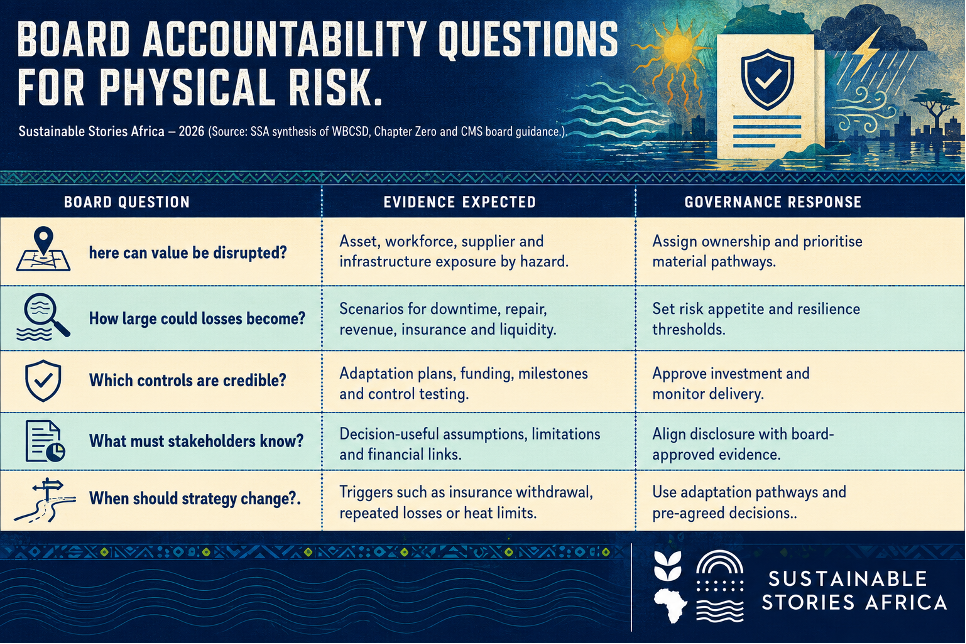
The briefing moves the subject beyond a narrow environmental remit. It says directors must understand exposure, strengthen oversight, embed risk into decisions, respond to stakeholder expectations and protect long-term performance.
Under the UK Companies Act 2006, the document places this work within directors’ existing responsibilities rather than presenting it as a separate voluntary agenda.
The timing is significant. The UK’s climate risk evidence base describes warmer, wetter winters, hotter summers and rising threats to property, agriculture and infrastructure. A July 2026 UK government analysis, citing the Office for Budget Responsibility, said damage to physical assets and lower labour productivity could reduce gross domestic product by 3% to 4% in 2050 under current policy trajectories, deepening to 7% to 8% by 2070.
Boards Need Evidence Beyond Hazard Maps
A hazard map shows where flooding or heat may occur; it does not show how a business fails.
Boards need to connect hazards to critical sites, workers, customers, suppliers, utilities, logistics routes, insurance contracts and financing.
A flooded supplier can halt production far from the damaged site. Heat can reduce output before it destroys an asset.
Drought can affect water availability, energy generation and community consent all at once.
The board’s first task is therefore to identify pathways to financial impact.
- That means testing revenue interruption, repair costs, working-capital needs, covenant headroom, insurance exclusions and capital expenditure.
- Scenario analysis should use several warming and time horizons; however, it should also reveal practical decisions: which assets need protection, which suppliers need alternatives and which investments cannot be delayed.
Data gaps are not a reason to wait. The board can require management to distinguish what is measured, estimated and unknown, then create a plan to close priority gaps.
This is more defensible than presenting a false level of precision or keeping the issue outside mainstream risk management.
Insurability Can Become A Strategic Corporate Constraint
Insurance is often treated as the final control, yet premiums, deductibles, exclusions and withdrawal can change faster than physical assets.
- A facility may remain technically operational while becoming economically difficult to insure or finance.
- Boards need early engagement with insurers and lenders to understand which data and adaptation measures preserve access.
This creates a strong business case for resilience investment. Flood barriers, cooling, water efficiency, diversified supply, maintenance and nature-based solutions can reduce expected losses and improve continuity.
The board should compare the cost of adaptation with downtime avoidance and capital effects, not only with the probability of physical damage.
Investor expectations also matter.
- Chapter Zero’s launch page notes that investors and banks increasingly seek good data and effective adaptation plans before making investment or lending decisions.
- The companies able to explain their exposure and show funded action may gain a competitive advantage over peers that disclose hazards without a response.
Insurance conversations can also reveal control weaknesses.
- Repeated claims, outdated asset values and incomplete business interruption analysis may indicate that risk ownership is fragmented.
- Boards should use renewal discussions as a stress test of resilience evidence, while recognising that insurance transfers only part of the financial loss.
African Supply Chains Share This Exposure
Although the briefing focuses on UK directors, the exposure is international. UK-listed companies may depend on African mines, farms, ports, factories and service centres.
Physical disruption by those locations can affect group earnings and create pressure for better supplier data, contractual resilience and evidence of adaptation.
African boards face the same hazards with fewer buffers in many markets.
- Insurance penetration can be lower, infrastructure redundancy weaker and public emergency capacity constrained.
The answer is not to copy a UK checklist without context.
- It is to connect enterprise risk management with local climate data, community knowledge, infrastructure dependencies and realistic financing.
This also creates an equity question.
- A resilience decision that protects a company while shifting water scarcity, flood exposure or costs onto communities is not sustainable.
Boards should prioritise worker safety, vulnerable groups and ecosystem dependencies when judging whether an adaptation measure is effective.
Local knowledge can improve formal models.
- Farmers, transport operators, municipal officials and workers may observe drainage failure, heat stress or seasonal water changes before corporate datasets capture them.
Engagement processes should record this evidence and show how it influenced the board’s assessment and investment priorities.
Directors Must Turn Oversight Into Action
Boards should set a clear mandate, assign committee responsibilities and require management to integrate physical risk into strategy, capital allocation, procurement, insurance and disclosure.
- Material investments should include climate assumptions, while major acquisitions and long-lived assets should be tested against future conditions.
A useful board dashboard tracks exposure, incidents, insured and uninsured losses, adaptation spending, critical supplier coverage and overdue actions.
- Assurance should test the underlying data and whether announced plans are actually funded.
- The board’s role is not to predict every hazard; it is to ensure the organisation can make timely decisions as evidence changes.
Remuneration and performance management should reinforce this mandate.
- Executives should not be rewarded for short-term cost reductions that defer essential maintenance or increase exposure.
- Conversely, resilience investment should be evaluated against service continuity and avoided loss, not treated automatically as an expense with no return.
Path Forward – Govern Resilience Before Losses
Boards should map material physical-risk pathways, fund priority adaptation and define triggers for changing strategy.
Disclosure must connect hazards to financial effects and actions.
For African companies and global groups sourcing from Africa, resilience should include workers, communities and ecosystems.
Strong oversight protects enterprise value only when it also reduces the vulnerabilities on which that value depends.