
PitchBook’s 2025 data reveal a $1.25 trillion market which is increasingly selective about strategy, scale and manager experience.
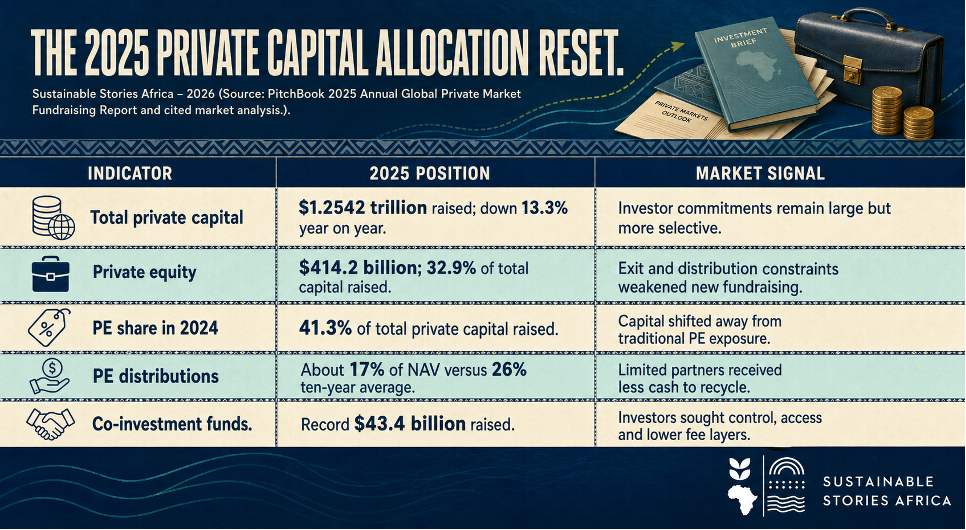
Global private capital fundraising fell 13.3% in 2025 to $1.254 trillion, extending a reset shaped by weak distributions and investor caution.
Real assets and secondaries moved against the decline.
For African managers, the message is sobering: specialised evidence, disciplined fund design and clearer routes to liquidity now matter more than broad growth narratives.
Fundraising Decline Reveals A Liquidity Problem
Private capital did not run out of money in 2025; it became more selective about where the money sits.
PitchBook’s 2025 Annual Global Private Market Fundraising Report recorded $1.2542 trillion raised across private-market strategies, down 13.3% year on year.
Fund counts also declined sharply.
The result reflects a circular pressure.
- Private funds rely on exits to return cash to limited partners, who then make new commitments.
- When portfolio companies remain unsold and distributions slow, investors approach allocation limits and reduce new commitments.
- That pressure is strongest in strategies where capital has been tied up for longer than expected.
Private equity illustrates the reset. It raised $414.2 billion in 2025, its lowest amount since 2018, and accounted for 32.9% of private capital raised, down from 41.3% in 2024.
PitchBook data cited in subsequent market analysis put distributions at about 17% of net asset value, against a ten-year average of 26%.
Secondaries And Real Assets Bucked Declines
Real assets and secondaries were the major exceptions, posting year-on-year gains in capital raised.
Their appeal reflects investor priorities. Infrastructure and other real assets can offer income, inflation linkage and exposure to large transition or resilience needs.
Secondaries can provide liquidity to existing investors and give buyers access to more mature portfolios.
Co-investment funds also raised a record $43.4 billion in 2025, according to PitchBook figures cited by market participants.
These vehicles can reduce fee layers and give investors more targeted exposure, but they also require strong deal selection and timely decision-making.
The shift does not mean risk has disappeared. Infrastructure performance depends on regulation, construction, demand and currency.
- Secondary buyers need reliable valuation and asset information.
- Private credit can offer yield and earlier cash flow, but underwriting discipline becomes more important as borrowers absorb high financing costs.
Experienced Managers Attract Scarcer Investor Commitments Today
When capital is constrained, investors tend to narrow their list of managers.
- Established firms can point to realised exits, institutional systems and repeat relationships.
- Emerging managers may have distinctive access and stronger local knowledge, yet they often have shorter track records and fewer resources for investor reporting.
This concentration can reinforce itself.
- Larger funds receive commitments, gain access to transactions and build performance records that support the next raise.
- New managers must therefore demonstrate a sharper edge: a specific sector, geography, sourcing network, operating capability or impact thesis supported by measurable outcomes.
Fund design is becoming part of that evidence.
- Investors want realistic deployment periods, transparent fees, sensible fund sizes and a credible liquidity path.
- An oversized fund can dilute returns if the opportunity set is too small.
- A vague pan-regional strategy may appear diversified, but it can also signal weak local execution.
Team stability has become another issue for diligence.
- Limited partners assess whether investment, operating and compliance capability will remain through the fund’s life.
- Succession, key-person provisions and economics across senior and emerging professionals can influence whether a manager appears institutionally durable.
African Managers Face A Double Constraint
African private-market managers operate within the global fundraising cycle while also managing local-currency volatility, shallow exit markets, fragmented regulation and smaller transaction pipelines.
International investors may recognise long-term demand for infrastructure, climate solutions and consumer services but still hesitate over liquidity and currency risk.
That makes evidence essential.
- Managers need to show how deals are sourced, how foreign-exchange exposure is allocated, which exit routes are realistic and how portfolio companies will improve governance and cash generation.
- Development finance backing can validate a strategy, but it should not be the only proof of commercial demand.
The 2025 preference for real assets can create openings in renewable power, grids, logistics, water, digital infrastructure and resilient agriculture.
These opportunities require careful construction and political risk allocation.
A credible fund must link impact claims to operating cash flows and define who ultimately pays for the service.
Local institutional capital could improve resilience, but pension and insurance allocation rules, liquidity needs and risk limits vary.
Market development requires investable vehicles, reliable valuation and regulatory clarity rather than pressure to allocate simply because an asset carries an African label.
Fundraising Strategy Must Start With Exits
Managers should design funds backwards from liquidity.
- That means identifying likely buyers, refinancing options, dividend capacity and the governance changes needed before an investment is made.
- Portfolio reporting should connect financial performance with operational and sustainability indicators that could influence valuation.
Limited partners should also examine whether a strategy’s liquidity promise matches its assets.
- Evergreen structures can reduce forced exits but require fair valuation and redemption controls.
- Secondaries can relieve pressure, but they do not fix weak assets. Better market discipline comes from transparent cash flows, realistic marks and aligned incentives.
Capital-raising materials should present downside evidence alongside upside.
- Stress tests for slower exits, weaker currencies, higher refinancing costs and delayed projects show how the manager will protect liquidity.
- A fund that can explain its response before a shock may be more credible than one that relies on a single favourable macroeconomic case.
Path Forward – Prove Value And Liquidity
The fundraising reset rewards managers that can return capital, explain risk and demonstrate a distinctive investment edge. Scale alone is no longer enough.
African funds should pair local access with rigorous governance, currency planning and credible exits.
Capital will follow opportunities where impact is measurable, cash flows are visible, and investors can see a practical route back to liquidity.
PRIMARY AND SUPPORTING SOURCES
PitchBook annual report page • PitchBook report PDF • CFA Institute private markets study