
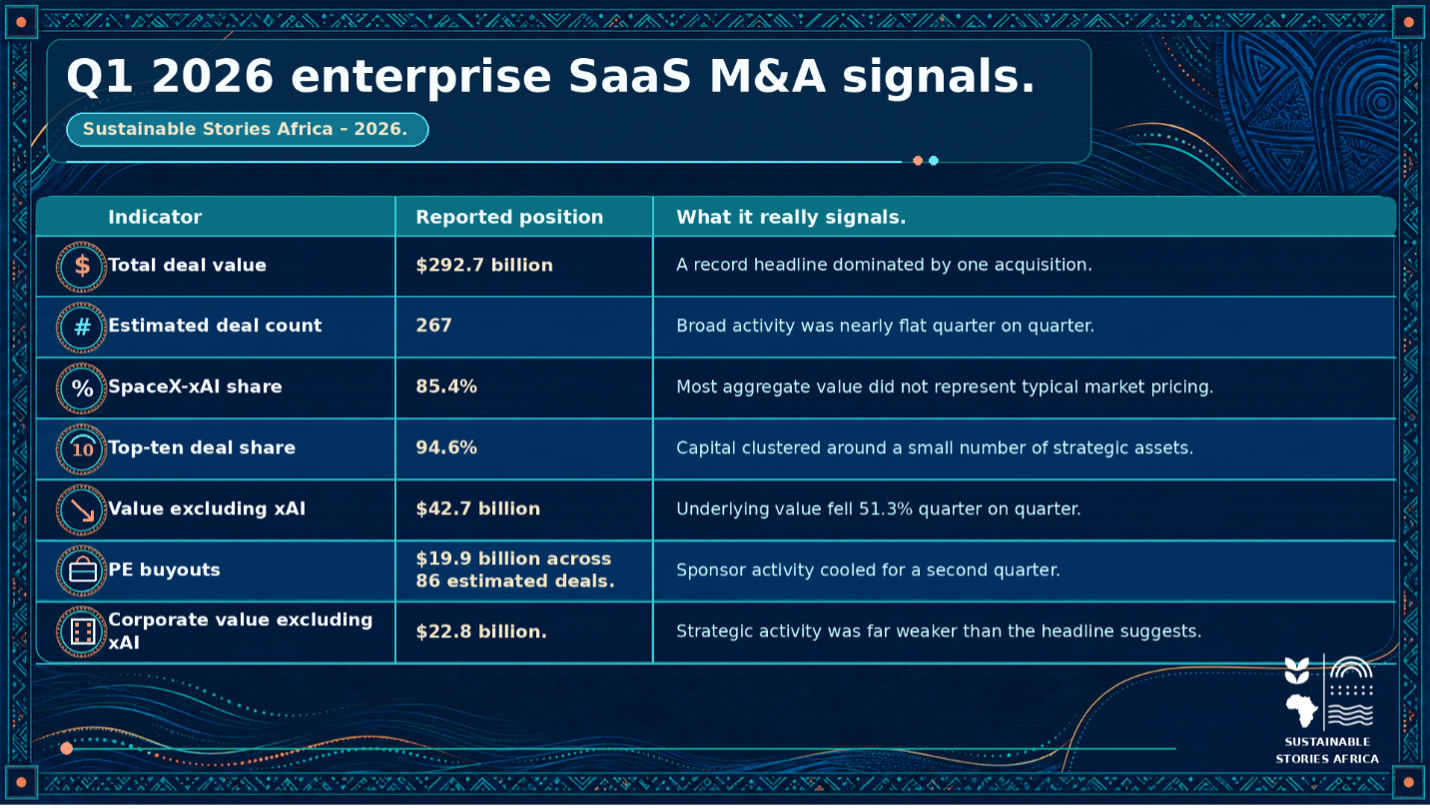
Enterprise SaaS mergers and acquisitions reached a record $292.7 billion in Q1 2026, according to PitchBook.
One transaction, the $250 billion SpaceX acquisition of xAI, created most of that record.
Remove it, and quarterly value falls to $42.7 billion, below every quarter of 2025. The real signal is concentration, rather than a broad boom.
A Record Quarter With One Driver
The headline is spectacular: $292.7 billion of enterprise software-as-a-service M&A across an estimated 267 transactions in the first quarter of 2026.
PitchBook calculates that deal value jumped 233.8% from the previous quarter while estimated deal count slipped only 1%, producing the highest quarterly value in its series.
That figure also exceeded the $286.1 billion recorded across all of 2025 and rose to more than two-and-a-half times the pandemic-era quarterly peak of $113.7 billion in 2021.
At first glance, it announces a market-wide return to aggressive software consolidation.
The appearance is misleading.
- SpaceX’s announced $250 billion acquisition of xAI accounted for 85.4% of the quarter’s total value.
- Excluding that deal, Q1 value was $42.7 billion, down 51.3% quarter on quarter and below every quarter of 2025.
The market was active; however, the record was mostly a single transaction.
One Deal Rewrote The Entire Quarter
Concentration extended beyond xAI. PitchBook counted ten multibillion-dollar deals, including four worth at least $5 billion.
- Together, the top ten accounted for 94.6% of total deal value.
- For the other 169 confirmed transactions, the average disclosed value was a much more modest $94.3 million.
The next largest transaction was the $6.4 billion take-private of corporate performance management provider OneStream by an investor group led by General Atlantic, Hg and Tidemark.
Capital One’s $5.2 billion acquisition of corporate finance platform Brex ranked third. Both deals reinforce buyer appetite for software embedded in financial and operational workflows.
The analytical lesson is simple: totals and medians answer different questions.
A giant transaction can reveal strategic conviction about artificial intelligence, data and platform control; however, it cannot prove that financing conditions or valuations improved for the typical enterprise software company.
Underlying Activity Was Far Less Spectacular
Private equity cooled for a second consecutive quarter.
Buyouts totalled $19.9 billion across an estimated 86 deals, with value down 40.7% and count down 15.2% from the previous quarter.
Three megadeals supplied $13.4 billion, or 67.4%, of PE value. It was the softest PE quarter since Q4 2024.
Corporate acquisitions tell two stories.
- Including xAI, value rose 403.9% to $272.8 billion across an estimated 180 deals, with the count up 7.7%.
- Excluding xAI, corporate value fell 57.8% to $22.8 billion.
The underlying PE-to-corporate value ratio moved nearer to one-to-one, compared with a historical ratio nearer one-to-two.
Target backing produced the same distortion. Venture-backed companies accounted for $265.6 billion, or 90.7% of total value, overwhelmingly because of xAI.
However, they also remained the largest category by count, representing 107 of 179 closed transactions.
The difference between “estimated” transactions and the smaller set of closed, classified deals is important when comparing tables.
Sector detail provides a better picture of where durable demand sits.
- Enterprise resource planning led the count with 67 deals, or 37.4% of classified transactions, and $19.9 billion in value.
- Customer relationship management followed with 36 deals and $6.1 billion.
- Supply-chain management produced only a small share of count, but deal value grew 166.4% year on year even as count fell 46.7%.
At subsegment level;
- Financial management systems led value excluding xAI with $14.6 billion across 17 deals.
- Procurement and sourcing recorded $6.1 billion across five deals, while marketing reached $4.7 billion across 16.
- Manufacturing and operations led the count with 24 transactions but generated only $2.1 billion, showing how frequently acquired categories can carry very different ticket sizes.
Workflow Depth Still Commands Strategic Premiums
Buyers are paying for software that controls essential decisions, data and work.
- Financial management, procurement, customer systems and enterprise search lie close to budgets, compliance, revenue and knowledge.
- Once deeply integrated, these platforms can be difficult to replace and can become distribution channels for AI-enabled automation.
That does not mean adding an AI label guarantees a premium.
- Strategic buyers and sponsors still need evidence that automation improves accuracy, speed, margins or customer retention.
- The strongest assets combine proprietary data, workflow depth, recurring revenue, security and credible product adoption rather than a collection of experimental features.
For operators;
- Consolidation can provide capital, distribution and product breadth. It can also reduce competition, increase vendor dependence and concentrate sensitive enterprise data.
- Boards evaluating acquisitions should therefore examine interoperability, cybersecurity, data rights, customer concentration and the cost of integrating products after the transaction.
The quarter’s record also points to a two-engine market.
- Corporates can pursue transformative acquisitions that reshape a strategic category, while private equity builds platforms through buyouts and add-ons.
- The balance between them may shift with rates, regulation and exit conditions, but both are seeking software with defensible economics and practical AI use cases.
African SaaS Builders Need Exit Readiness
African enterprise software founders should not read the $292.7 billion total as evidence that every SaaS valuation is rising.
- Global buyers will still test annual recurring revenue quality, retention, gross margins, sales efficiency, implementation costs, customer concentration and governance.
- Cross-border acquirers will also examine intellectual-property ownership, data protection, tax structure and contractual enforceability.
Workflow depth offers a clearer route to value.
- Products serving payments, accounting, logistics, procurement, health administration, workforce management or regulatory reporting can become strategic when they solve locally complex problems and integrate into customers’ daily operations.
- The advantage is not “African software” as a label; it is hard-to-replace execution inside a large and growing market.
Founders should prepare a clean data room before an approach arrives.
- That includes audited or reviewable financials, recurring-revenue cohorts, customer contracts, cap tables, employee and contractor IP assignments, privacy records, cybersecurity controls, product roadmaps and evidence that AI features are trained and deployed lawfully.
Investors should separate headline market enthusiasm from company-level readiness.
- Scenario analysis should test valuation with and without strategic premiums, assess integration risk and model slower exit timelines.
- A target’s ability to explain what drives retention and expansion will matter more than a market chart distorted by one transaction.
Policymakers also have a role.
- Predictable data-protection rules, competition enforcement, cross-border payment infrastructure and workable employee-equity regimes can make local software companies easier to scale and acquire without weakening public safeguards.
Path Forward – Read Concentration Before Chasing Market Signals
Q1 2026 was the largest enterprise SaaS M&A quarter on record, but it was not a broad-based valuation boom.
One deal accounted for 85.4% of value, and the underlying market slowed sharply.
Investors and founders should follow the durable signals: workflow depth, financial quality, AI execution, integration readiness and governance.
Aggregate records matter only after concentration is removed.