The world's transition away from fossil fuels now depends as much on wires, storage and flexible demand as it does on new solar panels and wind turbines.
IRENA says annual grid investment must roughly double, while Africa must expand electricity access and modernise networks without importing the congestion and inequity embedded in older energy systems.
The Grid Becomes Transition's Defining Test
The global energy transition has moved into a harder phase. Adding renewable generation remains essential, but the International Renewable Energy Agency says the decisive test is whether electricity networks, storage and end-use technologies can expand quickly enough to turn clean capacity into dependable energy services.
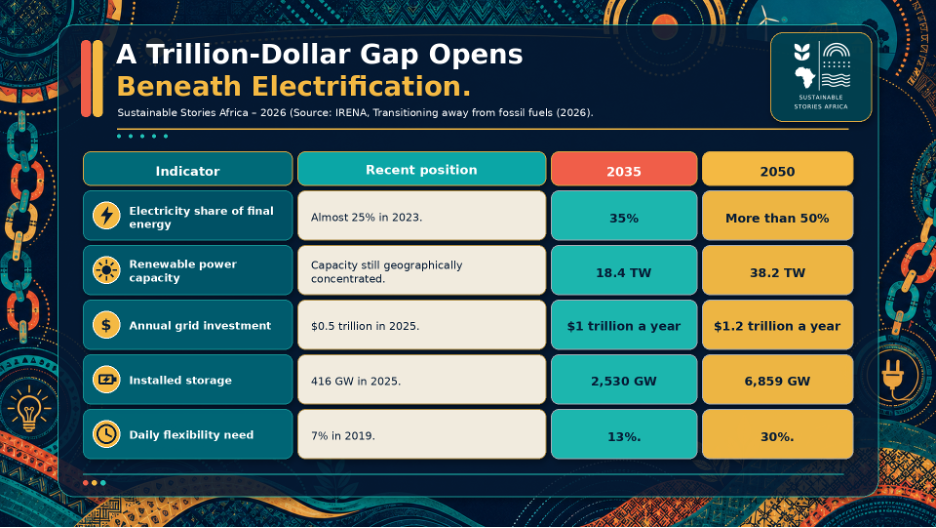
In its 2026 roadmap on transitioning away from fossil fuels, IRENA estimates that electricity must supply 35% of global final energy consumption by 2035 and more than half by 2050.
Meeting that trajectory would require renewable power capacity of about 18.4 terawatts in 2035 and 38.2 terawatts by mid-century, alongside a vast expansion in grid investment and storage.
For Africa, the argument is especially consequential. Electrification is not only a decarbonisation pathway; it is also a route to modern energy access, industrialisation, cooling, mobility and digital growth.
The continent's opportunity is to build systems that are cleaner and more resilient from the outset, but that opportunity will narrow if grids remain the last item financed.
A Trillion-Dollar Gap Opens Beneath Electrification
IRENA's central warning is stark: the physical network is falling behind the transition it is expected to carry.
Around 2,500 gigawatts of mainly wind, solar and storage projects are already waiting in grid connection queues worldwide.
Renewable plants can often be developed faster than transmission lines can be planned, permitted and built, creating a widening mismatch between generation ambition and delivery capacity.
The agency says average annual global grid investment must rise from about $0.5 trillion in 2025 to $1 trillion yearly during 2026 - 2035, and then to $1.2 trillion annually during 2036 - 2050.
Cumulative investment would reach $10 trillion by 2035 and $29 trillion by 2050. Without that capital, more renewable electricity will be curtailed, networks will become congested, reliability risks will rise, and consumers may pay more for a transition that looks abundant on paper but constrained in practice.
Storage and flexibility must grow at the same time.
- Installed storage capacity is projected to increase from 416 GW in 2025 to 2,530 GW in 2035 and 6,859 GW by 2050.
- Daily flexibility needs, measured as a share of electricity demand, rise from 7% in the recent baseline to 13% by 2035 and 30% by 2050.
Demand Growth Exposes Africa's Uneven Starting Point
Electrification remains starkly uneven across regions.
IRENA projects Africa's share of electricity in final energy consumption to increase from 12% in 2023 to 26% by 2035, and nearly 50% by 2050, a substantial shift, though starting from a low base shaped by limited access, infrastructure gaps and continued reliance on traditional biomass.
Sector-level projections are equally demanding.
- Globally, buildings will become the most electrified sector, reaching 55% by 2035 and over 75% by 2050, driven by heat pumps, cooling and electric cooking.
Industry follows;
- Hitting 35% by 2035 and over 40% by 2050, while transport surges from just 1% today to 15% by 2035 and above 45% by 2050.
These trends raise a critical question for Africa: will infrastructure keep pace with demand?
Rising loads from data centres, urban cooling, mobility and industry could strain distribution networks already struggling with metering and financing gaps, risking deeper outages rather than energy access.
IRENA calls for integrated planning to link new demand to generation, storage and grid reinforcement, rejecting a one-size-fits-all model in favour of hybrid systems that allow African nations to leapfrog legacy constraints.
Modern Grids Can Multiply Development Returns
A grid-centred transition can yield returns beyond lower emissions.
- Reliable electricity reduces dependence on imported fuels, limits exposure to volatile commodity prices and allows businesses to invest in productive equipment.
- Digital monitoring, demand response and smart charging can make existing assets work harder, while regional power trade can connect landlocked consumers to lower-cost renewable resources.
The employment and industrial benefits are also significant.
- Building and maintaining transmission lines, substations, storage systems and distributed networks requires engineers, technicians, construction workers, data specialists and local service providers.
- If procurement and skills policies are designed deliberately, the infrastructure programme can deepen domestic capability rather than reproduce import dependence.
There is also a financing opportunity.
- Flexible demand can create new revenue streams for system operators and consumers, while predictable grid-development pipelines can make projects more investable.
- Concessional capital and guarantees remain critical in developing economies, where currency, regulatory and perceived country risks often raise financing costs before a project reaches construction.
Governments Must Plan Demand and Supply Together
Governments should treat electrification and grid targets as a single policy package.
- National plans need sector-specific milestones for transport, buildings and industry, supported by corresponding targets for renewable generation, storage, transmission, distribution and energy efficiency.
- Planning institutions must share data rather than optimise their own mandates in isolation.
Regulators can accelerate permitting, establish transparent connection rules and reward anticipatory investment where future demand is credible.
Utilities need frameworks that recover efficient costs while protecting vulnerable consumers.
Development finance institutions should use guarantees, concessional loans and local-currency instruments to crowd in long-term capital, especially for distribution networks that are essential but often less attractive than generation projects.
African governments should also strengthen regional power pools and interconnections, match training systems to emerging grid occupations, and make digitalisation part of network investment rather than an afterthought.
Tracking must go beyond installed megawatts to include connection times, curtailment, outage duration, storage, flexibility, affordability and the share of electricity in final energy use.
Path Forward – Finance Infrastructure Before Bottlenecks Harden
The transition will not be secured by renewable capacity alone.
Governments and financiers must ensure grids, storage and flexible demand are at the centre of climate and development planning.
For Africa, the priority is sequenced investment: expand access, reinforce distribution, connect regional markets and finance skills alongside technology.
That is how electrification can displace fossil fuels without creating a new generation of unreliable systems.