
A comparative study covering 2000-2025 links lethal policing with weak rule of law, militarisation and institutional impunity across contrasting political systems.
The evidence is constrained by uneven availability of global data.
However, the central governance lesson is clear: transparency without enforceable accountability cannot reliably restrain state violence.
Police Violence Reflects Deeper Governance Failure
Police brutality is often narrated as the misconduct of an individual officer.
A July 2026 comparative study argues that the more revealing unit of analysis is the system around that officer: rules on the use of force, command culture, judicial independence, civilian oversight, and the perceived inequality that shapes who is policed most aggressively.
The researchers combined secondary datasets and documentary evidence covering 2000 to 2025, then examined the United States, Nigeria and Brazil as contrasting cases.
They also drew examples from South Africa and India to show how lethal encounters, custodial abuse and protest policing take different forms.
The African relevance is immediate. The 2020 #EndSARS movement exposed how allegations of torture, extortion and extrajudicial killing can accumulate when complaints do not produce credible consequences.
Reform, therefore, cannot stop at renaming units, issuing new guidance or purchasing cameras.
It must change the institutional incentives that allow abuse to survive.
Lethality Persists Across Different Political Systems
The study documents striking disparities in police-related deaths across countries, alongside strong statistical patterns linking accountability and militarisation to fatal outcomes.
Annual figures show;
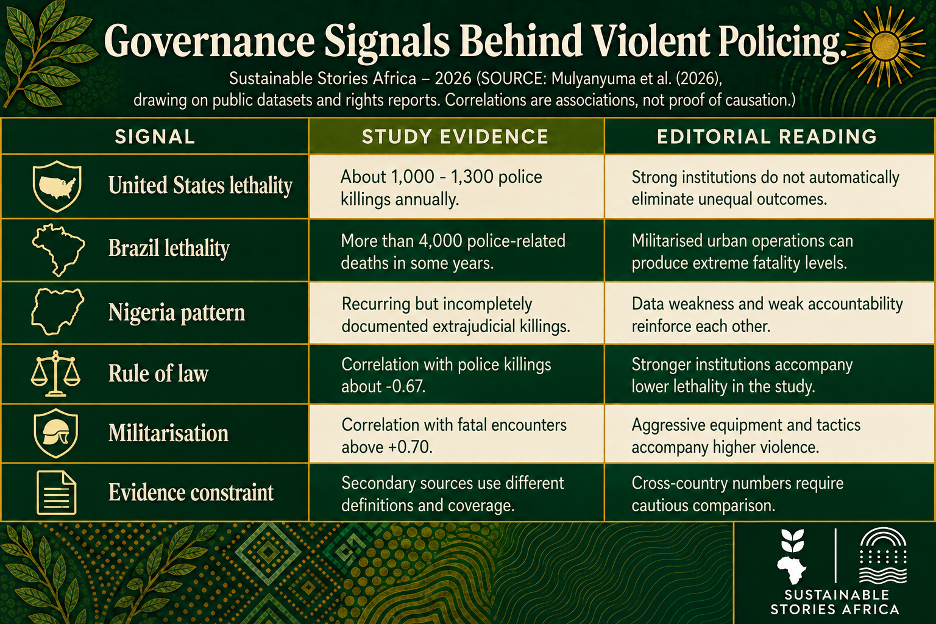
- Roughly 1,000 to 1,300 police killings in the United States.
- Over 4,000 in Brazil in some years.
- An undocumented but recurring toll in Nigeria, particularly around specialised units and protest repression.
These figures resist direct comparison given differing legal definitions and reporting quality; however, their persistence across systems remains significant.
Researchers found a correlation of about -0.67 between rule-of-law scores and police killings, and above 0.70 between militarisation and fatal encounters.
Correlation does not establish causation, and the paper lacks sufficient underlying data for independent verification; the findings should be read as a strong hypothesis, rather than a universal law.
Still, the pattern carries weight:
- Weak courts, powerless oversight bodies, opaque use-of-force records, and confrontation-rewarding command structures all lower the cost of misconduct.
- Militarised tactics can recast citizens as threats rather than rights holders.
Three Countries Reveal One Structural Pattern
The United States illustrates how formal legal safeguards can coexist with racial disparities and a high annual death toll.
Body cameras and public data can expose encounters; however, legal shields, fragmented accountability and organisational culture may still prevent transparency from turning to a remedy.
Nigeria shows a different institutional route to a similar trust crisis.
The study describes SARS as a symbol of longstanding impunity and argues that the unit's formal dissolution did not by itself dismantle the practices, incentives and power relationships associated with abuse.
The lesson is not that organisational change is useless, but that a name change without independent investigation, prosecution, transparent records and victim remedy is structurally incomplete.
Brazil demonstrates the interaction between militarisation and spatial inequality.
Police raids in favelas are framed through crime-control and counter-narcotics objectives, while poor and Afro-Brazilian communities carry disproportionate exposure to lethal operations.
Across the three cases, social marginalisation shapes who most frequently encounters coercive state power and with the least protection.
The study further reports that violent encounters are concentrated in marginalised urban areas and protest-prone locations.
However, its claim that more than 60% occur in urban informal settlements is not accompanied by sufficient detail in the dataset construction in the published article to treat that percentage as a settled global estimate.
The broader pattern is plausible and supported by the case narratives; the exact share needs independent replication.
Accountability Can Rebuild Safety And Legitimacy
Effective reform can improve both rights protection and public safety.
- When people expect fair treatment, understandable decisions and credible complaint resolution, cooperation with lawful policing becomes easier.
- Officers also benefit from clearer rules, better supervision, de-escalation support and institutions that distinguish legitimate force from abuse.
The positive outcome is not simply fewer viral incidents.
- It is a system in which every use of force creates a traceable record, serious cases trigger independent review, victims can obtain remedy, and command responsibility reaches beyond the officer at the scene.
- That turns public trust from a communications objective into an institutional result.
For African governments, credible reform can also strengthen investment conditions and democratic resilience.
- Arbitrary force raises legal, political and social risk, while protest repression can deepen instability.
- Rights-respecting policing supports the rule of law on which markets, communities and public institutions depend.
Reform Must Change Rules, Data And Culture
Governments should publish standardised use-of-force data covering deaths, injuries, weapons, location, demographic information, disciplinary action and case outcomes, with privacy safeguards.
Independent civilian bodies need authority to compel evidence, protect complainants and refer cases for prosecution.
Parliaments and courts must then examine patterns rather than waiting for individual scandals.
- Rules on the use of force should reflect necessity, proportionality, precaution and accountability under international human rights standards.
- Immunity doctrines and procedural barriers that prevent redress should be reviewed.
- Procurement policies should also test whether military-style equipment and tactics are necessary for civilian policing, and require documented authorisation and after-action review when used.
Training matters; however, it cannot substitute for consequences.
- De-escalation, procedural justice and human-rights instruction will have limited effect if promotion, deployment and discipline reward aggressive outcomes.
Reform must therefore align command incentives, performance assessment, prosecution, victim remedy and public reporting.
Path Forward – Turn Oversight Into Consequences
Police reform should make every serious use of force visible, independently reviewable and capable of producing remedy.
Courts, civilian oversight bodies, legislatures and police leadership must share enforceable responsibility.
Better cross-country data are also essential.
Common definitions, disaggregated records and transparent methods would allow future research to test the study's correlations more rigorously and help governments identify where institutional weakness can turn to preventable violence.