
Angel investors are quietly underwriting the future of emerging markets. Across Africa, Latin America, Southeast Asia and South Asia, more than 220 angel networks are shaping the earliest stages of innovation, often before venture capital steps in.
But while participation is expanding, liquidity remains thin, exits are scarce, and the sustainability of networks is under pressure. The future of early-stage ecosystems may depend on whether angels receive the policy and institutional backing they need.
Angels Anchor Emerging Market Innovation
Across emerging markets, angel investors are becoming the structural backbone of early-stage entrepreneurship — filling funding gaps, professionalising deal flow, and building pipelines for venture capital.
A 2025 report Foundational Trends in Angel Investing and Networks Across Emerging Markets (2025), which maps more than 220 angel networks across Africa, Latin America and the Caribbean, Southeast Asia, and South Asia, finds that 74% remain operational, signalling resilience despite macroeconomic headwinds.
However, beneath this growth lies fragility: limited exits, weak liquidity, high investment costs, and concerns about network sustainability threaten momentum. Angel investing may be expanding, but it remains insecure.
Early Capital Shapes Emerging Markets
Angel investors are often the first believers.
In emerging markets where institutional venture capital remains risk-averse, angels bridge the “missing middle”, deploying capital typically between $20,000 and $750,000 into pre-seed and seed-stage ventures.
More than 75% of mapped angel networks invest at the pre-seed and seed stages, primarily using SAFEs (76%) and convertible notes (19%) due to their flexibility and lower transaction costs.
Without angels, many startups would not survive long enough to attract institutional capital.
The stakes are clear: angels do not simply invest; they determine which innovations enter the funding continuum.
Expansion, Concentration and Structural Evolution
Angel investing has grown its level in the broader development of the startup ecosystem.
Network Growth and Regional Concentration
- Over 220 angel networks identified across target regions
- 74% confirmed operational
- India accounts for 31% of networks in South Asia
- Singapore hosts 68% of operational networks in Southeast Asia
- Nigeria, South Africa, Egypt and Kenya dominate African activity
Angel activity remains concentrated in Tier 1 ecosystems, markets with stronger regulatory frameworks, deeper VC presence, and proven exit pathways.
Investment Patterns
- Most angels:
- Target high-growth technology sectors (fintech, healthtech, e-commerce dominate).
- Maintain sector-agnostic flexibility due to limited deal flow
- Provide more than capital, they provide mentoring (⅓ of networks), VC introductions (¼ of networks)
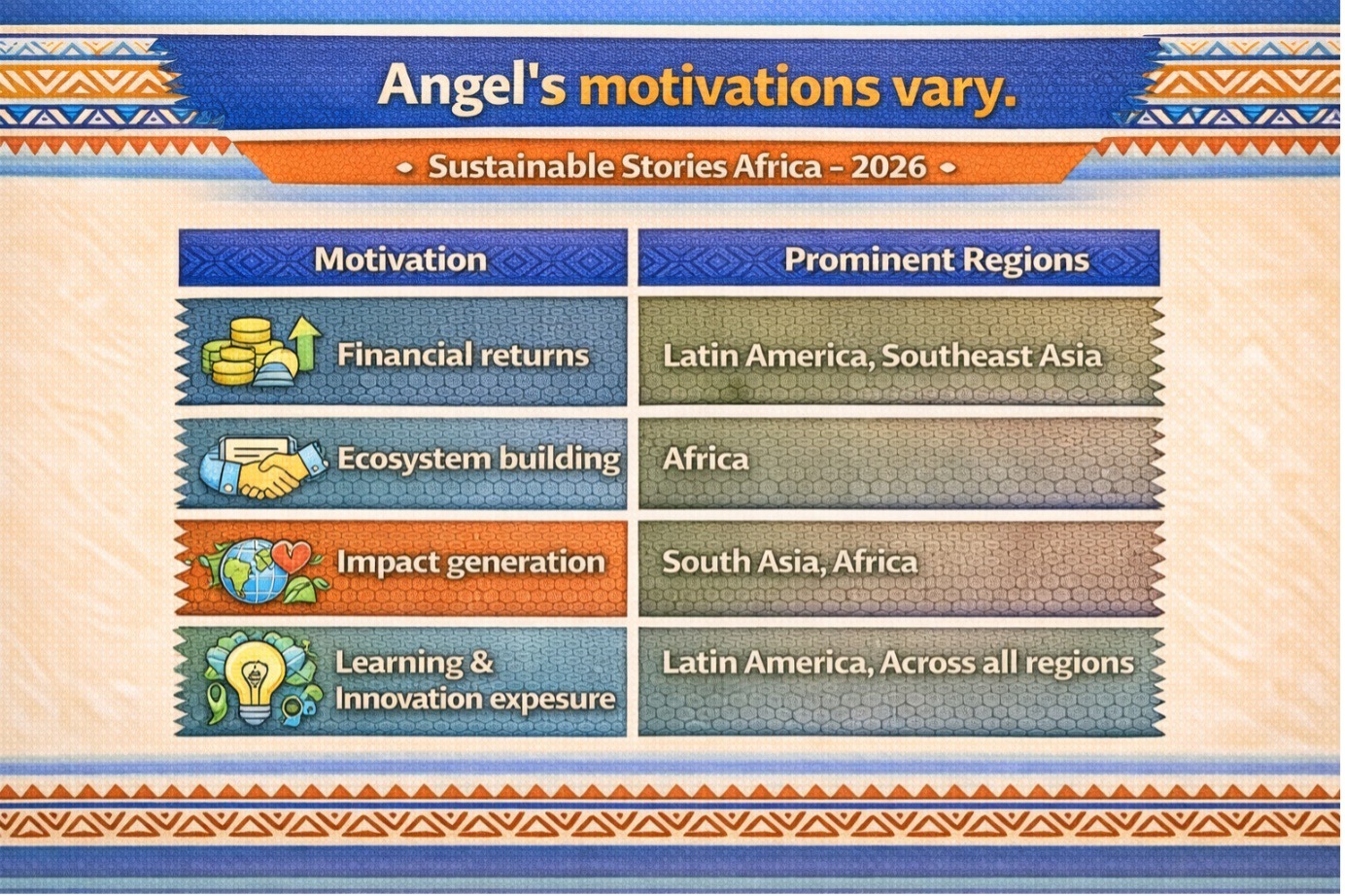
- Angel's motivations vary:
Motivation | Prominent Regions |
|---|---|
Financial returns | Latin America, Southeast Asia |
Ecosystem building | Africa, South Asia |
Impact generation | Africa, Latin America |
Learning & innovation exposure | Across all regions |
Structural Models
Three dominant structures shape participation:
- Member-led networks – low-cost, informal, common in Africa
- Manager-led networks – professionalised governance, common in Latin America and Southeast Asia
- Micro VCs – pooled capital, fund structures, prominent in India
However, sustainability remains a recurring challenge. Membership fees ($250–$1,000 annually in many markets) often fail to cover operating costs.
Many networks rely on catalytic or donor funding, which is frequently short-term.
Why Angel Capital Matters Systemically
Angel investors play four systemic roles:
- Filling Early-Stage Gaps – They provide the first structured capital after friends and family, especially in ticket sizes between $60,000 and $300,000, a funding range often too small for VCs but too large for informal investors.
- De-risking for Institutional Investors – Angels validates teams, refines governance, and prepares startups for VC due diligence, effectively lowering risk for later-stage capital.
- Catalysing Impact – Less than 10% of networks explicitly follow impact mandates, but many prioritise financial inclusion, job creation, or climate solutions indirectly.
- Professionalising Ecosystems – Networks introduce SPVs, syndicates, and standardised instruments, reducing transaction friction and accelerating deal closure.
The report emphasises that angels are not merely capital providers; they are ecosystem architects.
However, fragility persists:
- Limited exit opportunities (notably Africa, Southeast Asia)
- Economic and political instability (Africa, Latin America, South Asia)
- High transaction costs and knowledge gaps
Without structural support, early momentum is at risk.
Strengthening the Angel Investment Continuum
To deepen angel participation, the report identifies coordinated action across stakeholders:
Governments
- Establish regulatory clarity and tax incentives
- Strengthen exit markets
- Reduce administrative barriers
Development Finance Institutions
- Provide catalytic capital
- Fund training and capacity-building
- Support sustainable network models
Private Sector Actors
- Enable exit pathways
- Collaborate on co-investment structures
Angel Networks
- Improve governance
- Adopt efficient legal instruments (SPVs, SAFEs)
- Equip members through structured training
Angel investing should be treated as a strategic infrastructure layer, not a peripheral activity.
Path Forward – Strengthen Angel Capital Foundations
Emerging markets must treat angel investing as foundational economic infrastructure.
Policy incentives, catalytic capital, and stronger exit ecosystems are required to convert early-stage optimism into sustainable capital formation.
Building durable angel networks today will determine whether tomorrow’s high-growth startups emerge locally or migrate to deeper capital markets abroad.