South Africa’s proposed 2035 climate target is not merely an environmental pledge; it is a strategic economic positioning.
A joint note by the National Business Initiative (NBI) and the We Mean Business Coalition frames the country’s second Nationally Determined Contribution (NDC) as a lever to restore competitiveness, attract capital and shield exports from rising carbon border taxes.
The message to policymakers is clear: climate ambition and industrial growth are now inseparable.
South Africa’s 2035 Climate Competitiveness Pivot
South Africa is warming at twice the global average, remains among the world’s top 20 emitters, and still generates over 80% of its electricity from coal.
However, its newly proposed 2035 emissions target, 320 – 380 MtCO₂e with net zero by 2050, signals a decisive recalibration of economic strategy (p.12).
The NBI–We Mean Business Coalition briefing, released in November 2025, makes the stakes explicit: in a decarbonising global economy, ambition is no longer optional; it is a competitiveness requirement.
The note argues that aligning climate policy with industrial strategy can unlock green investment, protect export markets and accelerate job creation; its inability to act risks stranded assets and trade penalties.
Climate Targets Now Shape Trade
Carbon border measures introduced by the EU and UK are poised to penalise carbon-intensive exports, including steel, aluminium and fertilisers. For South Africa, a major exporter to Europe, the implications are immediate.
Business sentiment reflects urgency. According to polling cited in the report:
Business Sentiment Indicator | Finding |
|---|---|
Support renewable electricity | 95% |
Support phasing out coal by 2035 | 86% |
Would consider relocation if no transition | 84% |
Global executives backing net zero | 96% |
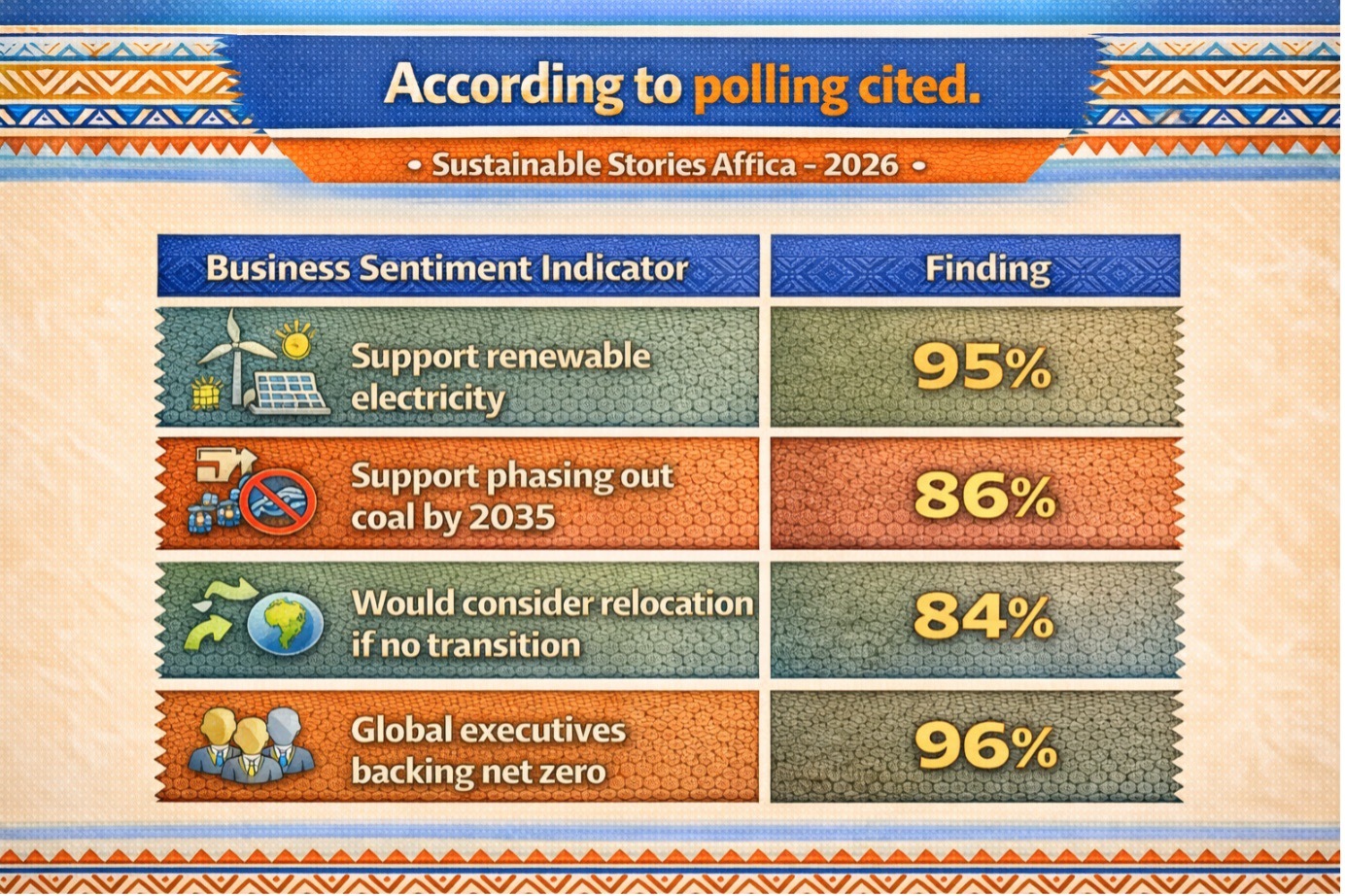
The message from corporate South Africa is clear: investment decisions depend increasingly on the clarity of policy and access to renewable energy access.
The report highlights that oil imports cost approximately $19 billion annually, while electrifying mobility could save ZAR 255 billion per year by 2050, equivalent to 3.75% of GDP.
In short, climate ambition has become macroeconomic policy.
Power Sector Reform As Foundation
At the core of the transition lies energy reform.
The briefing estimates that at least 190 GW of renewables are needed by 2050 to fully decarbonise the power sector.
South Africa’s Renewable Energy Independent Power Producer Procurement Programme (REIPPPP) has already deployed 8.9 GW and attracted ZAR 234 billion in private investment.
Rooftop solar capacity has doubled in a year to 5.7 GW, illustrating private-sector momentum.
Power Sector Imperatives:
- Target 6–8 GW of renewable additions annually
- Expand and modernise the grid via NTCSA
- Commit to no new coal-fired power plants
- Align coal decommissioning with renewables rollout
Without rapid transmission upgrades and SAWEM market reform, investment momentum could stall.
Industrial Renewal And Job Creation
The report frames decarbonisation as industrial renewal.
South Africa’s heavy manufacturing sector, including steel, cement, and petrochemicals, faces carbon intensity risks and opportunities for green hydrogen.
Transitioning to green processes could require significant investments of between ZAR 150 – 160 billion in upgrades; however, it positions the country as a hub for future green manufacturing.
Transport electrification, meanwhile, addresses 11% of national emissions. Modal shifts toward rail and EV expansion offer emissions reductions alongside industrial growth.
The NBI’s Just Transition Pathways warn that in a decarbonising world, roughly 50% of export value, 1 million direct jobs and 15% of GDP could be at risk without transition.
Conversely, renewables deployment supports:
- Green hydrogen exports
- Electric vehicle manufacturing
- Critical minerals value chains
- Grid and battery infrastructure employment
Climate ambition, the report concludes, is not about sacrifice; it is about capturing emerging value pools.
Coordinated Implementation Required
The note emphasises execution over aspiration.
Four near-term priorities are identified:
- Advance power sector reform via SAWEM and NTCSA operationalisation.
- Implement a renewables-centred Integrated Resource Plan.
- Finalise business-government plans for EVs, green hydrogen and critical minerals.
- Expand stewardship of critical water catchments to strengthen adaptation and water security.
Small and medium enterprises (SMEs), which contribute roughly one-third of GDP and half of employment, must be integrated into climate finance mechanisms.
Breaking long-term targets into five-year sectoral investment plans will make decarbonisation more manageable and investible.
Path Forward – Investible Ambition Anchors Economic Stability
South Africa’s 2035 NDC must translate ambition into policy certainty. Rapid renewable deployment, grid reform, transport electrification and heavy industry transition are immediate levers for growth.
Clear carbon budgets, sectoral targets and blended finance frameworks will reduce risk premiums, attract capital and secure export competitiveness in a carbon-constrained global economy.