China has quietly become Ghana’s largest single source of green-aligned finance, committing over $623 million between 2007 and 2024.
But as Accra deepens engagement under the Forum on China-Africa Cooperation (FOCAC), the real question is no longer how much is flowing, but how strategically those flows are shaping Ghana’s green industrial future.
China’s FOCAC Model and Ghana’s Green Future
Beijing has become instrumental in reshaping Ghana’s green transition.
A policy brief by the Africa-China Centre for Policy and Advisory (ACCPA), under the Sino-Africa Green Finance Alliance (SAGFA), highlights that China has disbursed more than $623 million in green-aligned infrastructure financing to Ghana between 2007 and 2024, surpassing the European Union ($174.8 million) and the United States ($93.5 million) over the same period.
As Ghana pursues its Nationally Determined Contributions (NDCs), Renewable Energy Master Plan, and industrial transformation agenda, China’s FOCAC framework has emerged as a central pillar of green finance mobilisation.
The opportunity is significant. So are the governance risks.
Ghana’s Green Partnerships Redefined
Ghana’s green growth agenda, anchored in the Ghana Beyond Aid Charter, the 24-Hour Economy Initiative, and for climate commitments under the Paris Agreement, requires large-scale capital and technology inflows.
China, under FOCAC, has become the country’s leading bilateral partner in green-aligned infrastructure, shifting the relationship beyond traditional aid toward strategic industrial cooperation.
Between 2000 and 2024, China committed $248.2 billion to Africa through FOCAC frameworks, with Ghana positioned as a key beneficiary.
Top International Green Finance Contributors to Ghana (2007–2024)
Rank | Country/Institution | Investment (US$) | Key Projects | Mechanism |
|---|---|---|---|---|
1 | China | 623.5 million | Bui Dam, Industrial Parks | Policy bank loans |
2 | European Union | 174.8 million | Northern Savannah Agriculture | Grant-concessional blend |
3 | United States | 93.5 million | 77 decentralised climate projects | USAID grants |
4 | AfDB | 127.8 million | Multi-country renewables | Blended finance |
5 | Germany | 64 million | Photovoltaic systems | Technical cooperation |
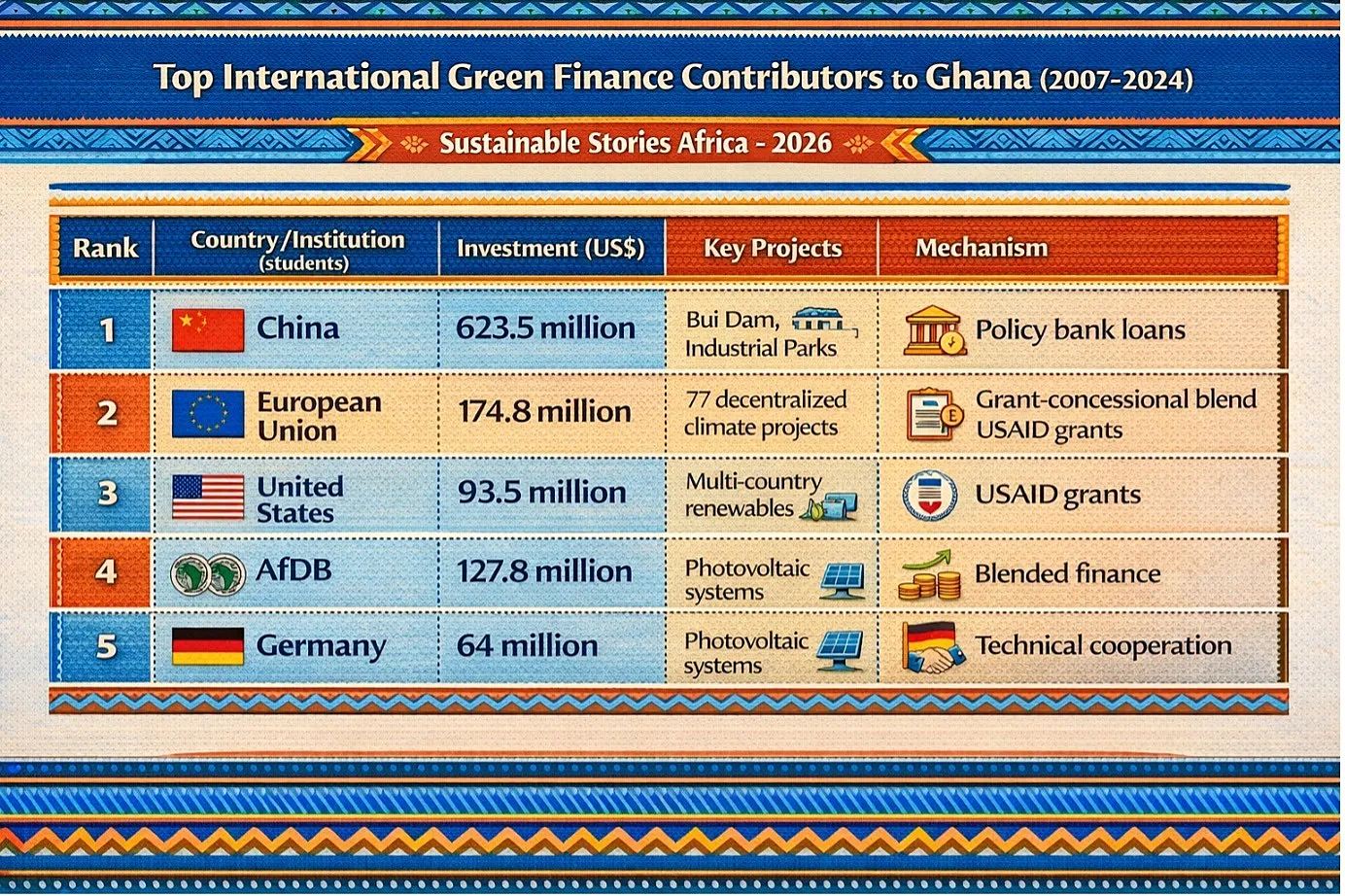
China’s dominance in green-aligned financing is structurally significant.
Where the Money Flows
FOCAC-backed financing has concentrated on large-scale infrastructure and industrial projects:
- Bui Hydroelectric Dam – $790 million
- Sunon Asogli Power Plant – $580 million
- Tema Industrial Park – $320 million
- Green Industrial Complex, Kumasi – $200 million
- Renewable Energy Technology Transfer initiatives
Notably, 35% of FOCAC-funded projects in Ghana are aligned with green finance objectives, above the West African regional average of 25%.
Between 2022 and 2024, investment emphasis shifted toward:
- Solar panel assembly (400MW annually)
- Electric vehicle hubs (US$150 million)
- Battery storage facilities (US$120 million)
This signals a move from pure infrastructure to localised green manufacturing.
Technology Transfer and Workforce Strategy
Technology localisation is emerging as the second phase of Ghana-China green cooperation.
The brief highlights several institutional platforms:
- China-Ghana Renewable Energy Technology Transfer Project
- Ghana-China Technology Transfer Centre
- Ghana-China Climate Technology Centre ($150 million)
- Tema Green Industrial Park (40% lower emissions than conventional zones)
The Tema Park alone is projected to create up to 300,000 jobs, positioning Ghana as a hub of lithium-ion battery manufacturing in West Africa.
If effectively governed, this could anchor Ghana’s industrial decarbonisation trajectory.
Alignment and Institutional Frictions
FOCAC initiatives are formally aligned with Ghana’s NDCs, Renewable Energy Master Plan, and industrial policy.
Implementation involves:
- Ministry of Trade and Industry (MoTI)
- Ghana Investment Promotion Centre (GIPC)
- EPA and MESTI
- Joint Industrial Cooperation Working Group (est. 2021)
- Joint Arbitration Committee
However, structural gaps persist:
- Limited disclosure of loan terms
- Weak public finance registries
- Insufficient centralised monitoring
- High-level negotiations with limited local agency input
Without an improved governance architecture, green ambition risks underperforming.
Strategic Reforms Proposed
The brief outlines two core reform pillars:
Strategic Alignment and Policy Engagement
- Establish a Green Industrial Development Unit within MoTI
- Adopt a Green Technology Transfer Framework
- Launch a Ghana-China Green Industry Training Institute
- Deploy digital monitoring systems for KPIs
- Create a Green Industry Innovation Fund
Leveraging Synergies and Co-Financing
- Develop a blended Green Industrial Development Fund
- Institutionalise a Ghana-China Green Industry Alliance
- Enhance private sector participation
- Integrate environmental criteria into co-financing agreements
The message is clear: capital alone is insufficient. Institutional capacity determines long-term value.
A Strategic Crossroads
FOCAC has undeniably reshaped Ghana’s green finance landscape.
But concentration in large megaprojects, while transformative, does not automatically translate into deep industrial competitiveness, SME participation, or technology sovereignty.
The next stage of Ghana’s green partnership with China will hinge on:
- Transparency
- Domestic coordination
- Technology absorption capacity
- Co-financing leverage
- Public accountability mechanisms
As the brief concludes, Ghana must transition from passive recipient to strategic co-architect of its green industrial future.
The stakes are regional. If executed well, Ghana could emerge as West Africa’s low-carbon manufacturing hub. If not, it risks infrastructure without industrial depth.
Path Forward – Institutionalise, Localise, Monitor
Ghana must urgently institutionalise a central Green Industrial Development Unit, deploy digital monitoring systems, and embed binding technology transfer provisions in all FOCAC-backed agreements.
Transparency and public finance registries should become standard practice.
By blending FOCAC resources with climate finance and private capital, while strengthening domestic coordination, Ghana can convert bilateral green finance into sustained industrial transformation and regional leadership in clean manufacturing.