Water is no longer just an environmental issue; it is also a challenge to development, food security, and macroeconomic stability.
From drought-stressed farms to rapidly expanding cities, the pressure on freshwater systems is intensifying.
Securing water for people, food, and the planet now defines the next frontier of sustainable growth.
Securing Water for People, Food, Planet
Water security has emerged as one of the most urgent and interconnected development challenges of the decade, with rising demand, climate stress, and fragmented governance placing unprecedented pressure on freshwater systems.
Discussions in Talking Development | Securing Water for People, Food & the Planet highlight a critical reality: without coordinated investment and reform, water scarcity risks undermining food production, public health, and economic stability, especially across climate-vulnerable regions, including Africa.
As population growth accelerates and agricultural systems strain under climate shocks, the debate is shifting from access alone to include resilience, efficiency, and long-term resource governance.
Water Stress Is Development Stress
Water scarcity is no longer a distant environmental concern. It is reshaping economic performance, food systems, and migration patterns.
Globally, agriculture accounts for roughly 70% of freshwater withdrawals, making water availability directly linked to food security and rural livelihoods.
Urbanisation is compounding the challenge: growing cities are competing with farms and ecosystems for finite supplies.
Climate variability, including prolonged droughts and erratic rainfall, is intensifying this pressure.
For developing regions, the economic cost of water stress predominantly includes crop losses, health burdens resulting from unsafe water, and infrastructure damage from floods.
In Africa, where agriculture employs a significant portion of the population, and rain-fed farming remains dominant, water volatility translates directly into macroeconomic vulnerability.
Three Interconnected Water Frontiers
The discussion highlights three central water challenges:
- Water for People – Access to safe drinking water and sanitation remains uneven. Rapid urban growth often outpaces infrastructure expansion, leaving informal settlements particularly vulnerable.
- Water for Food – Irrigation efficiency remains low in many regions. With agriculture being the main contributor to most water withdrawals, improving productivity per drop becomes central to resilience.
- Water for Ecosystems – Rivers, wetlands, and aquifers are under strain. Over-extraction and pollution reduce natural buffering systems that protect against floods and droughts.
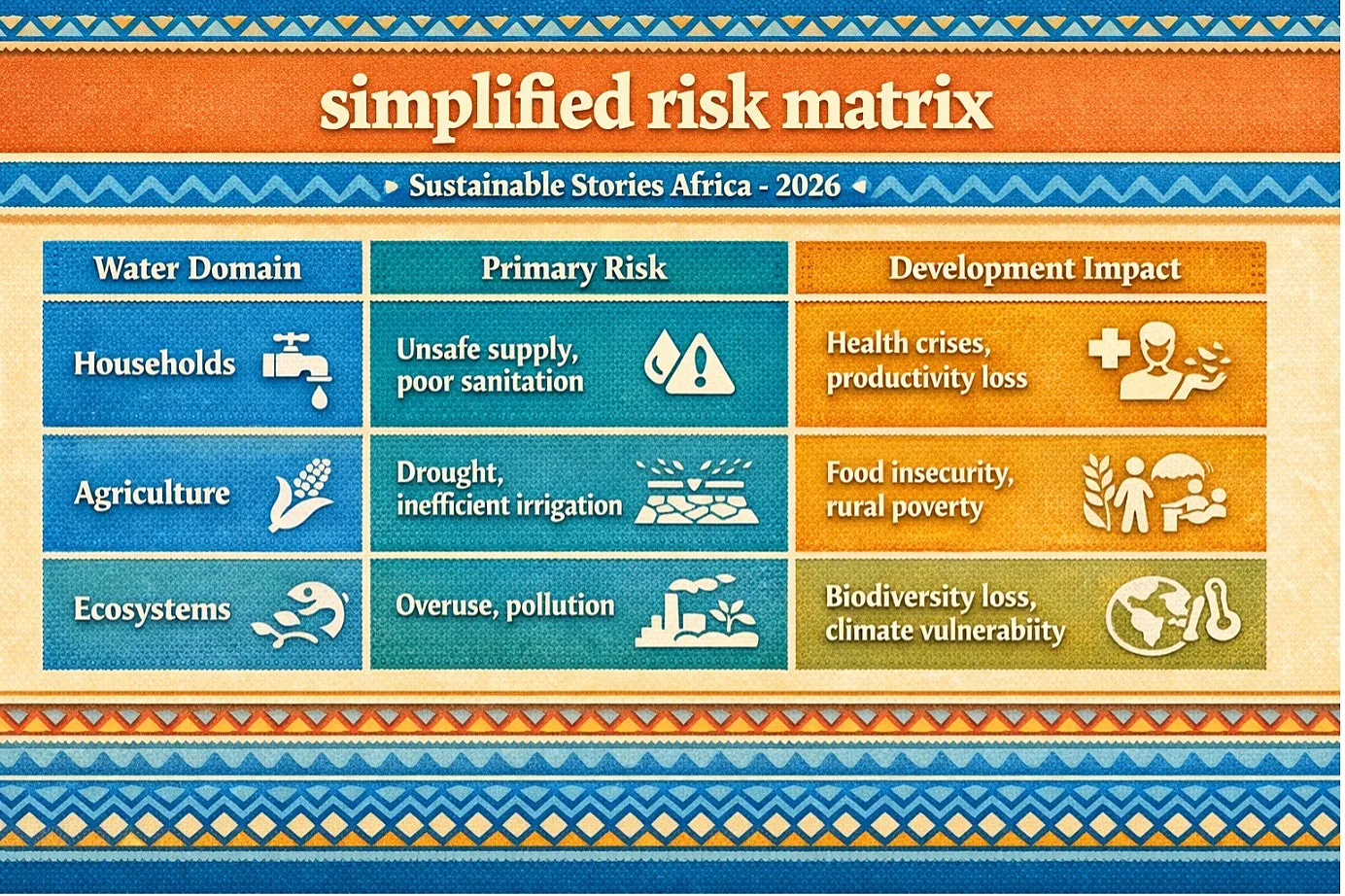
Below is a simplified risk matrix:
Water Domain | Primary Risk | Development Impact |
|---|---|---|
Households | Unsafe supply, poor sanitation | Health crises, productivity loss |
Agriculture | Drought, inefficient irrigation | Food insecurity, rural poverty |
Ecosystems | Overuse, pollution | Biodiversity loss, climate vulnerability |
Investment gaps compound the challenge. Financing for water infrastructure, particularly wastewater treatment and climate-resilient systems, remains insufficient relative to demand.
Resilience Through Integrated Solutions
The discussion emphasises that water security is achievable when policies align across sectors.
Three solution pathways emerge:
- Efficiency and Innovation – Modern irrigation techniques, water recycling, and digital monitoring systems can significantly reduce waste.
- Governance Reform – Integrated water resource management aligns the interests of both upstream and downstream users, balancing the needs of the agricultural, urban, and environmental sectors.
- Financing and Partnerships – Blended finance, public-private partnerships, and climate adaptation funds can mobilise capital for infrastructure upgrades.
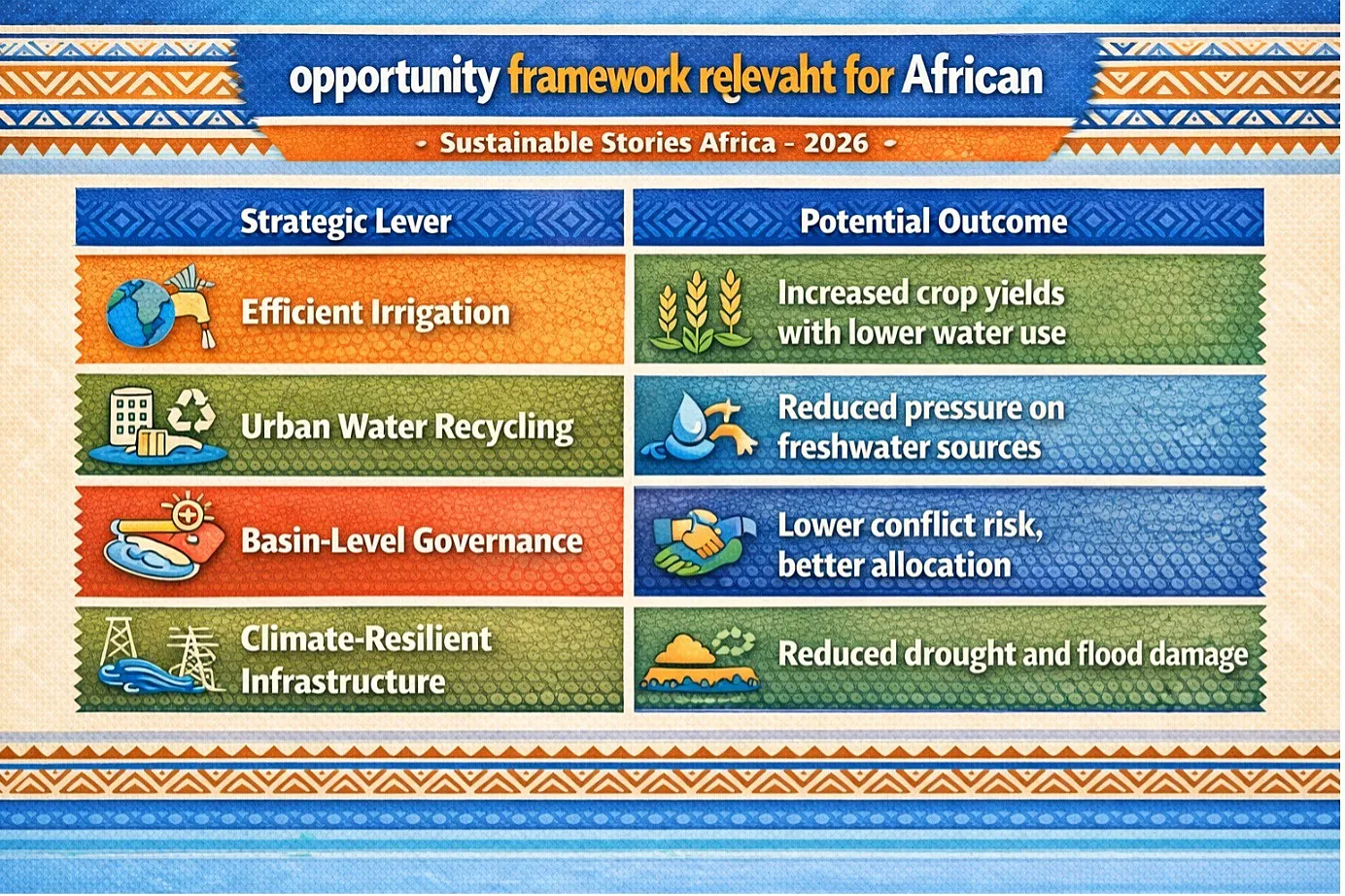
Below is an opportunity framework relevant for African economies:
Strategic Lever | Potential Outcome |
|---|---|
Efficient Irrigation | Increased crop yields with lower water use |
Urban Water Recycling | Reduced pressure on freshwater sources |
Basin-Level Governance | Lower conflict risk, better allocation |
Climate-Resilient Infrastructure | Reduced drought and flood damage |
The broader economic case is clear: investing in water resilience supports agricultural productivity, urban growth, and climate adaptation simultaneously.
Align Policy, Finance, and Innovation
The call emerging from the discussion is coordination.
Water governance often remains fragmented across ministries: agriculture, environment, and urban planning, leading to policy misalignment. Climate adaptation strategies often overlook the integration of the water system.
African policymakers can prioritise:
- Scaling climate-resilient irrigation systems.
- Investing in wastewater reuse for agriculture and industry.
- Strengthening basin-level management authorities.
- Embedding water security into national climate plans.
- Expanding access to concessional and blended climate finance.
Regional cooperation will also be essential. Many African river basins cross borders, making shared governance frameworks strategic for ensuring equitable distribution and conflict avoidance.
Water security, therefore, becomes not only an environmental priority but a strategic economic reform agenda.
PATH FORWARD – Invest Now, Secure Water Futures
Water security demands coordinated action across infrastructure, governance, and finance. Policymakers must integrate agricultural reform, urban resilience, and ecosystem protection into unified national strategies.
By prioritising efficiency, climate adaptation, and basin-level cooperation, countries can reduce economic vulnerability, protect food systems, and safeguard freshwater ecosystems for future generations.