
Technology is reshaping demography faster than policy can adapt. From AI diagnostics to robotics in eldercare, digital systems are transforming how societies age, migrate, learn, and reproduce.
However, more than 60% of people in the least developed countries remain offline. Without rights-based governance and equitable research investment, the digital transition risks deepening inequality rather than accelerating sustainable development.
Digital Divides Threaten Demographic Progress
The world is entering a demographic and digital inflexion point. Population ageing is accelerating. Africa’s working-age population is projected to grow by 667 million by 2050.
Cities will absorb an additional 1.3 billion residents globally within the same timeframe.
Simultaneously, artificial intelligence, digital health platforms, robotics, and geospatial data systems are redefining how governments deliver services and how economies generate growth.
However, the transformation is uneven. While 93% of people in high-income countries are online, only 39% of individuals in the least developed countries have internet access and just 29% of women in those countries are connected.
The January 2026 report of the Secretary-General to the Commission on Population and Development presents a clear case: closing digital and research divides is now central to achieving the Sustainable Development Goals (SDGs) and fulfilling the ICPD Programme of Action.
Demography Meets Digital Acceleration
The demographic story of the next 25 years must be dual.
In ageing economies, more than 20% of the population will be over 65 by 2050, driving demand for assistive technologies, geriatric care, and automation.
In contrast, Africa’s youth bulge presents the potential for a demographic dividend, if jobs, digital literacy, and infrastructure expand at pace.
However, digital inequality is stark.
As of February 2025, 5.6 billion people were online globally (68% of the population), but internet penetration in many East and Central African countries remains below 35%.
Technology is advancing. Access is not.
Health, Data and Education in Transformation
- Health Technology Expansion – Digital health platforms are scaling rapidly:
- India’s Sanjeevani telemedicine platform has delivered over 150 million consultations.
- Estonia operates a unified national electronic health record system.
- Rwanda’s Babyl platform connects pregnant women via mobile consultations.
- HPV self-sampling kits and rapid multiplex STI diagnostics are expanding access in fragile contexts.
AI-assisted mammography now detects breast cancer with fewer false positives than human radiologists, while non-invasive prenatal testing achieves over 99 per cent detection accuracy for chromosomal anomalies.
However, privacy risks are escalating alongside innovation.
- Digital Education and Workforce Shifts – Digital learning systems are expanding:
- UNICEF and ITU’s Giga Initiative has connected more than 2.2 million schools.
- Singapore’s SkillsFuture has reached over one million citizens.
- Estonia’s AI Leap aims to equip 16 – 17-year-olds with AI tools by 2027.
However, generative AI is transforming one in four jobs globally, with clerical roles, disproportionately held by women, at risk of high automation.
Women remain underrepresented in high-growth digital sectors, comprising less than 30% of the workforce in AI and cloud computing.
- Research Inequality: A Structural Barrier – Research investment disparities remain severe:
Indicator | High-Income Regions | Sub-Saharan Africa |
|---|---|---|
R&D Investment (% GDP) | 2.6% | <0.4% |
Researchers per Million | Over 4,000 | <100 |
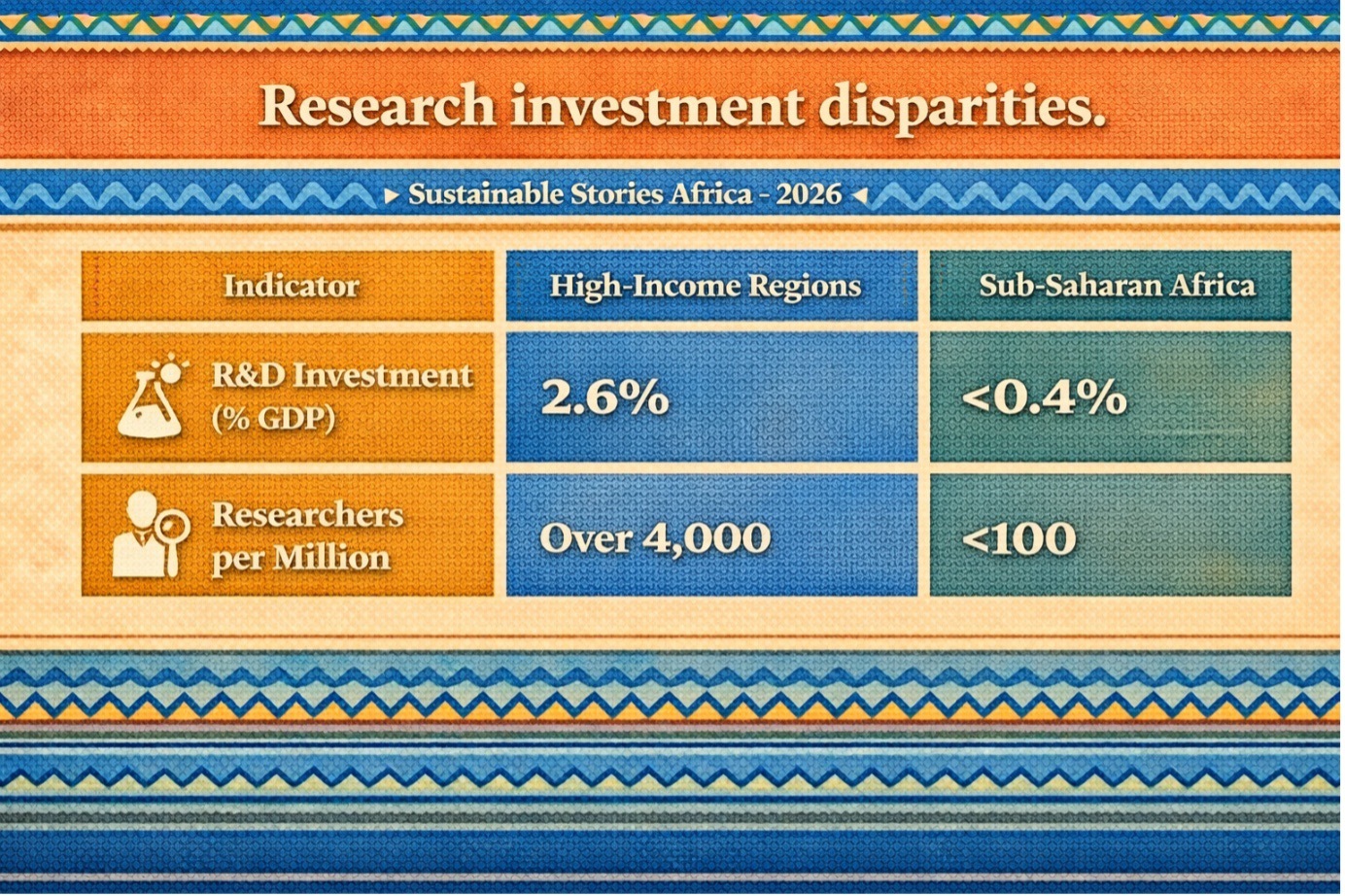
G20 countries account for approximately 90% of global research expenditure and patents.
Scientific capacity remains concentrated. Innovation is geographically skewed.
Inclusive Technology as Development Catalyst
The report highlights a central principle: universal digital inclusion must be paired with rights-based governance.
Positive examples illustrate what works:
- GDPR-style data protections now adopted across multiple jurisdictions.
- Chile’s 24/7 intelligent eldercare systems.
- Jordan’s National Priority Assistive Products List.
- Rwanda’s 50 per cent female university STEM quota.
- iamtheCODE Foundation reaching 150,000 learners across 88 countries.
If scaled equitably, technology can:
- Improve maternal health outcomes
- Expand reproductive autonomy
- Support ageing populations
- Increase STEM participation for girls
- Improve climate forecasting and migration preparedness
However, without safeguards, digital systems risk enabling misinformation, gender-based violence, surveillance misuse, and new forms of digital colonialism.
Digital inclusion without digital safety is incomplete.
Governance, Capacity and Accountability
The Secretary-General’s recommendations are concrete:
- Establish human-rights-based regulatory frameworks for AI and digital systems.
- Expand universal internet access and affordability.
- Strengthen national research and population data systems.
- Ensure digital health platforms protect privacy and promote equality.
- Expand assistive technology access for ageing populations.
- Invest in gender parity in STEM and digital sectors.
- Implement whole-of-government reskilling strategies.
The core objective is to align digital transformation with equality, accountability, and sustainable development.
Path Forward – Inclusion, Protection, Capacity
Universal digital access must be matched with enforceable human-rights-based governance. Countries are being urged to expand internet infrastructure, strengthen research systems, and embed privacy safeguards into AI and healthcare platforms.
At the same time, governments must reskill the workforce, invest in gender parity in STEM, and ensure that assistive technologies reach ageing populations. The future of sustainable development will depend on pairing digital acceleration with institutional integrity.