Nigeria’s kidnap crisis has entered a more dangerous economic phase. Between July 2025 and June 2026, recorded ransom payments more than tripled to N7.78 billion, even as total demands fell.
SBM Intelligence says one Boko Haram faction collected 90% of the money through only eight cases.
The result is a governance emergency in which mass abduction increasingly finances organised terror.
Nigeria’s ransom market has changed hands
Nigeria’s kidnapping economy is no longer best understood as thousands of isolated negotiations between criminal gangs and desperate families.
New data from SBM Intelligence show that the market’s most valuable end has been captured by an organised terrorist actor with the scale, territorial reach and coercive power to convert mass hostages into large cash transfers.
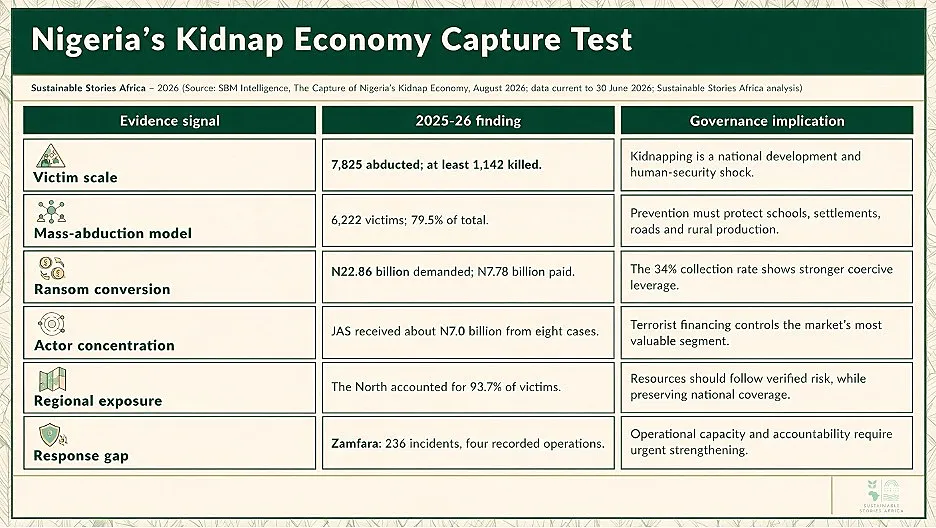
From July 2025 to June 2026, at least 7,825 people were abducted in 1,411 kidnapping incidents.
A further 302 anti-kidnap operations brought the broader incident count to 1,713, while at least 1,142 people were killed.
The North accounted for 93.7% of victims, with the Northwest remaining the crisis centre.
The economic signal is even sharper.
- Kidnappers demanded N22.86 billion and received at least N7.78 billion.
- That 34% collection rate, up from 5.35% in the previous cycle, reflects two mass abductions whose payments now dominate the national ledger.
One faction captured the ransom market
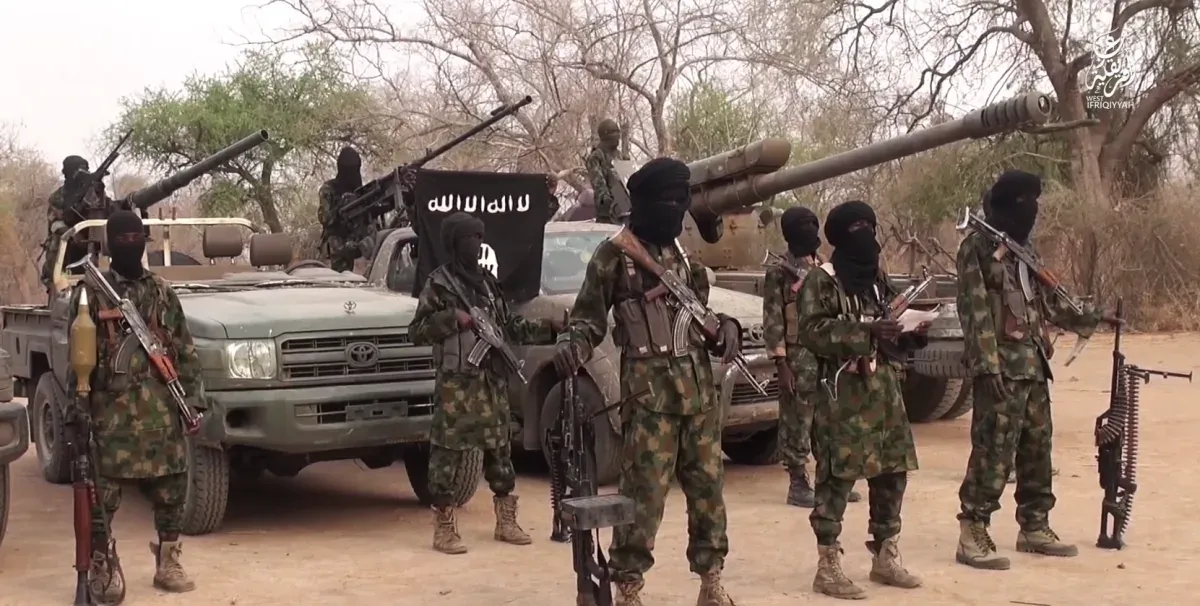
A Jama’atu Ahlis Sunna Lidda’awati Wal-Jihad faction of Boko Haram collected about N7.0 billion from eight recorded cases, 90% of every naira of ransom that SBM could price.
By comparison, unaffiliated kidnappers and bandits demanded N13.49 billion across 146 cases but collected only N719.4 million, a 5.3% conversion rate.
Two events drove the concentration.
- In April 2026, 416 people were abducted from Ngoshe in Borno State, and a reported N5 billion demand was paid in full.
- In November 2025, 315 pupils and staff were taken from St Mary’s School in Papiri, Niger State, with intelligence sources placing the payment at N2 billion.
Together, those incidents represented almost the entire national ransom bill.
That distinction changes the policy question.
- Ordinary kidnapping remains high-volume and devastating, but its demands are often negotiated down because families have limited cash.
- Mass-abduction groups can hold hundreds of people, impose deadlines and demonstrate lethal intent.
Their leverage turns ransom from dispersed criminal income into a concentrated financing channel for insurgency.
Mass abductions now drive victim totals
The human geography confirms the threat at an industrial scale.
- SBM defines a mass abduction as one incident involving at least five victims.
- Such events made up only 396 of 1,411 kidnappings, or 28.1%, yet they produced 6,222 victims - 79.5% of everyone abducted during the year.
Four in every five victims were therefore taken in groups, rather than in isolated roadside or household seizures.
- Zamfara recorded 236 incidents and 1,921 victims, the highest totals nationally; however, only four anti-kidnap operations.
- Sokoto recorded 1,157 victims, Kaduna 814 and Katsina 559.
- Across the country, 895 civilians, 179 kidnappers and 68 security personnel were killed.
The imbalance between the scale of harm and the operational response is especially pronounced in the worst-hit states.
The recorded N7.78 billion is a floor, rather than a complete bill.
- SBM verified payments without exact values in 16 additional incidents, meaning money changed hands in at least 86 cases.
- In at least six incidents, victims were killed after payment.
- Ransom bearers were themselves abducted in another six cases, widening the circle of exposure around each negotiation.
Fourteen incidents also involved demands for motorcycles, food, fuel, phones and other goods.
- These in-kind ransoms show a market adjusting to the poverty of its victims.
The economic damage extends beyond the payment:
- Farmers abandon fields, schools close, transport becomes riskier, businesses spend more on protection, and communities lose confidence in the state.
The currency picture confirms that this was not merely a naira-inflation story.
- At the end-of-June official exchange rate used by SBM, the N7.78 billion paid was worth about $5.7 million, more than three times the previous cycle’s roughly $1.66 million.
For the first time in the series, the greatest demand and the largest payment were the same N5 billion event, signalling a captor with enough leverage to secure its opening price.
Payments were also geographically concentrated.
- Borno accounted for about 65% of the national total and Niger for 25.7%.
- The five highest-paying states produced 95.8% of all priced ransom.
That concentration gives investigators a narrower set of high-value cases, intermediaries and financial routes to examine, even as prevention remains nationwide.
Safer communities require financial disruption first
The data points toward a more targeted opportunity.
- Because 90% of priced payments flowed to one faction, disrupting a relatively small number of high-value networks could have an outsized effect on the funds available for weapons, recruitment, logistics and future attacks.
- Financial intelligence should treat large ransom events as potential terrorist-financing cases, rather than only as private criminal settlements.
A safer operating environment would create benefits far beyond crime statistics.
- Protected farm corridors would support food production and rural incomes.
- Secure schools would reduce learning disruption and the long-term exclusion of girls and vulnerable children.
- More reliable roads would lower logistics costs, while businesses could redirect money from guards and emergency payments into jobs and investment.
The social objective must remain central.
- A no-ransom posture may weaken the business model, but applying it without credible rescue capacity can transfer unbearable risk to hostages and families.
- Reform therefore needs trusted crisis protocols, trained negotiators, victim support and clear safeguards alongside financial interdiction.
A two-track response can reduce returns
First,
- Nigeria should build a joint ransom-finance architecture linking security agencies, financial institutions, mobile-money operators and telecommunications companies under lawful, time-bound procedures.
- High-value payments, unusual cash movements, phone activity and known facilitator networks should be analysed together. Post-incident financial investigations should continue after hostages return so that each case produces intelligence for the next prevention cycle.
Second,
- Operations should be matched to verified exposure.
- Zamfara’s four recorded anti-kidnap operations against 236 incidents illustrate why input measures such as patrol announcements are inadequate.
- Governments should publish a compact performance dashboard covering incidents, victims, rescue outcomes, civilian harm, prosecutions, disrupted payments and repeat hotspots.
- Public reporting must protect operational details while making delivery visible.
Third,
- Prevention must protect the places mass abductors exploit: schools, farming settlements, worship centres and transport corridors.
- Community early-warning systems, safe communication channels and properly governed local security networks can shorten response times.
- Investments in rural roads, lighting and communications should be assessed for security resilience rather than treated as stand-alone infrastructure.
Finally, security policy must address recruitment.
- Rural unemployment, displacement, weak local justice and the absence of legitimate income create a pool that armed groups can exploit
- Livelihood programmes will not replace policing, but without them enforcement may displace violence without shrinking the supply of fighters and informants.
Path Forward – Nigeria must break kidnapping’s financing loop
Nigeria’s priority is to separate hostage rescue from the financial success of organised terror.
That requires faster intelligence sharing, accountable operations, protected payment tracing and sustained support for affected families and communities.
The wider test is whether government can make mass abduction less profitable while making vulnerable regions more governable.
Success should be measured not only by arrests, but by fewer victims, safer schools and farms, lower ransom flows and restored public trust.