The UN's 2026 assessment shows global gains, but Africa carries a disproportionate share of the poverty, energy, jobs and data gaps.
Only 36% of assessable SDG targets are on track or making moderate progress, while 15% have fallen below 2015 baselines.
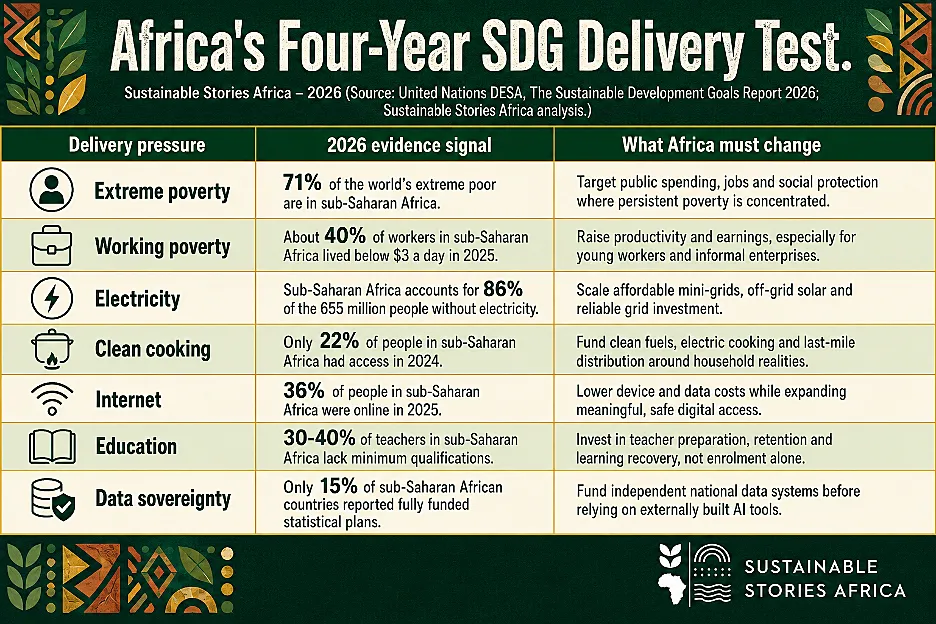
For Africa, the final four years are a delivery emergency: sub-Saharan Africa holds 71% of the world's extreme poor, 86% of people without electricity and some of the weakest-funded statistical systems.
Four Years Expose Africa's Delivery Gap
The United Nations' Sustainable Development Goals Report 2026 presents a world that knows more about its development failures but is moving too slowly to correct them.
Of 139 targets with enough trend data, only 36% are on track or making moderate progress. Nearly half are advancing too slowly, and 15% have moved backwards since 2015.
Africa sits at the sharpest edge of that global shortfall.
- Sub-Saharan Africa now contains 71% of people living in extreme poverty worldwide and accounts for 86% of those without electricity.
- Working poverty remains around 40%, while only 22% of the population had access to clean cooking in 2024.
This is not evidence that the Goals are irrelevant.
- It is evidence that finance, institutional capacity and delivery systems have not matched the scale of Africa's needs.
With four years remaining to 2030, the central question is no longer whether the targets are ambitious, but whether budgets, debt rules, energy systems, jobs and data can be reorganised quickly enough to reach people.
Global Progress Hides Africa's Concentrated Risk
The global record contains real gains.
- Electricity reaches 92% of the world's population.
- Internet use has risen from 40% in 2015 to 74% in 2025.
- Social protection covers more than half of humanity for the first time, and disaster-related deaths are 65% lower than in the previous decade.
However, averages conceal where exclusion is becoming concentrated.
- An estimated 826 million people still lived below $3 a day in 2026.
- At the current trajectory, roughly 9% of the world will remain in extreme poverty in 2030.
With four in five living in sub-Saharan Africa or fragile and conflict-affected countries.
The financing environment is also deteriorating.
- The report says official development assistance fell by a record 23% in 2025.
- The annual SDG financing gap in developing countries remained around $4 trillion.
For governments already devoting scarce revenue to debt service, the squeeze can turn long-term development plans into unfunded commitments.
The Numbers Point to Interlocking Failures
Africa's SDG gaps reinforce one another.
- A household without electricity is less able to study, use digital services or run a productive enterprise.
- A worker trapped below the poverty line has less resilience to food-price or climate shocks.
- A government without reliable, disaggregated data cannot target limited resources or prove which intervention works.
The report's regional indicators show why isolated projects will not be enough. They point to a system in which poverty, energy, education, connectivity and state capacity must improve together.
The data gap deserves special attention.
- The SDG system now contains about three million data points and covers nearly every indicator; however, only 59% of national statistical plans under implementation were fully funded in 2025.
- In sub-Saharan Africa, the share was just 15%.
That weakness limits policy accountability and leaves countries dependent on data systems designed elsewhere.
Artificial intelligence raises the stakes.
- The report argues that official statistics must remain trusted, nationally owned and transparent about the difference between observed and modelled data.
- Countries that cannot finance or govern their own statistical infrastructure risk becoming consumers of answers they cannot audit.
Existing Gains Show Acceleration Remains Possible
The same report shows that coordinated policy can move large systems.
- Since 2015, global electricity, sanitation, internet access and social protection have expanded.
- New HIV infections and AIDS-related deaths have each fallen by roughly a third, and 134 countries have met the target for reducing child mortality.
These gains show that money, institutions and political commitment still produce results.
There are also encouraging signals for Africa.
- The long-term rise in undernourishment in sub-Saharan Africa halted, and the region recorded its first improvement in moderate or severe food insecurity since 2015.
- Support to African agriculture reached $8.7 billion in 2024, nearly double its 2015 level in real terms.
- Developing countries also recorded 13% annual renewable-capacity growth over five years, ahead of the 8% rate in developed economies.
The opportunity is to connect those gains.
- Distributed renewable energy can power clinics, schools, cold chains and small businesses.
- Social protection can keep climate or food-price shocks from becoming permanent poverty.
- Better teachers and internet access can expand skills, while nationally owned data can direct finance to communities with the deepest gaps.
Finance Systems, Not Isolated Goal Projects
African governments should concentrate the final four years on a limited set of linked delivery systems:
- Reliable energy, productive jobs, food security, foundational learning, primary health, social protection and trusted data.
- National budgets should show how each priority reaches excluded populations, not simply how much a ministry spends.
International partners must address the financing architecture described in the report.
- That means implementing the Sevilla Commitment, expanding affordable finance, providing meaningful debt relief and tripling multilateral development bank lending capacity.
- More finance must also reach local governments and institutions able to deliver services, rather than remaining in fragmented projects with high transaction costs.
Domestic resource mobilisation remains essential; however, it must be fair and growth-supporting.
- Governments can reduce tax leakage, improve procurement, redirect inefficient subsidies and use public finance to crowd in private capital for energy, transport and digital infrastructure.
- Social spending should be tested for who actually benefits; globally, only 18% of health spending and 21% of education spending reaches the poorest fifth on average.
Data must be treated as infrastructure.
- National statistical offices need predictable domestic budgets, legal independence, modern systems and authority to govern public-interest use of AI.
- Every major SDG programme should publish disaggregated results, costs and delivery timelines so citizens can see whether apparent progress reaches women, young people, rural communities and people living in conflict-affected areas.
Path Forward – Turn the Final Years Into Delivery
Africa's 2030 push should focus on linked systems that reduce poverty while expanding power, jobs, learning, health, protection and digital access.
That requires debt relief, affordable long-term finance, stronger domestic revenue and fully funded national data systems.
The final measure is not the number of initiatives launched, but how many excluded people experience durable improvement.