A new implementation playbook shows how blended capital, community rights and measurable outcomes can turn degraded landscapes into productive infrastructure.
Land degradation and drought are growing faster than the finance designed to prevent them.
A new implementation playbook argues that the problem is no longer a shortage of workable models.
From Cape Town's outcomes-based water bond to community rangeland carbon finance and Kenya's farmer loan guarantees, the challenge is building pipelines, governance and proof strong enough to move capital before the next crisis.
Restoration's Finance Problem Is Now Solvable
The financing debate around land restoration is shifting. Innovative Financing for Land Restoration and Drought Resilience: An Implementation Playbook brings together 11 cases that use blended finance, credit facilities, carbon markets, outcomes-based instruments and long-term project structures to move nature from a grant-dependent cause toward investable resilience.
The playbook, developed with the United Nations Convention to Combat Desertification and partners, starts from a blunt diagnosis:
- Most drought finance remains short-term and reactive, arriving after communities, food systems and public budgets have absorbed the damage.
- Prevention is cheaper, but projects often lack the preparation, risk-sharing and evidence needed to attract capital.
Africa is central to the opportunity.
- The cases include a nature-linked water bond in Cape Town, community rangeland finance across northern Kenya and Tanzania, and an adaptation finance programme for Kenyan smallholders.
Together, they show what becomes possible when ecological outcomes, local livelihoods and financial structures are designed as one system.
The Cost of Reaction Keeps Rising
Drought affects approximately 1.8 billion people and causes more than $300 billion in economic losses each year, according to the playbook.
An estimated $2.6 trillion will be needed by 2030 to restore degraded land and strengthen drought resilience globally.
Public budgets and humanitarian aid separately cannot meet that scale.
The investment problem is partly structural.
- Restoration benefits are spread across water security, agriculture, biodiversity, carbon storage, jobs and disaster avoidance, while investors often look for a single predictable revenue stream.
- Projects may also face uncertain land rights, weak baseline data, long ecological timelines and high early-stage costs.
The playbook's answer is not to label every landscape bankable.
- It is to build the conditions under which suitable projects can become investable: concessional capital that absorbs early risk, technical assistance that prepares a credible pipeline, measurable performance indicators and governance that ensures communities share in benefits.
Eleven Models Show Capital in Motion
The cases span drought resilience, rangelands and soil health across Africa, Asia, Europe, Latin America and the United States.
Their common feature is financial architecture built around a specific barrier.
- A guarantee reduces lender risk.
- A performance bond pays for verified outcomes.
- Carbon revenue rewards improved grazing.
- A conservation trust protects long-term commitments beyond political and donor cycles.
The African examples show that scale is possible; however, not through a single instrument alone.
- Public and philanthropic finance prepare projects; private capital funds expansion; and community institutions, governments and technical partners make implementation credible.
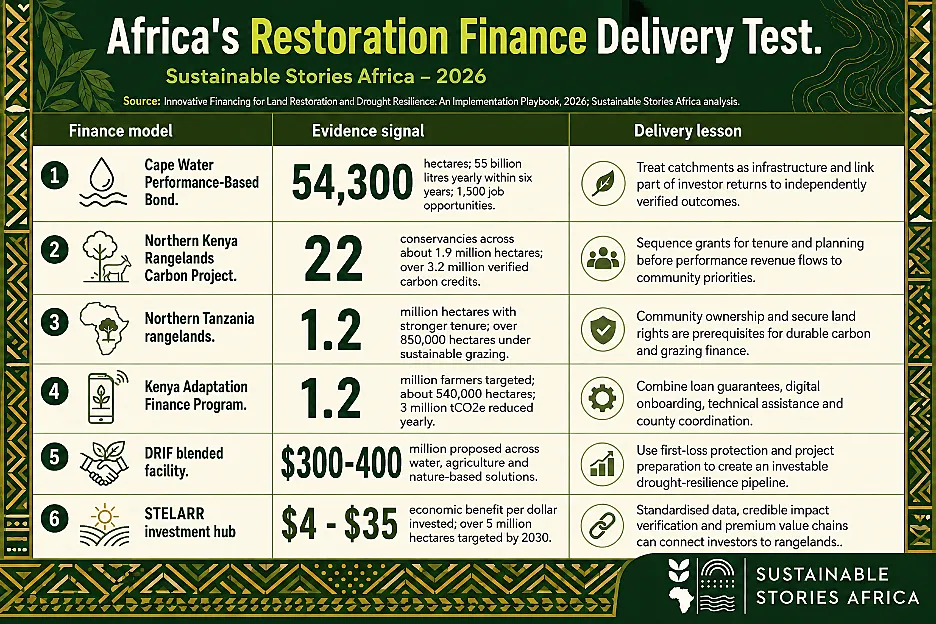
Cape Town offers the clearest infrastructure comparison.
- Removing invasive alien plants is expected to deliver water at about R1.2 per cubic metre, roughly one-tenth the cost of desalination or water reuse.
- Restoring seven priority sub-catchments could add 55 billion litres a year within six years and about 100 billion litres annually within 30 years.
The rangeland programmes make a different case.
- In Kenya, coordinated grazing and monitoring support carbon-credit revenue across 22 community conservancies.
- In Tanzania, strengthened communal tenure and sustainable grazing are laying the groundwork for a community-owned carbon enterprise.
More than 450,000 people already benefit across the two landscapes through stronger rights, grazing security and emerging revenue.
African Landscapes Can Become Productive Infrastructure
When restoration works, its returns compound.
- Healthier catchments can raise water availability, reduce sediment in reservoirs and lower wildfire risk.
- Regenerative farms can improve soil moisture, productivity and income stability.
- Better-managed rangelands can support livestock, biodiversity and carbon storage while protecting migration routes and pastoral livelihoods.
The Kenya Adaptation Finance Program makes those links explicit.
- It aims to benefit 1.2 million farmers, improve roughly 540,000 hectares, restore about 3,500 kilometres of river systems and reduce approximately three million tonnes of carbon dioxide equivalent each year.
- Its loan guarantee is paired with digital credit tools, technical assistance and joint planning with county governments.
This combination changes what investors are financing. The asset is not just a carbon credit or a loan book; it is improving a landscape and the livelihoods within it.
- For African governments, that can reduce future disaster costs and strengthen food, water and economic security.
- For communities, it can expand finance without separating ecological recovery from local priorities.
Bankability Depends on Governance and Proof
The first requirement is a stronger project pipeline.
- Governments, development finance institutions and philanthropies should fund feasibility work, ecological baselines, legal structuring and community engagement before expecting commercial investment.
- Technical assistance is not an optional grant beside the transaction; it is part of the investment infrastructure that lowers execution risk.
Land and resource rights must be clear.
- The Kenya-Tanzania experience shows that tenure formalisation, community governance and locally agreed grazing plans need to precede revenue.
- Benefit-sharing arrangements should be public, understandable and designed with women, young people and pastoralists, not merely disclosed after a project begins.
Measurement should match the promised outcome.
- Water projects need verified hydrological results; soil and rangeland projects require credible baselines and monitoring; livelihood claims need household-level evidence.
- Independent verification can strengthen investor confidence, but public agencies should also retain the capacity to audit results and prevent private standards from replacing national accountability.
Finally, revenue should be diversified.
- Carbon markets can support restoration, but long verification periods and volatile prices create risk.
- Blending carbon income with agricultural productivity, water payments, premium livestock value chains, public budgets and concessional finance can make projects more resilient
The goal is not to financialise every hectare, but to direct appropriate capital toward landscapes where ecological and economic value can be measured and shared.
Path Forward – Move Capital Before the Next Drought
Africa should build restoration pipelines before crises occur, using concessional capital, guarantees and technical assistance to prepare credible projects.
Secure community rights, transparent benefit sharing and independently verified outcomes must anchor every structure.
Capital can then scale water, farming and rangeland resilience without treating nature or local livelihoods as secondary to financial returns.