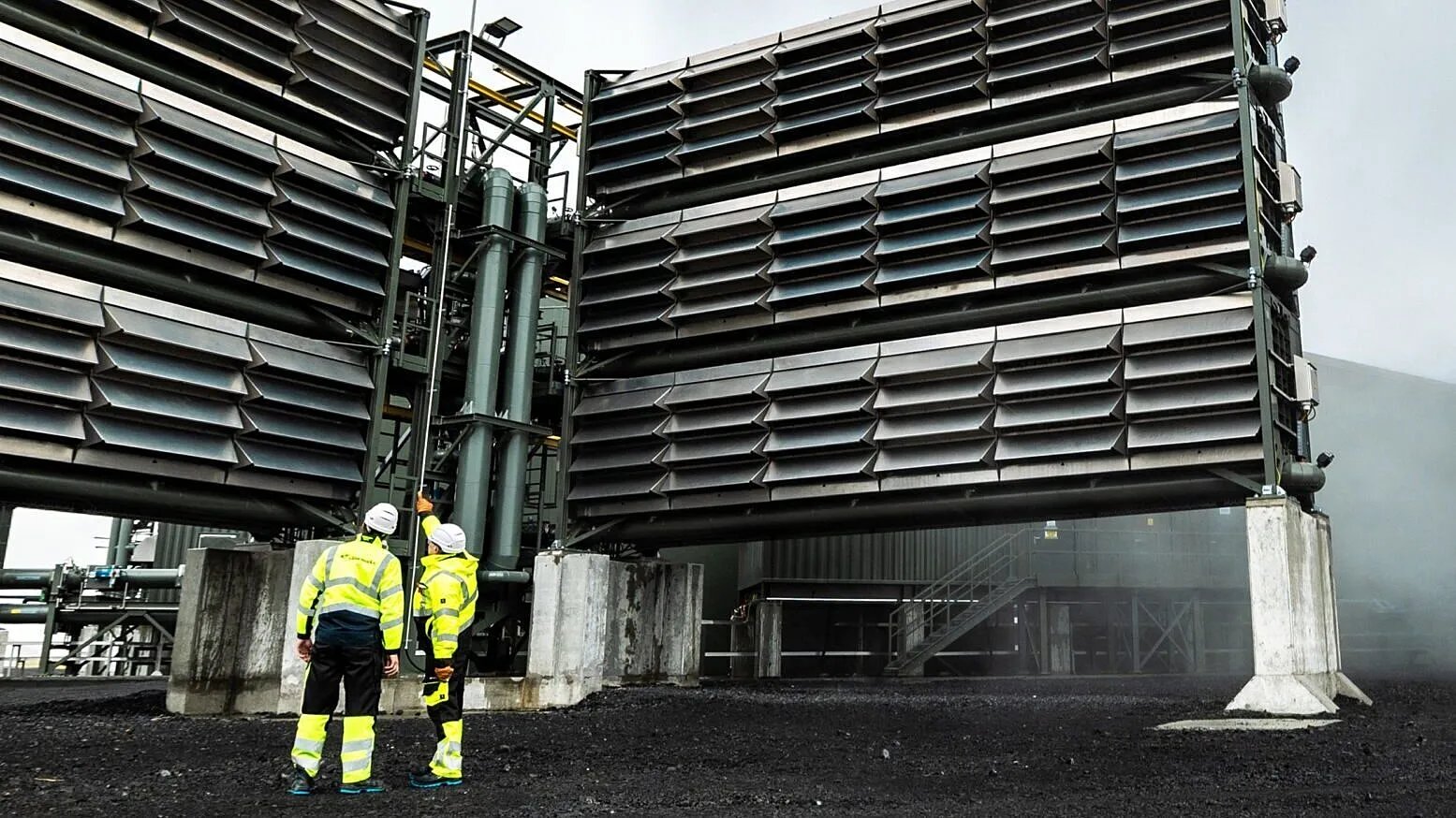
Permanent removals can help Europe reach net zero. However, admitting them into a compliance market could also let emitters delay harder cuts.
CATF and CONCITO compare four integration routes and conclude that the safest entry requires a maintained gross emissions cap, technology-specific controls, robust verification, differentiated allowances and an early review.
The choices offer timely lessons for emerging African carbon markets.
Carbon Removals Meet The Compliance Market
The European Union has asked a deceptively difficult question: can permanent carbon removals enter its Emissions Trading System without weakening the emissions cuts that the market exists to deliver?
The answer will shape the 2026 review and the longer transition from a shrinking emissions cap to net zero and, eventually, net-negative emissions.
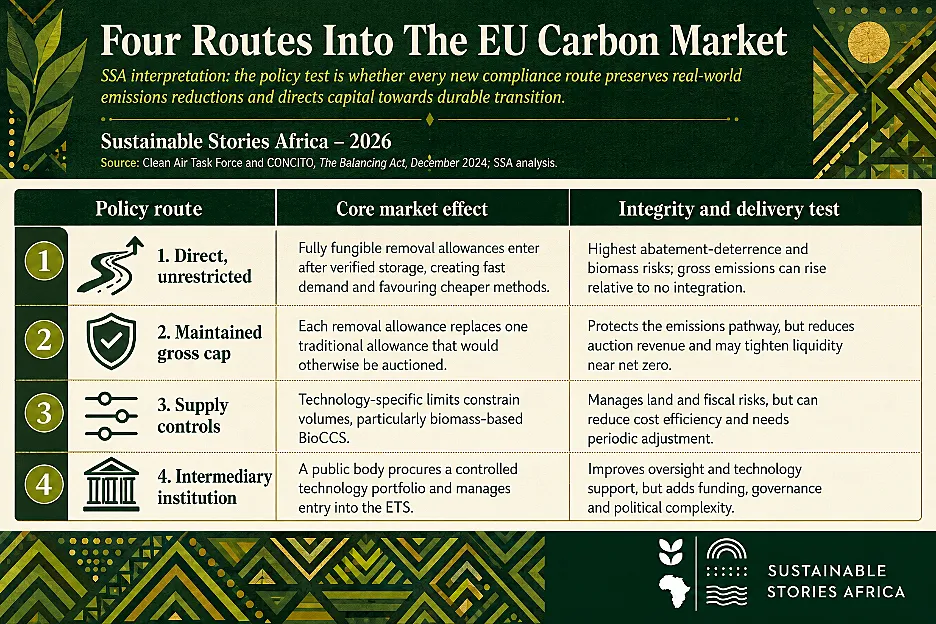
A December 2024 report by Clean Air Task Force and Danish climate think tank CONCITO tests four routes: unrestricted direct integration, integration with the gross emissions cap maintained, integration with technology-specific supply controls, and procurement through an intermediary institution.
Its conclusion is not that removals should be rejected.
Rather, they must be introduced carefully enough to create demand for durable technologies without turning them into a cheaper permission to continue emitting.
That balance is equally important for African countries designing crediting systems, for sectoral carbon markets and for projects seeking international buyers.
Four Options Reveal A Difficult Trade-Off
Some residual emissions will remain after aggressive decarbonisation, but the EU ETS was built to cap emissions, not manage unlimited removal units.
If both allowance types carry equal compliance value, every new removal can alter prices, revenue, liquidity and the incentive to abate.
CATF and CONCITO test the options against removal demand, abatement deterrence, cost-effectiveness, market functioning, land sustainability, administration, fiscal impact and climate goals.
The model assumes 2030 as the earliest integration date after a 2026 process, but its scenarios are directional, not forecasts.
The base analysis focuses on BioCCS and DACCS because geological storage is highly permanent and measurable.
Biochar appears only in sensitivity testing because its permanence, liability and biomass effects remain contested.
A removal label does not guarantee equivalence with permitted emissions.
Cheapest Removals Can Distort Abatement Choices
Unrestricted integration would issue fully fungible allowances after verified storage, creating demand and deploying the cheapest options first.
- It would also let gross emissions and removal allowances rise above the traditional cap, enabling companies to substitute removals for reductions.
This abatement deterrence can delay direct cuts, especially when low-cost biomass options scale. Without controls, BioCCS could exceed levels in the Commission's 2040 assessment, pressuring sustainable biomass, land carbon sinks, biodiversity and food production.
The report does not quantify social spillovers from European biomass use outside the EU.
African policymakers should not equate a high removal price with sustainable development.
Land rights, water, food, energy additionality and local value must lie within project rules.
Technology Costs Shape Who Enters First
Currently available DACCS costs roughly EUR489 to EUR1,313 per tonne of CO2.
At gigatonne scale, modelled costs could fall towards EUR320 for liquid-solvent systems and EUR351 for solid sorbents, still above typical allowance prices.
Combustion-based BioCCS is estimated at EUR150 to EUR250 per tonne and biogas at EUR50 to EUR150. Early transport and storage can add EUR50 to EUR80, potentially falling towards EUR20.
Biochar ranges from EUR50 to EUR200, with climate value dependent on production and decay.
Lower-cost BioCCS is likely to enter first; DACCS needs consistent support; and cheap biochar could crowd out alternatives.
Europe emits about 200 million tonnes of biogenic CO2 annually, but accessible sustainable supply is smaller.
Global sustainable biomass may be limited to around 100 exajoules a year by 2050.
Market Safeguards Change Who Bears Costs
Maintaining the gross cap means each removal allowance displaces one traditional allowance at auction.
Emissions stay on course, but governments lose auction revenue, firms may face greater volatility near net zero, and too few traditional allowances may remain to replace.
Supply controls manage land and fiscal risks.
The illustrative pathway caps biogas CCS at 50 million tonnes per year and BECCS at 100 million tonnes.
The limits protect sustainability but may reduce cost efficiency.
An intermediary could procure a controlled technology portfolio to improve oversight. It would also add cost, need public funding and face resistance to delegated ETS control.
The report finds integration unnecessary, although procurement could still support the market.
Guardrails Could Build Durable Removal Demand
With safeguards in place, the ETS could provide an enduring demand signal while protecting the primacy of direct emissions cuts.
Differentiated allowances would highlight in the market whether a unit came from DACCS, BioCCS or another approved method.
Robust lifecycle accounting would prevent energy use, biomass sourcing or transport emissions from disappearing due to a single gross removal figure.
Supporting policies remain essential. Separate reduction and removal targets can stop one from obscuring the other.
Public procurement, reverse auctions and carbon contracts for difference can bridge the gap for expensive early technologies.
Coordinated CO2 transport and storage infrastructure can lower costs. Stronger biomass rules and voluntary-market additionality tests can limit harmful competition and double claiming.
For African economies, credible rules could unlock higher-quality investment rather than a race to sell the cheapest tonne.
- Projects that demonstrate durable storage, clean-energy additionality, transparent land use and equitable benefit sharing will be better positioned for long-term finance.
The lesson is to build an asset class with public legitimacy, not only a pipeline of exportable credits.
Five Safeguards Define A Credible Entry
- The first safeguard is to maintain the gross emissions cap during initial integration.
- The second is to apply supply controls by removal method, particularly where biomass creates sustainability or revenue risks.
- The third is to require permanence and robust monitoring, reporting and verification so a removal delivers climate value equivalent to a surrendered emissions allowance.
- The fourth is differentiated allowances that preserve traceability and give regulators better information.
- The fifth is a formal review clause, no later than two years after the revised provisions take effect, examining environmental integrity, market functioning, abatement costs and the development of supporting policies before controls are adjusted.
EU institutions must also prepare for what the ETS cannot do.
- Direct integration may help covered sectors reach net zero, but it will not by itself deliver economy-wide climate neutrality or finance net-negative emissions after 2050.
- Member State obligations, a net-negative cap, carbon take-back duties or a separate compliance market may be needed.
African regulators should make the same distinction early: present-day credit demand is not a complete long-term climate architecture.
Path Forward – Build Removals Without Weakening Real Cuts
Europe should introduce permanent removals gradually, keep the gross cap intact, control biomass-based supply, distinguish allowance types and review performance before relaxing safeguards.
Separate targets and public finance should support technologies the allowance price cannot yet carry.
African markets can adopt the principle before the mechanism: reductions first, removals for residuals, and no credit without durable storage, lifecycle MRV and fair local outcomes. Integrity is the foundation of demand, not an obstacle to it.