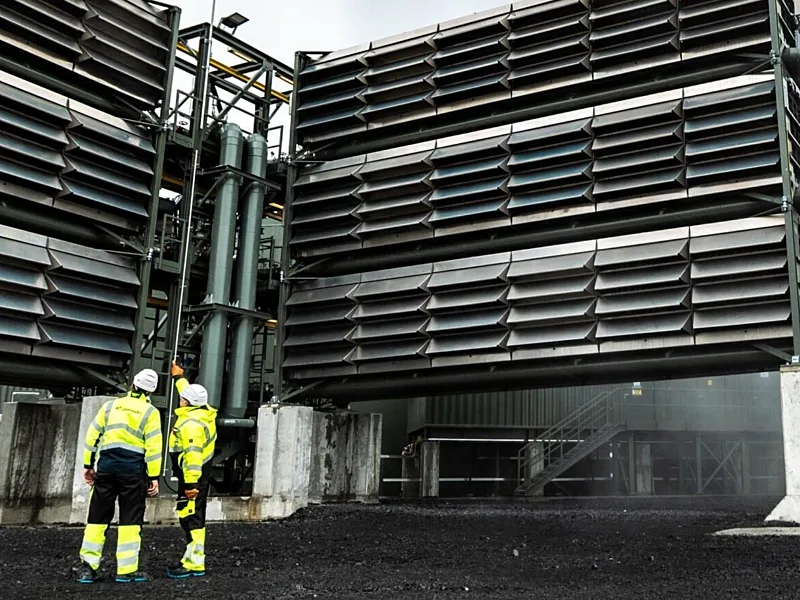
Europe's next carbon market reset will decide whether scarcity accelerates real decarbonisation or opens new compliance routes.
Clean Air Task Force argues for guarded carbon removals, wider coverage of aviation, shipping and waste, and targeted reinvestment.
For African markets connected through trade, travel and carbon finance, the design choices will shape emerging expectations around integrity, measurement and who pays for transition.
Europe's Carbon Market Enters Its Endgame
Beginning in mid-2026, the European Union is reviewing the Emissions Trading System, its flagship carbon-pricing instrument, as the bloc prepares for a 2040 climate target and net zero by 2050.
The decision will determine whether a shrinking supply of allowances continues to force deep emissions cuts or becomes diluted by poorly designed alternatives.
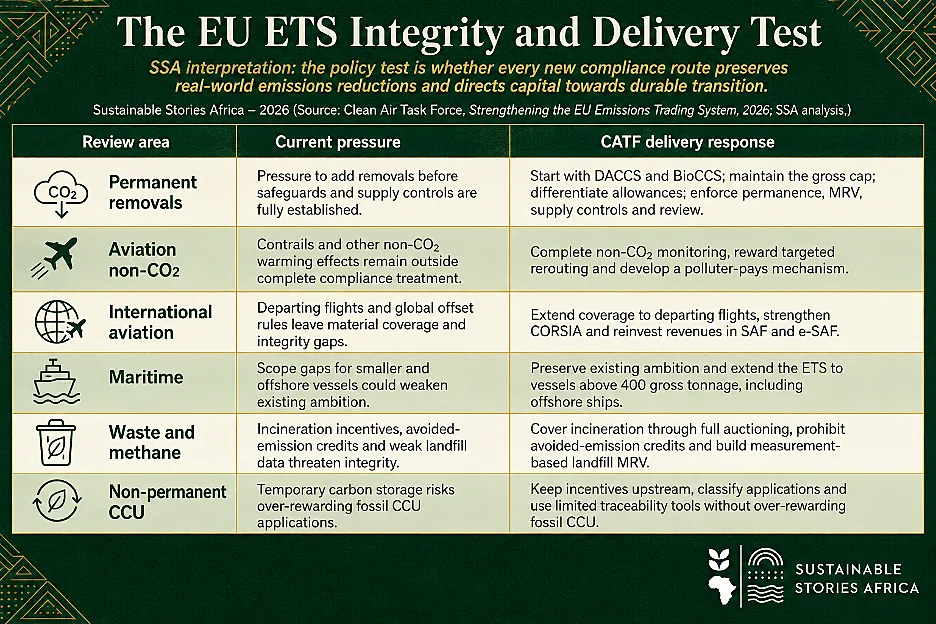
A 2026 Clean Air Task Force briefing places five questions at the centre of the review: how permanent carbon removals should enter the market; whether aviation coverage should widen; how maritime ambition can be preserved; whether municipal incinerators and landfills should pay; and how non-permanent carbon capture and utilisation should be treated.
These are European rules with wider consequences.
African exporters, airlines, ports, waste businesses and carbon-project developers operate in markets increasingly shaped by European compliance standards.
The central lesson is simple: carbon pricing only earns trust when measurement is credible, gross emissions keep falling, and revenues help finance real transition.
One Review, Five Pressure Points Converge
The EU ETS is moving towards an endgame.
- Under the current linear reduction factor, its cap could approach zero by 2039, raising price, liquidity and cost-efficiency.
- Permanent removals could support residual emissions and market volumes, but also let firms postpone cuts if every tonne removed permits another tonne emitted.
CATF frames the review as a test of the system's core function:
- Delivering deep, rapid and sustained reductions at credible cost.
The standard must apply across the package, including aviation warming, smaller vessels, incinerators and landfill methane.
For African markets, climate rules travel through value chains.
Wider aviation and shipping pricing can alter costs; stronger removal standards can influence project acceptance; and better methane measurement can reset waste expectations.
Policymakers should watch the architecture, not only the headline price.
Removals Need Guardrails, Not Easy Substitution
CATF supports high-integrity permanent removals such as direct air carbon capture and storage, or DACCS, and BioCCS for residual emissions.
The EU Carbon Removal and Carbon Farming Regulation provides a foundation for the certification framework, but demand policy remains weak.
CATF proposes gradual entry with five protections: keep the gross cap fixed by matching each removal with one fewer auctioned allowance; control supply by technology; differentiate allowance origins; require permanence and robust monitoring, reporting and verification; and review effects within two years of the revised rules taking effect.
Biochar and temporary removals require caution because uncertain permanence, low costs and biomass demand could crowd out alternatives or weaken abatement.
The ETS will not close every cost gap, especially for DACCS, so procurement, reverse auctions and carbon contracts for difference may still be needed.
Aviation's Hidden Warming Demands Direct Pricing
Contrails can equal or exceed a flight's near-term CO2 warming and still add roughly one-third over 100 years.
The impact is concentrated: about 80% of contrail warming comes from only 2% of flights.
Google and American Airlines tests used about 2% more fuel to reroute 3% to 5% of flights and cut contrail warming by 54% in satellite analysis.
CATF calls for full non-CO2 monitoring from 2027, avoidance incentives and a polluter-pays mechanism.
Long-haul services are less than 10% of departures but generate more than half of aviation CO2, rising to 56% by 2050.
Pricing all departing flights from 2012 to 2023 could have raised EUR 41 billion. CATF recommends extending the ETS to extra-EEA departures while strengthening CORSIA.
Up to 20 million allowances are reserved from 2024 to 2030 to narrow the sustainable-fuel price gap - up to 95% for renewable fuels of non-biological origin and 70% for advanced biofuels.
CATF wants support extended beyond 2030 and for revenues earmarked for fuel and contrail mitigation.
Shipping and Waste Expand Carbon Coverage
For shipping, CATF argues against retreat while global carbon pricing progress stalls.
- It proposes covering vessels with a 400 gross tonnage, including offshore ships.
- Smaller vessels on predictable routes may suit early electrification, hybrid propulsion and clean-fuel infrastructure near ports.
Waste creates a paired problem.
- The sector produces roughly one-quarter of EU human-caused methane.
- Pricing incinerators without landfills could encourage methane-intensive disposal.
CATF recommends full auctioning for incineration, no hypothetical avoided-landfill credits, and measurement-based landfill rules with direct monitoring, satellite reconciliation and independent verification.
Non-permanent carbon utilisation risks pricing embedded fossil carbon when captured and again when burned.
- CATF considers upstream pricing more prudent, potentially supported by Guarantees of Origin.
- Because fossil utilisation is projected to remain a small feedstock share, rules should protect integrity without excessive administration.
Stronger Signals Could Accelerate Clean Investment
A well-designed review would do more than add sectors to a ledger.
- It could create durable demand for permanent removals, give airlines confidence to finance new fuel pathways, help ports prepare for zero-carbon shipping and turn methane detection into an operational requirement rather than a reporting exercise.
- Earmarking revenues would connect the cost of pollution to the infrastructure needed to reduce it.
The opportunity for African economies lies in preparing early.
- Airlines and shipping companies can build fuel-efficiency and emissions data into commercial planning.
- Ports can test electrification and alternative-fuel readiness. Waste authorities can develop measurement-led methane programmes.
- Carbon-removal developers can prioritise additionality, lifecycle accounting and durable storage before international rules make weak projects unbankable.
The risk is uneven transition.
- Higher compliance costs can reach passengers, exporters and consumers, while technology finance remains concentrated elsewhere.
- African governments and regional bodies therefore need evidence on exposure, targeted support for affected sectors and negotiating positions that recognise climate responsibility without accepting low-integrity exemptions.
Regulators Must Align Prices, Rules, Revenues
EU institutions should preserve the declining emissions signal, separate reductions from removals in market information, close aviation and waste gaps, and direct a defined share of revenue towards sectoral decarbonisation.
Technology support should remain neutral enough to encourage innovation but strict enough to prevent unsustainable biomass, food-based fuel expansion or accounting claims that do not match atmospheric outcomes.
African regulators should translate the review into a preparedness agenda.
- That means mapping trade, aviation and maritime exposure; strengthening emissions and methane data; defining permanence and liability before issuing removal credits; and requiring transparent community, land and energy safeguards.
- Regional coordination can reduce fragmented standards and improve bargaining power with buyers, carriers and financiers.
Businesses should treat measurement as infrastructure.
- Credible fuel data, lifecycle emissions, waste-site monitoring and chain-of-custody records will increasingly determine market access and capital costs.
The winning transition strategy will not be the cheapest compliance claim, but the one that can prove a lasting reduction in atmospheric harm.
Path Forward – Carbon Market Built For Delivery
Europe should keep gross emissions falling while admitting only durable removals, pricing uncovered warming and reinvesting revenues in aviation, shipping and waste transition.
Clear review clauses must test whether safeguards work before they are relaxed.
African markets should use the review as an early warning system, to strengthen MRV, map cross-border exposure and demand fair access to transition finance.
Carbon pricing will be credible only when it changes infrastructure, protects communities and delivers measurable atmospheric outcomes.