A proposed licensing architecture could widen connectivity, but its success will depend on affordability, clarity and measurable public benefit.
Liberia's proposed 2026 satellite communications guidelines would place landing rights, space-segment filings and earth-segment services inside one national licensing system.
The real test is not whether the country can regulate orbit-to-ground connectivity, but whether fees, reporting duties and security controls translate into affordable access for communities beyond the reach of conventional networks.
Satellite Access Meets Liberia's Regulatory Test
Liberia is preparing to bring satellite connectivity under a more explicit regulatory architecture, setting out who may transmit signals into the country, which services require licences and what operators must pay.
The proposed Satellite Communications Guidelines 2026 cover geostationary and non-geostationary systems in Liberia's terrestrial, maritime and aeronautical territory.
The framework arrives as satellite broadband, backhaul and direct-to-device services reshape the economics of connecting remote communities.
For Liberia, where difficult terrain and the cost of terrestrial infrastructure can constrain coverage, satellites can provide redundancy, extend service to underserved places and support aviation, shipping, broadcasting and public services.
However, connectivity is only one side of the policy choice.
- The Liberia Telecommunications Authority, or LTA, is also seeking oversight of spectrum, cybersecurity, data sovereignty, consumer protection and national security.
- Whether those goals reinforce universal access or create a costly entry barrier will depend on how the guidelines are finalised and implemented.
New Gateway Requires Multiple Permissions
The proposed rules make landing rights the first regulatory gate.
- A satellite provider would need LTA authorisation before transmitting to or receiving from earth terminals in Liberia.
- That approval could support very small aperture terminals, licensed telecommunications providers and earth stations in motion on aircraft, ships or vehicles for no more than 90 successive days.
Landing rights alone would not authorise direct transmission to international mobile telecommunications devices for voice or data.
- Direct-to-device service appears separately among earth-segment activities requiring a satellite communications licence.
- This distinction matters because consumers increasingly expect ordinary phones to connect through satellites, while regulators must decide how those services interact with mobile operators, emergency communications and spectrum assignments.
Applicants for landing rights would submit proof of International Telecommunication Union filings, a certified home-country licence, system specifications, coverage maps, intended users and a data-routing and cybersecurity plan.
Providers would also have to keep current technical records, disclose prices and performance standards, maintain a register of customers in Liberia and confirm that local service partners hold the appropriate LTA permissions.
Fees Reveal the Market's Real Entry Price
The framework does more than define services; it attaches layered costs to market entry.
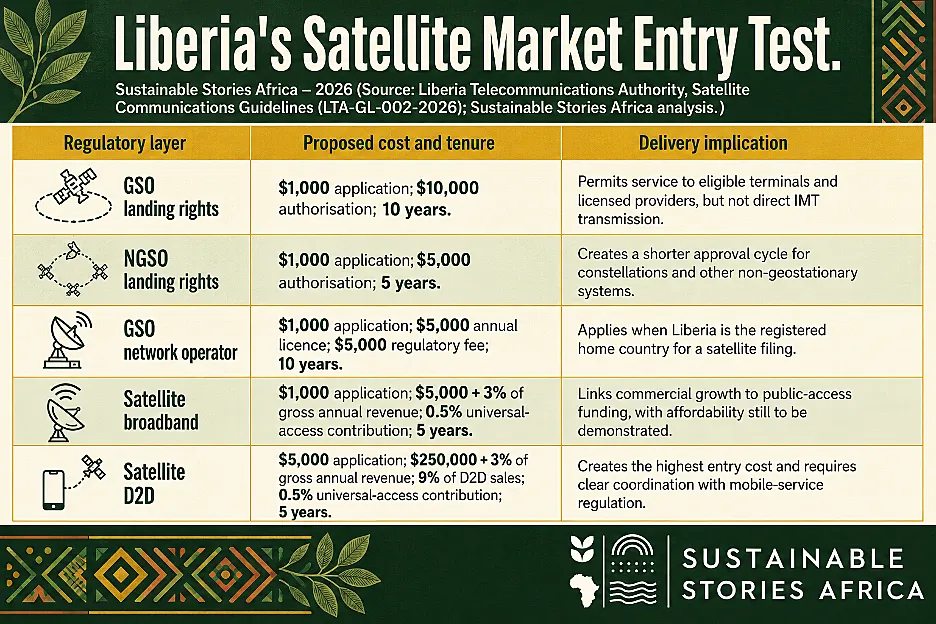
- A provider may need landing rights in the space segment, a network-operator licence if Liberia is used as the satellite's registered home country, and an earth-segment licence for the service sold locally.
- Tenures also differ: ten years for a geostationary system, but five years for a non-geostationary system and most earth services.
The most demanding category is direct-to-device service.
- Its proposed annual charge combines a $250,000 licence fee, 3 per cent of gross annual revenue, a regulatory fee equal to 9% of D2D voice and data sales, and a 0.5% universal-access contribution.
- For satellite broadband, the annual licence fee would be $5,000 plus 3 per cent of gross annual revenue, alongside the 0.5 per cent universal-access contribution.
- Commercial VSAT service would carry a $100 application fee and an annual charge of $1,000 plus 3 per cent of gross annual revenue.
- Non-commercial VSAT users would pay $500 per terminal. Gateway, backhaul, broadcasting and managed-data services each have separate fee structures, making licence selection a material part of an operator's business case.
Earth-segment licensees would report quarterly on subscriber distribution, resellers, technical performance and complaint resolution.
- That reporting can become a strong public-interest tool if the LTA publishes aggregated coverage, quality and affordability indicators.
Without transparent outcomes, compliance may measure paperwork more effectively than connectivity.
Rules Could Make Remoteness Less Expensive
A predictable framework can lower uncertainty for investors and give licensed mobile operators, internet providers and broadcasters a clearer route to satellite capacity.
- For remote clinics, schools, border communities, farms and disaster-response teams, that could mean connectivity without waiting for fibre or towers to reach every location.
- Maritime and aeronautical permissions could also support safer transport and more resilient logistics.
The universal-access objectives are especially important.
- A revenue contribution from satellite broadband and D2D services could help fund connectivity where purely commercial deployment is unattractive.
- However, the guidelines do not yet specify how those contributions would be allocated, which communities would be prioritised or what affordability threshold would define success.
The strongest outcome would be a market in which regulation does three things at once:
- Protects users, encourages credible operators and expands service.
The weakest would be a licensing system that produces government oversight without producing lower prices, wider coverage or faster complaint resolution.
Public reporting can make the difference visible.
Regulation Must Prove Access and Trust
Before implementation, the LTA should publish final application forms, decision timelines, renewal rules and a single map showing how landing rights, frequency authorisation, type approval and earth-segment licences fit together.
- It should also clarify the route from the landing-right restriction on direct IMT transmission to the separate D2D licence, so investors and mobile operators understand which permission authorises what activity.
Consumer outcomes need equal precision. Licence conditions should define minimum service availability, speed and complaint-handling standards; require clear retail price disclosure; and protect user data across cross-border routing arrangements.
- Quarterly reports should be converted into an accessible dashboard covering subscribers by county, outages, complaints, resolution time and universal-access spending.
Fee proportionality also deserves review.
- High fixed costs may be defensible for national-scale D2D operations, but they could discourage pilots or smaller specialised services.
- A phased or tiered approach tied to scale, revenue and public-interest deployment could preserve oversight while allowing innovation.
- Competitive safeguards should prevent satellite access from becoming dependent on a narrow group of intermediaries.
Finally, the legal status must be unmistakable.
- The proposed guidelines become effective only upon approval and publication in the National Gazette.
- Until those steps occur, stakeholders should treat the text as a proposed framework, and the LTA should clearly communicate consultation, adoption and commencement milestones.
Path Forward – From Licensing Rules to Measurable Access
Liberia should finalise a clear, proportionate licensing pathway, publish its effective date and resolve the D2D authorisation sequence before operators commit capital.
The public test is measurable: more communities connected, better service quality, affordable prices, protected data and transparent use of universal-access contributions. Regulation will matter only when those outcomes reach people beyond existing networks.