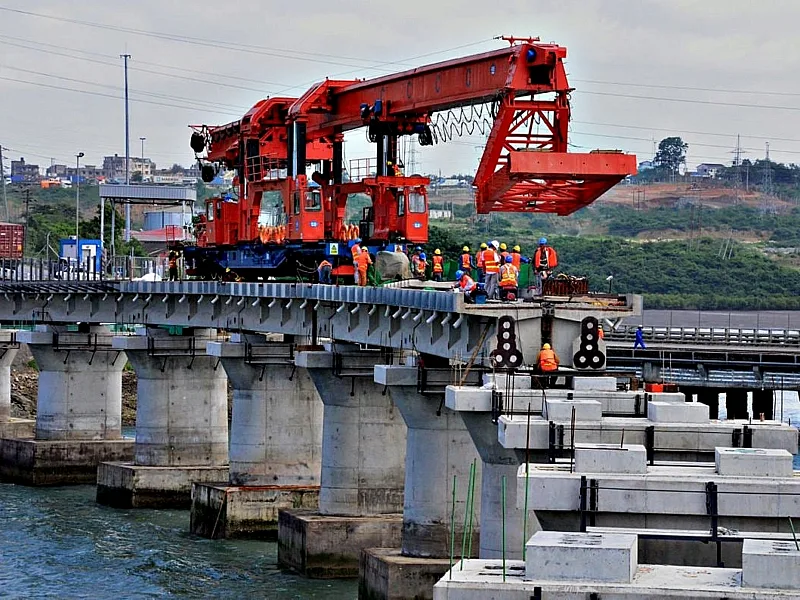
Morocco entered 2026 with its strongest growth cycle in more than a decade, but the next stage depends on productivity, not infrastructure spending alone.
A World Bank survey of 1,256 firms finds broad adoption of basic digital tools but limited integration of advanced systems.
Closing that usage gap could lift aggregate productivity by 10-15%.
Morocco’s growth needs a digital handover
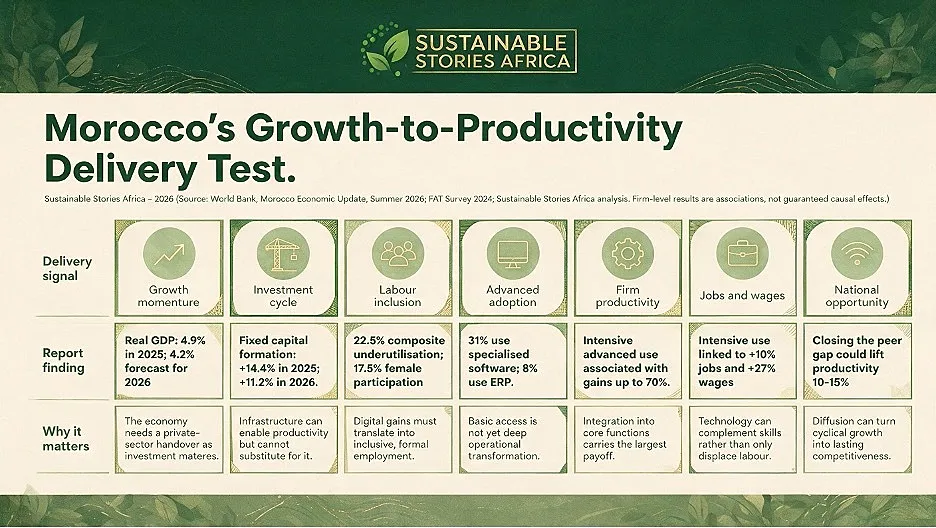
Morocco’s economy expanded by 4.9% in 2025, its fastest pace in almost a decade and part of the strongest growth cycle in more than ten years.
Agriculture rebounded, tourism and mining grew, construction benefited from major infrastructure projects, and investment accelerated ahead of the 2030 FIFA World Cup.
The World Bank expects growth to moderate to 4.2% in 2026 as Middle East conflict raises energy and freight costs.
Public investment remains a powerful engine, but the medium-term test is whether private firms can take over through higher productivity, stronger household incomes and more durable job creation.
The Bank’s Summer 2026 Morocco Economic Update identifies incomplete digital transformation as a central constraint.
A nationally representative survey of 1,256 formal firms shows that technology ownership is spreading, but advanced tools are often absent or weakly integrated into the business processes that produce value.
Strong growth masks a productivity challenge
Morocco’s recent momentum is broad but investment-heavy.
- Gross fixed capital formation rose 14.4% in 2025 and is projected to expand another 11.2% in 2026.
- Inflation was contained at 0.8% in 2025, the fiscal deficit narrowed to 3.5% of GDP, and government debt stabilised at 66.6%.
Those buffers support the investment cycle, but they do not guarantee a sustained private-sector productivity acceleration.
External pressures are already testing the model.
The World Bank estimates that, without the Middle East shock, 2026 growth could have approached 5%; instead, the conflict is expected to subtract about 0.8 percentage points through higher energy import and freight costs.
Inflation is forecast to rise to 2.4%, while the current-account deficit widens from 2.4% to 3.3% of GDP.
The labour market adds urgency.
- Morocco created about 193,000 net jobs in 2025, more than twice the previous year, but a revised survey shows composite labour underutilisation of 22.5%.
- Female participation is only 17.5%, among the world’s lowest.
- Productivity growth must therefore create jobs while drawing more women and discouraged workers into formal economic activity.
The projected handover is visible in the medium-term numbers.
- Growth is expected to settle at 4.0% in 2027 and recover to 4.3% in 2028, while private consumption accelerates to 4.8%.
- Reserves remain near five months of imports and debt is projected to ease gradually after a small 2026 increase.
Those buffers create time for reform, but not a substitute for it.
Adoption without integration leaves gains unrealised
The Firm-level Adoption of Technology survey covers more than 300 technologies across 60 business functions.
- Moroccan firms sit near the middle of the 18-country comparison, suggesting meaningful progress, but remain well behind the frontier.
- The gap is particularly large among the country’s most sophisticated firms, which trail leading peers more than lower-performing businesses do.
Only 31% of establishments use specialised software, and just 8% rely on enterprise resource planning systems for business administration.
- Even among adopters, fewer than half use advanced technology intensively in administration and supply-chain management, roughly one-third do so in production planning, and fewer than one-quarter in quality control.
The problem is therefore depth of use, not simply access.
The payoff is substantial but should be read carefully.
- Firms in the highest technology-sophistication quintile are 50% more productive than those in the lowest after controlling for sector and size.
- Intensive use of advanced systems in administration and production planning is associated with productivity gains of about 70%; supply-chain and quality-control use is linked to gains near 50%.
The survey highlights this, not automatic returns from buying software.
Employment outcomes challenge the assumption that digitalisation must reduce jobs. Adoption is associated with 7% higher firm-level employment growth, intensive use with 10% higher growth and 27% higher wages.
The implication is that technology can complement skilled workers when firms reorganise processes around it.
Deeper use can lift firms and workers
Closing Morocco’s digital gap to comparator countries could raise aggregate productivity by 10-15%, the World Bank estimates.
- That scale of improvement would help convert World Cup-era infrastructure, nearshoring and foreign investment into a longer-lasting expansion led by competitive private firms rather than recurrent public spending.
The distribution of the gains matters.
- Exporters and firms linked to multinational enterprises tend to adopt more sophisticated technology because international markets transmit standards, know-how and competitive pressure.
- Stronger supplier links can extend those spillovers to domestic small and medium-sized enterprises, provided they receive practical support to change workflows, not just acquire hardware.
Workers can gain when skills policy moves with technology policy.
- Advanced tools increase demand for managers who can use performance indicators, redesign processes and train teams.
- Better digital capability can support more structured wage employment, but inclusion requires deliberate pathways for women, young people and workers leaving low-productivity agriculture.
The policy challenge is two-speed.
- Morocco must help its leading firms close the distance to global frontiers such as Korea, while lifting a much larger group of lagging firms into effective digital use.
Treating both groups alike would waste resources: frontier firms need advanced capability, international links and innovation support; laggards need diagnostics, basic management systems and guided implementation.
Policy must move beyond hardware access
Morocco’s Digital Morocco 2030 strategy provides a policy platform, but the report argues that supply-side incentives alone are insufficient.
- Tax relief, loans and equipment subsidies should be paired with technical assistance, hands-on training and structured partnerships between SMEs and digital solution providers.
- Support should be measured by adoption intensity and business-process change, not the number of licences distributed.
Management modernisation is equally important.
- Many less-digital firms overestimate their capabilities, weakening the incentive to upgrade.
- Benchmarking tools can show managers how their practices compare with domestic leaders and international peers.
- Programmes should link technology support to the use of key performance indicators, worker incentives and formal improvement plans.
Skills institutions should coordinate with firm-level programmes.
- Vocational education, universities and lifelong-learning providers need curricula built around actual business functions - administration, production planning, supply chains and quality control.
- Public support can reward firms that train workers and demonstrate progression into higher-value roles, including targeted participation by women.
Finally, competition and international exposure should become digital policy tools.
- Reducing market-entry barriers, strengthening export readiness, attracting quality foreign direct investment and building supplier-development programmes can create the pressure and knowledge transfer that accelerate adoption.
- Government schemes must also reach smaller firms; awareness and participation currently favour larger, better-connected enterprises.
Path Forward – Turn infrastructure momentum into lasting productivity
Morocco’s next growth phase depends on moving firms from owning digital tools to using them intensively.
Technical assistance, management reform, skills development and competitive pressure should operate as one productivity system.
Success will mean more than higher software adoption. It should pick up in output per worker, formal job creation, women’s participation, wage growth, SME supplier capability and stronger private investment as the current public infrastructure cycle matures.