Infrastructure projects do not fail to be agile simply because teams move slowly.
They struggle when procurement, governance, regulation and stakeholder decisions are treated as interruptions rather than part of delivery.
For African project leaders, the practical shift is clear: agility must mean faster learning and better decisions, while protecting safety, public value and institutional confidence.
Africa's Infrastructure Ambition Meets Delivery Friction
A road, power plant, water network or logistics hub may be managed through modern delivery methods; however, it cannot be run like a software sprint detached from contracts, approvals and physical risk.
That is the central argument in Dami Owaseye's practitioner explainer, Why Infrastructure Projects Struggle to Stay Agile:
- Infrastructure does not need less agility; it needs a form of agility that respects the system in which projects are delivered.
The distinction matters across African and other emerging markets, where a single programme can bring together public agencies, financiers, contractors, regulators, communities and external suppliers.
Each actor carries different responsibilities, incentives and timelines. Speed is valuable, but only when it is coordinated.
An accelerated decision that ignores procurement rules, stakeholder consent, or environmental obligations can create rework, disputes and loss of public confidence.
The better question thus is not whether infrastructure teams should use Agile methods.
- It is how they can build adaptability without compromising confidence.
That reframes agility from a race for velocity into a discipline for making sound decisions sooner, learning before costs become locked in, and responding to change without weakening governance.
Speed Alone Cannot Deliver Infrastructure Confidence
Owaseye challenges one of the most persistent assumptions in transformation work:
That Agile means moving fast.
In infrastructure, speed without coordination can multiply the cost of a wrong decision.
- Designs connect to contracts; contracts connect to suppliers; approvals connect to financing; and construction choices can affect safety and operations for decades.
- The delivery system is interdependent; as such, local acceleration can create wider delay.
Sometimes the most agile decision is to pause execution long enough to align the people whose approval, funding or operational support will determine whether the project can proceed.
- That pause is not passivity.
- It is an effort to remove uncertainty before it becomes an expensive variation order, a procurement dispute or a stalled worksite.
This is especially important where public infrastructure must also demonstrate value for money, social legitimacy and environmental responsibility.
- A project team may complete a sprint on time and still fail the programme if the output cannot pass assurance, secure a sponsor's decision or fit the contract.
Agility should therefore be measured by the speed and quality of learning across the whole delivery chain, rather than the team's velocity.
Procurement and Governance Shape Every Sprint
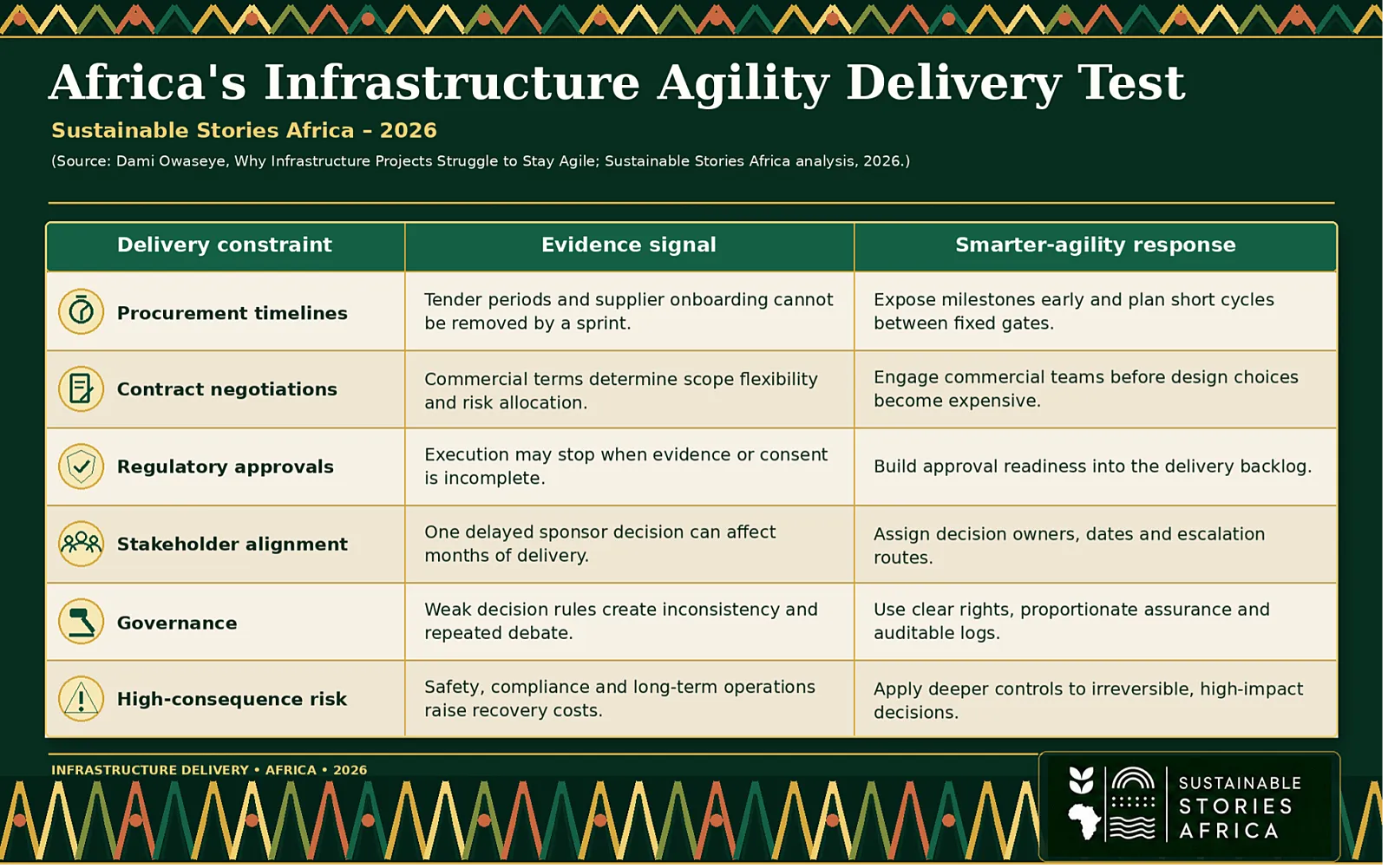
Procurement is not an administrative stage sitting outside delivery.
- It determines when suppliers can be engaged
- What can be changed
- How risk is allocated
- Which decisions require formal approval.
Contract negotiations, tender periods, regulatory reviews and supplier lead times are part of the project's operating reality.
No sprint can remove them; however, a well-designed programme can make them visible early and plan around them.
Governance plays a similar role.
- Attempts to remove governance in the name of agility can produce inconsistent decisions, unclear accountability and declining stakeholder confidence.
- Strong governance does not require endless committees.
It requires clear decision rights, proportionate assurance, accessible evidence and a predictable route for escalation.
- Poor governance slows delivery because teams repeatedly revisit questions that should have been settled once.
Stakeholder alignment can be more valuable than sprint velocity.
- One delayed executive approval can affect months of work, while one unresolved community or regulatory issue can stop physical execution altogether.
The programme leader's job is therefore to reduce decision friction across organisational boundaries, not simply to push delivery teams to work faster.
Adaptability Can Strengthen Confidence and Value
Smarter agility encourages better outcomes than choosing between rigid control and reckless speed.
- It enables leaders to test assumptions before full-scale commitment, sequence irreversible decisions carefully and keep reversible decisions flexible.
- It also creates regular moments for sponsors, technical teams, operators and affected stakeholders to examine evidence together.
The benefits are practical.
- Earlier alignment can reduce redesign.
- Visible dependencies can improve procurement readiness.
- Shorter decision cycles can help teams respond to price shocks, supply disruption or new regulatory requirements.
- A shared risk view can protect safety and environmental performance without turning every issue into a programme-wide stop.
In African markets, this discipline can also bridge institutional discontinuity.
- Infrastructure projects may outlast budget cycles, political administrations and leadership teams.
- A clear record of assumptions, decisions and responsibilities makes adaptation possible without restarting the programme whenever people change.
- It also helps lenders and delivery partners distinguish a justified course correction from weak scope control.
Governance, in this sense, becomes the institutional memory that enables agility to survive across a long project life.
For financiers and public institutions, this approach strengthens confidence and supports adaptability through an auditable decision process.
For communities, it improves the chance that concerns are addressed before construction choices become fixed.
For delivery teams, it replaces the false promise of unrestricted speed with a workable system for moving through complexity.
Leaders Must Redesign Agility Around Reality
The first action is to design delivery around the project's real constraints.
- Procurement milestones, regulatory gates, land access, financing conditions and long-lead equipment should appear in the same planning view as design and construction work.
- Teams can then use shorter planning cycles to manage the space between those fixed points instead of pretending the fixed points do not exist.
Second, leaders should map decision rights.
- Every major decision needs an owner, a deadline, the evidence required and a defined escalation route.
- Availability of Sponsors must be treated as a delivery dependency.
- Decision logs should capture why a choice was made, what assumptions support it and when it should be revisited.
Third, assurance should be risk-based.
- Multi-million-pound or multi-billion-naira investments, public safety, environmental compliance and long-term operational effects justify deeper scrutiny than a reversible internal process change.
- The aim is not to apply maximum control everywhere, but to concentrate control where failure would be hardest to recover from.
Finally, performance measures must be widened.
- Sprint completion and task velocity should sit beside decision cycle time, approval readiness, unresolved dependencies, rework, safety indicators and stakeholder confidence.
- Those measures reveal whether the programme is genuinely becoming more adaptable or merely moving activity faster.
Path Forward – Building Infrastructure That Adapts With Confidence
Africa's infrastructure pipeline needs delivery systems that can learn and adjust without weakening accountability.
That means integrating procurement, governance, risk and stakeholder alignment into Agile practice from the start.
The path forward is smarter agility: clarify decisions, expose dependencies, apply assurance in proportion to risk and measure value beyond velocity.
Real transformation begins when adaptability and confidence reinforce each other.