
In Africa's boardrooms, something structural is changing. Hard evidence now confirms that governance, diversity, board independence, and disciplined oversight increase firm value, but only when ESG performance strengthens governance credibility and market trust.
This is not theory; this is market reality: boards that embed ESG discipline create more valuable firms.
Boards, ESG, Markets, Value, Proof, Africa
Across Sub-Saharan Africa, corporate governance has matured from compliance language to an economic weapon. This is based on a powerful research insight that: ESG performance does not merely sit beside corporate governance; it amplifies governance into market value, especially in developing economies where credibility, trust, and sustainability execution are contested strategic assets.
Drawing on 4706 firm-year observations across 362 manufacturing companies in Sub-Saharan Africa (2010–2022), the study proves that firms with gender-diverse boards, independent directors, foreign expertise, strong board structures, and effective meeting governance experience higher firm value and this positive impact gets dramatically stronger when ESG performance is embedded into governance systems.
At the same time, poor governance behaviours, especially CEO duality and ineffective attendance dynamics, erode value.
The message is clear: in African markets, governance without ESG discipline is incomplete. ESG transforms governance from structural compliance into financial strength.
Africa's New Boardroom Truth: ESG Turns Governance Into Market Value
For years, African companies have debated ESG's relevance. This study closes that debate. Hard data now proves that corporate governance improves firm value, and ESG makes that result stronger, deeper, and more resilient.
Boards with women, foreign nationals, capable size, independence, regular meetings and strong governance ethos outperform peers; concentrated leadership power weakens valuation.
The results are consistent, statistically significant, and robust across models. Markets reward structure. Markets punish governance shortcuts.
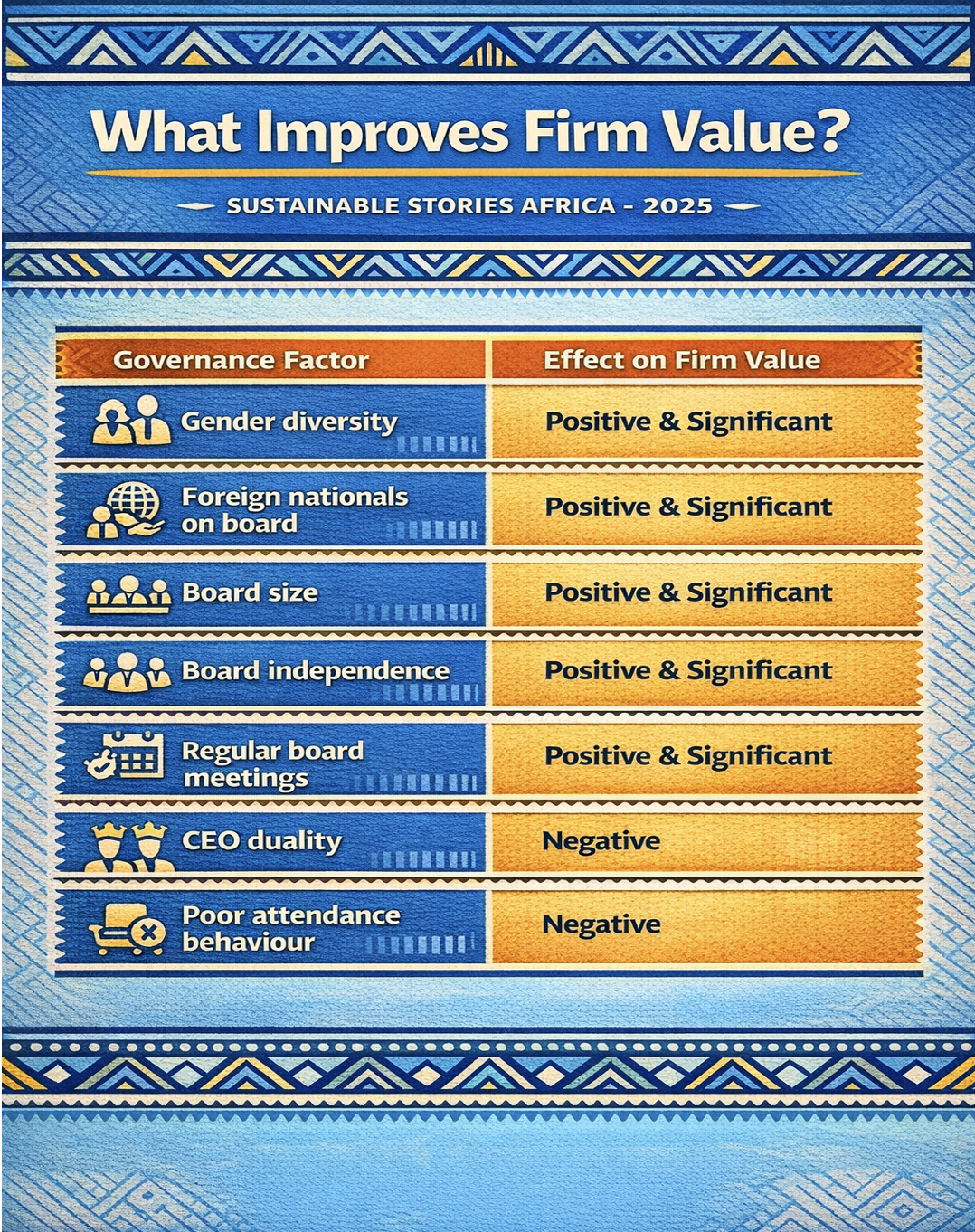
What Improves Firm Value?
| Governance Factor | Effect on Firm Value |
|---|---|
| Gender diversity | Positive & Significant |
| Foreign nationals on board | Positive & Significant |
| Board size | Positive & Significant |
| Board independence | Positive & Significant |
| Regular board meetings | Positive & Significant |
| CEO duality | Negative |
| Poor attendance behaviour | Negative |
Why Governance Matters and Why ESG Makes It Even Stronger
The research is uniquely African and uniquely relevant. Based on Sub-Saharan African manufacturing firms, the study uses advanced econometric models (CCEMG, AMG, 2SLS robustness) to prove credibility.
Board diversity, structural integrity, and process discipline drive firm value, not rhetoric, not press releases, not public relations claims.
However, here is the transformative insight: ESG performance strengthens every positive governance factor. With ESG in the mix, the coefficients rise, the market response deepens, and firm value strengthens.
ESG makes boards more accountable, signals legitimacy to stakeholders, reduces perceived risk, builds investor trust, and stabilises corporate reputation. This is not ESG as branding. This is ESG as economic architecture.
Africa's markets are saying: prove your governance, back it with ESG and value follows.
What Africa Gains if Boards Get ESG Right
If African firms internalise this evidence, three transformational outcomes emerge:
- More Valuable Companies – Markets reward disciplined governance supported by ESG credibility.
- Stronger Investment Appeal – Foreign and domestic investors interpret ESG + governance alignment as institutional maturity.
- Economic Stability and Corporate Longevity – Better governance reduces risk shocks, mismanagement failures, and corporate reputation crises.
The study highlights a second truth: ESG is not an accessory to governance. It is the multiplier that turns governance into long-term value.
What Boards, Regulators, and Investors Must Do Now
Based on clear empirical evidence, Africa's corporate systems now face three urgent imperatives:
- Boards must embed ESG frameworks directly into governance processes.
- Regulators should mandate ESG integration as a governance discipline, not disclosure cosmetics.
- Investors must reward firms that prove credible ESG governance execution.
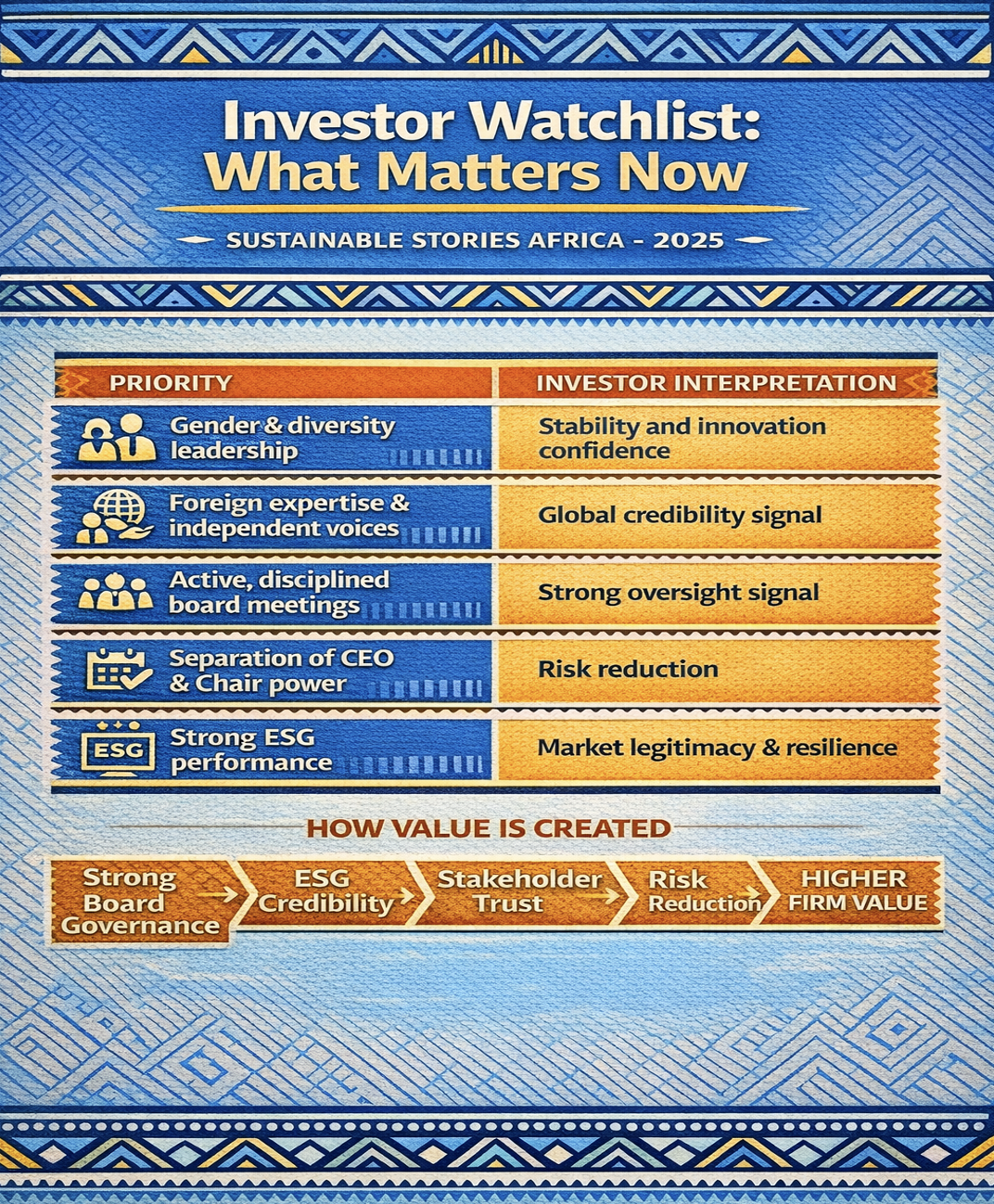
Investor Watchlist: What Matters Now
| Priority | Investor Interpretation |
|---|---|
| Gender & diversity leadership | Stability and innovation confidence |
| Foreign expertise & independent voices | Global credibility signal |
| Active, disciplined board meetings | Strong oversight signal |
| Separation of CEO & Chair power | Risk reduction |
| Strong ESG performance | Market legitimacy & resilience |
Because ultimately, markets do not reward noise. Markets reward governance discipline proven through ESG performance.
PATH FORWARD – Govern Better. Embed ESG. Build Value.
African firms must integrate ESG deeply into governance frameworks, not performatively, but structurally. Boards must strengthen diversity, independence, and disciplined oversight, while regulators institutionalise ESG as governance accountability.
With evidence now clear, the priority is execution: stronger board cultures, ESG-aligned decision-making, credible disclosures, and disciplined leadership separation.
This is how African companies secure trust, attract capital, stabilise value and move confidently into a climate-conscious economic future.