Gulf states are rapidly expanding their footprint in Africa’s energy transition, positioning themselves as major investors in renewable energy, hydrogen development and green industrial infrastructure across the continent.
From multi-billion-dollar wind and solar projects to emerging green hydrogen hubs, partnerships between Gulf economies and African governments are reshaping the geopolitics of clean energy while raising important questions around sustainability, governance and long-term development outcomes.
Gulf Investments Reshape Africa Energy Transition
Africa’s energy transition is increasingly being shaped by an unexpected set of partners: the Gulf states.
Traditionally associated with oil and gas exports, countries such as the United Arab Emirates, Saudi Arabia and Qatar are emerging as major financiers and strategic partners in Africa’s renewable energy expansion, according to the AGDA Insight report.
Driven by economic diversification strategies and global climate commitments, Gulf investors are channelling billions of dollars into solar, wind and hydrogen infrastructure across the continent.
These investments are supporting Africa’s growing electricity demand but also positioning the region as a potential hub for green industrial production.
The shift reflects a broader transformation in global energy geopolitics. As Africa seeks capital to close its massive infrastructure gap, Gulf states are leveraging financial strength, technological expertise and flexible financing models to accelerate clean energy development across the continent.
Gulf States Expand Influence Across Africa
Gulf economies, especially the United Arab Emirates and Saudi Arabia, are increasingly adopting “rule-shaper” roles in global climate and energy diplomacy.
Their growing engagement in Africa reflects a deliberate strategy to diversify economies while securing long-term influence in emerging energy markets.
According to the AGDA Insight report, Gulf states are pursuing investments in renewable energy and hydrogen projects while exporting low-carbon technologies and expertise across Africa.
The UAE has pledged more than $110 billion in contributions between 2019 and 2023, while Saudi Arabia’s Vision 2030 framework allocates approximately $190 billion toward clean energy development.
These investments are positioning Gulf states as pivotal actors in Africa’s energy transition, complementing traditional Western financing while expanding South-South cooperation.
Strategic Partnerships Drive Clean Energy Expansion
Several flagship projects illustrate the growing depth of Gulf-Africa energy collaboration.
These partnerships combine financing, technology transfer and infrastructure development, enabling large-scale renewable energy projects across the continent.
Major Gulf-Africa Energy Transition Projects
Project | Country | Capacity | Investment/Key Impact |
|---|---|---|---|
Aysha-1 Wind Project | Ethiopia | 300 MW | Expected to power 140,000 households |
AMAN Green Hydrogen | Mauritania | 8 million tonnes of hydrogen potential | Multi-phase project targeting exports to Europe |
ACWA Wind Project | Egypt | 1.1 GW | One of Africa’s largest wind farms |
ACWA CSP Solar | South Africa | 100 MW | Supplies electricity to 200,000 homes |
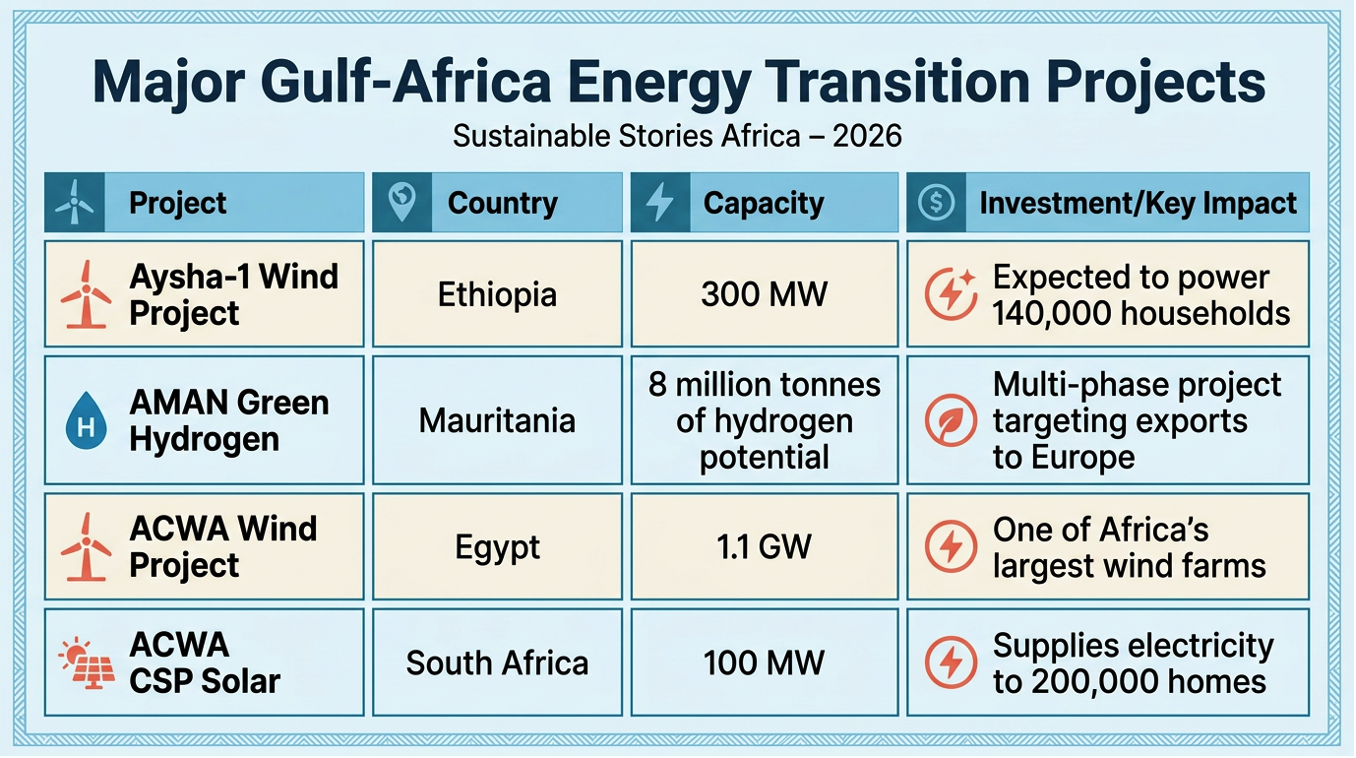
The Aysha-1 wind project in Ethiopia, developed with UAE-based AMEA Power, is expected to provide electricity to approximately 140,000 households while preventing nearly 690,000 tonnes of CO₂ emissions annually.
Meanwhile, Mauritania’s AMAN Green Hydrogen project aims to produce up to 8 million tonnes of green hydrogen annually, positioning the country as a potential exporter to European energy markets.
Large-Scale Investments Transform Energy Landscape
Africa’s energy deficit remains one of the largest barriers to economic development, with more than 600 million people lacking reliable electricity access.
Large-scale renewable energy projects backed by Gulf investors are therefore emerging as a critical solution.
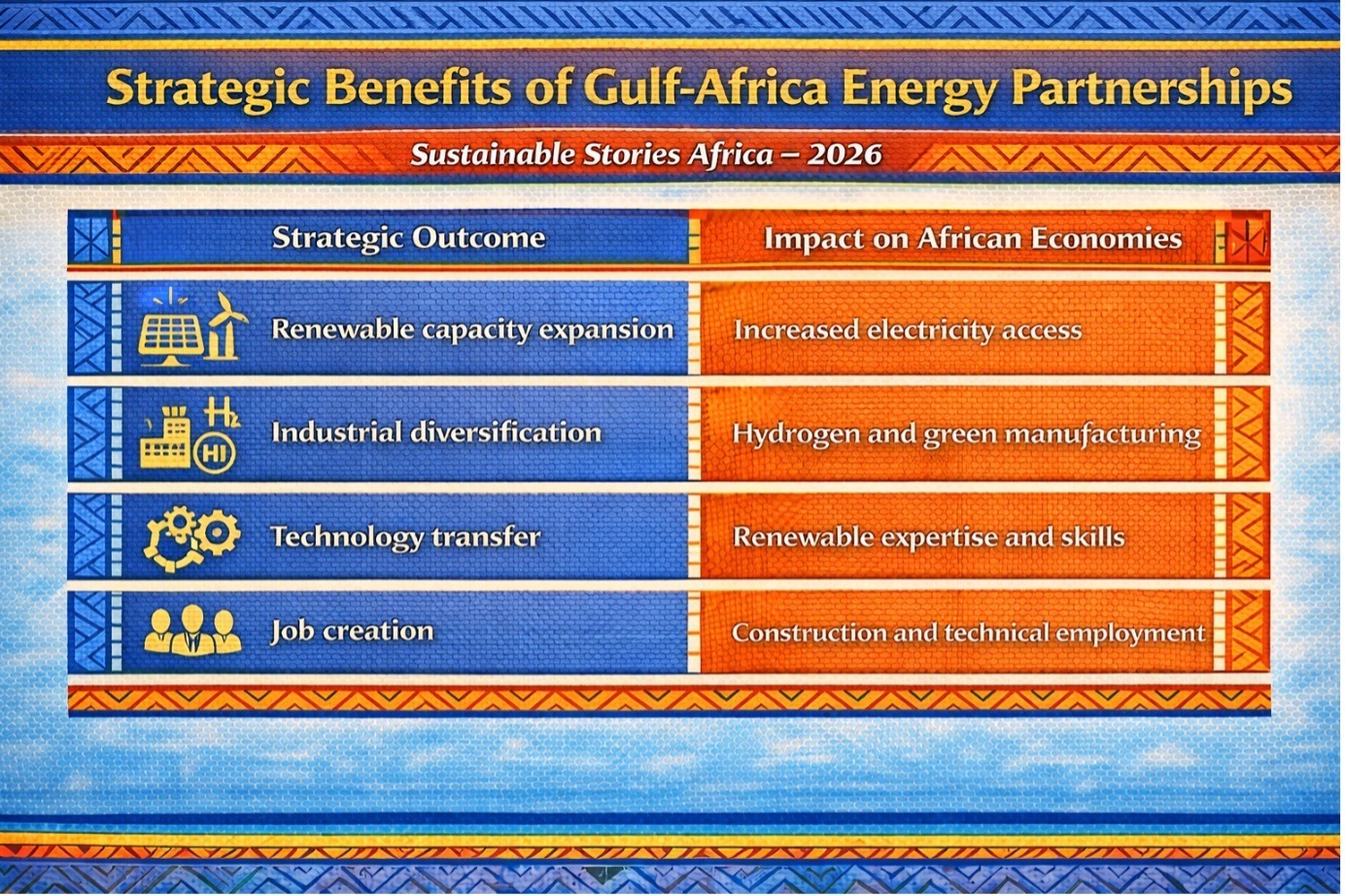
Strategic Benefits of Gulf-Africa Energy Partnerships
Strategic Outcome | Impact on African Economies |
|---|---|
Renewable capacity expansion | Increased electricity access |
Industrial diversification | Hydrogen and green manufacturing |
Technology transfer | Renewable expertise and skills |
Job creation | Construction and technical employment |
Projects such as ACWA Power’s solar and wind developments in Egypt and Morocco are helping accelerate renewable energy deployment while aligning with national decarbonisation targets.
Similarly, South Africa’s Redstone Concentrated Solar Power plant, supported by ACWA Power, is expected to generate approximately 480 GWh annually, reducing approximately 440,000 tonnes of CO₂ emissions annually.
Beyond energy generation, these projects contribute to job creation, technology transfer and the development of local supply chains.
Balancing Opportunity With Governance Risks
Despite the opportunities, experts caution that Gulf-Africa energy partnerships also carry risks that require careful governance.
Key concerns include regulatory instability, environmental and social impacts, and the potential for economic dependency if projects are focused primarily on export markets rather than domestic energy access.
For example, mega-projects such as Mauritania’s hydrogen development could expose host countries to volatile global markets and carbon policy shifts if export demand declines.
In addition, weak regulatory frameworks in some African countries could complicate project implementation or create long-term governance risks.
The report emphasises that transparent procurement processes, environmental safeguards and inclusive stakeholder engagement are critical for ensuring that Gulf investments deliver long-term development benefits.
Path Forward – Strengthening Responsible Gulf-Africa Energy Partnerships
Ensuring the long-term success of Gulf-Africa energy partnerships will require stronger governance frameworks, transparent investment processes and inclusive stakeholder engagement.
By embedding sustainability standards, local capacity development and diversified partnerships into energy projects, African governments and Gulf investors can build a resilient model for climate cooperation that accelerates renewable deployment while delivering shared economic benefits.