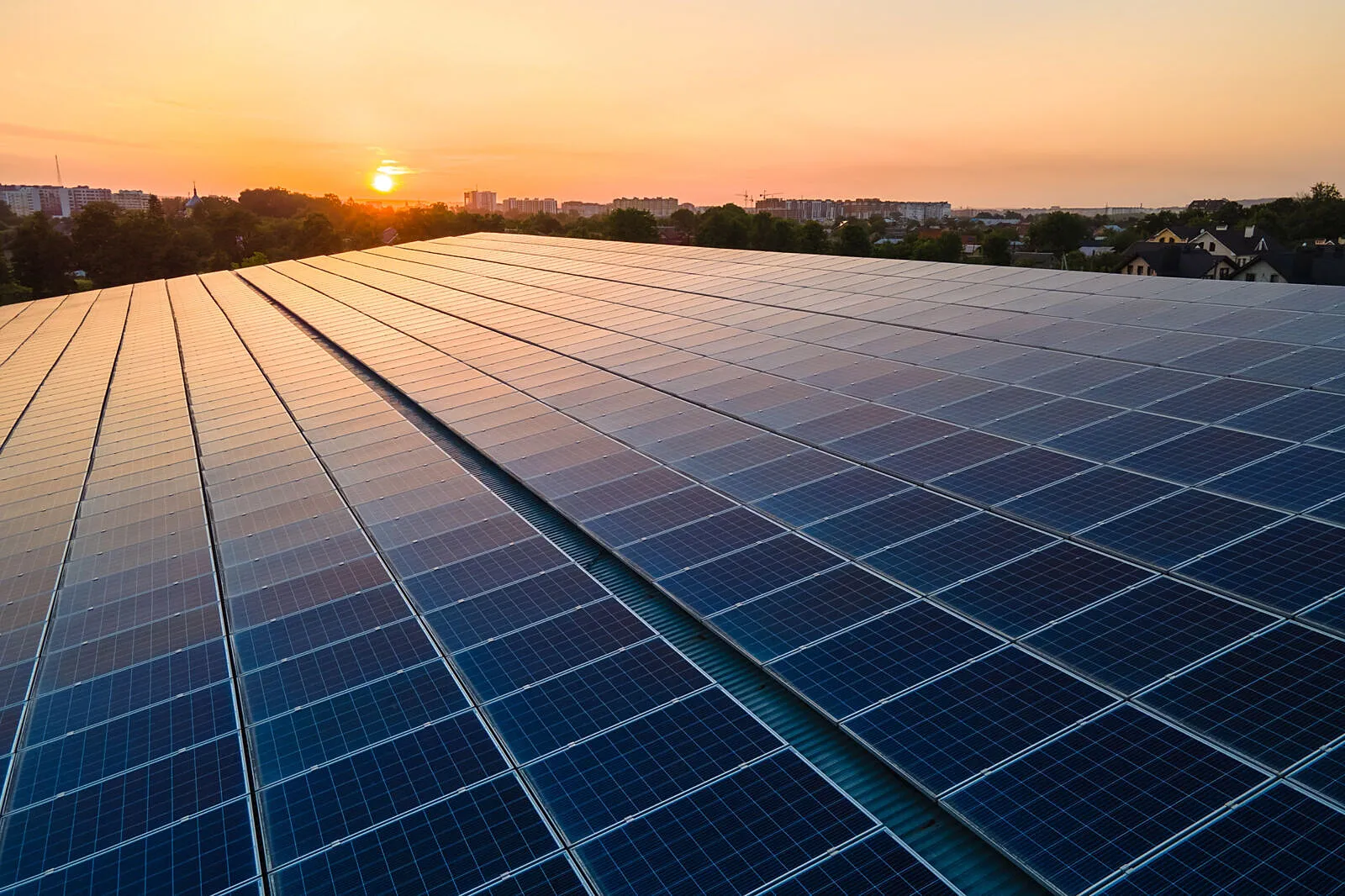
Zambia’s green bond tranches show how a utility can raise capital to expand solar generation. The nature question runs from where power is produced to how it reaches the grid.
Developers can build habitat, water and land safeguards into projects early enough to change which sites and technologies they choose.
Power Access Has a Physical Footprint
An electricity connection can support a clinic, a workshop or a cold room for a fishing business. Supplying that electricity requires equipment, land and a route to the user.
- A good project considers the pressure that route places on rivers, grasslands, wildlife and the people using those places.
This Sustainable Stories Africa special on nature’s business draws on The Little Book of Nature Business, the 2026 Global Canopy publication by John Tobin-de la Puente and Andrew W. Mitchell.
- Chapter six follows electricity generation and transmission and considers where design, operations and finance can reduce ecosystem impacts.
The African decision is especially concrete where households and enterprises still lack reliable power.
- Utilities need affordable new capacity and resilient networks.
- Water scarcity, contested land use or damage to important habitat can undermine service delivery if addressed late.
Ecological safeguards can inform the engineering design and the procurement plan from the beginning.
The Access Gap Raises Delivery Stakes
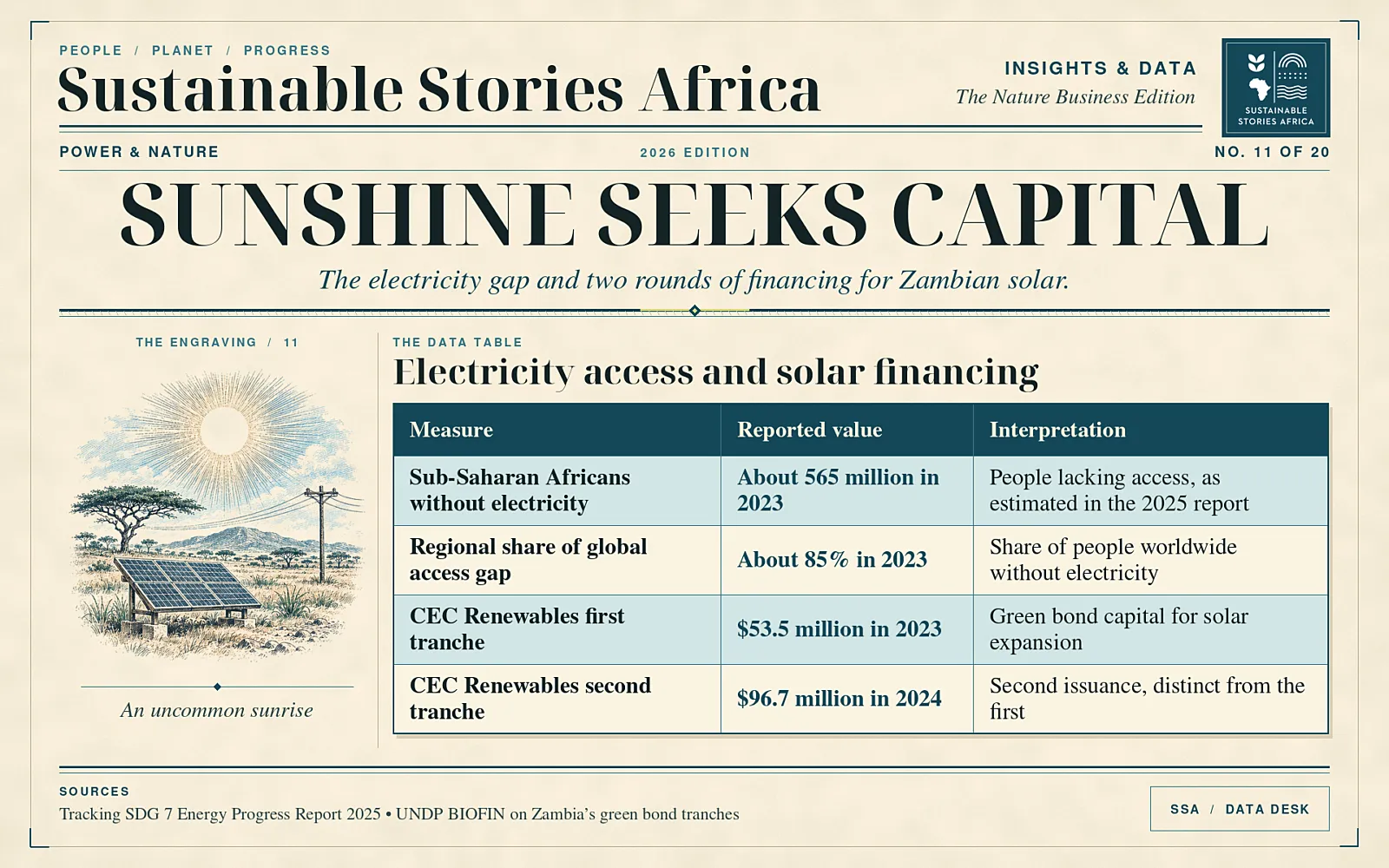
The 2025 Tracking SDG7 assessment estimated that about 565 million people in sub-Saharan Africa lacked access to electricity in 2023, roughly 85% of the global gap.
- Access captures whether people have electricity under the report’s definition.
- Affordability, outages and the service quality available to a business are additional considerations when judging gains from a new project.
Zambia’s CEC Renewables raised $53.5 million through its first green bond tranche in 2023 and announced a $96.7 million second tranche in December 2024.
UNDP’s BIOFIN initiative linked the financing to expanding solar generation.
- A green bond can mobilise capital and define eligible uses.
- To understand the nature of the outcome, the financing record must align with information on sites, transmission routes and operating practices.
Kenya’s Lake Turkana Wind Power project provides the scale at which siting decisions operate.
- A parliamentary report describes a 310 MW wind farm in Marsabit County with 365 turbines and a high-voltage substation.
- The footprint of a project at that scale includes more than the turbine foundations.
- Roads, transmission access, maintenance activity and seasonal land uses all belong in the analysis.
Comparable projects need early decisions about which data can be gathered before routes and sites are fixed.
Power Projects Carry Different Ecological Pressures
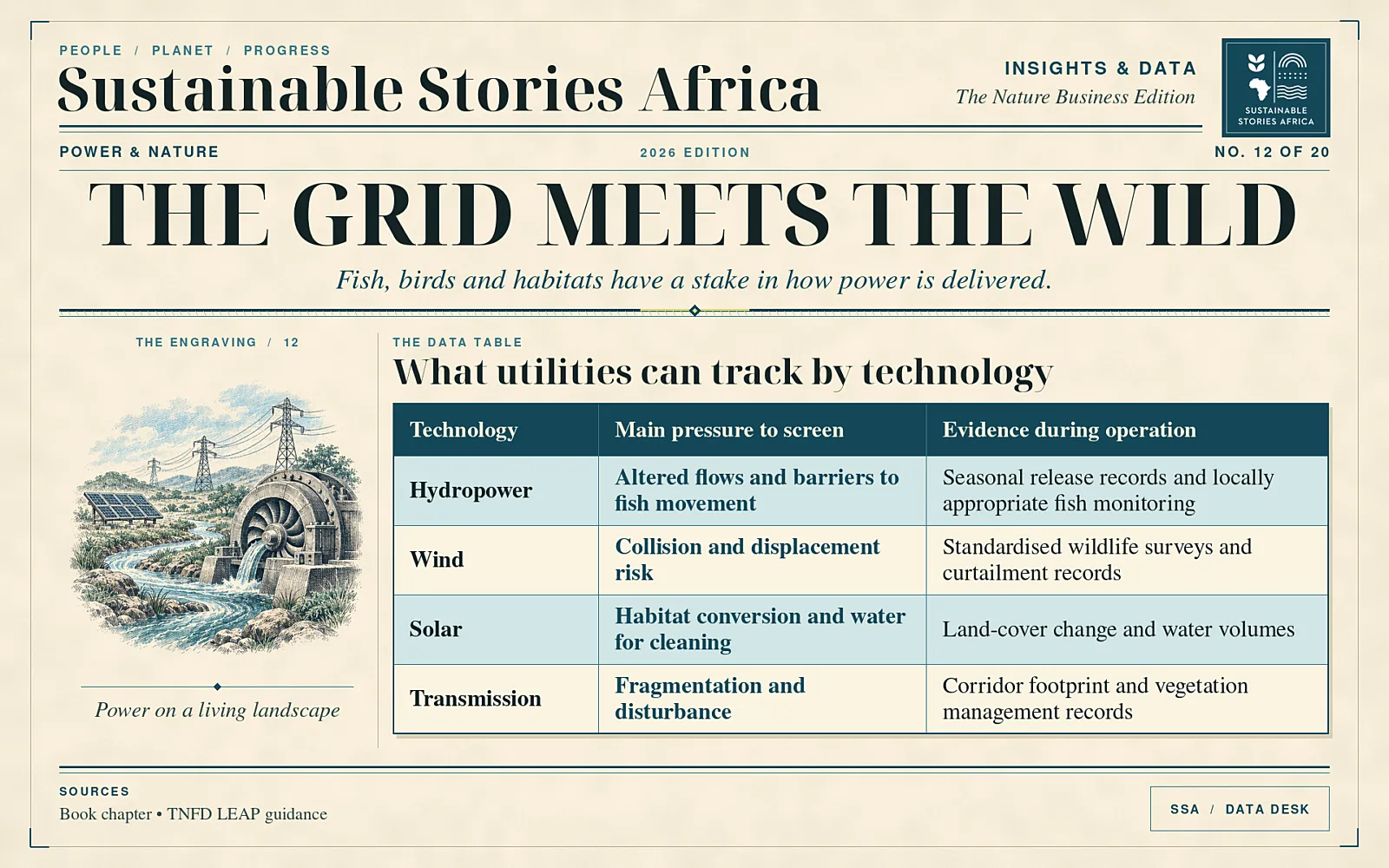
The book describes fish-friendly turbine designs, bird-aware wind operations and transmission corridors managed to retain compatible vegetation.
Each addresses a different pressure.
- A turbine may lower direct harm to some fish and still leave a river with altered flow or impaired migration.
- A wind project can reduce collision risk through design and operating changes, while effects depend heavily on migration, local species and siting.
Solar developers can assess disturbed land and existing infrastructure corridors as alternatives to clearing relatively intact habitat.
- Where a site is used seasonally for grazing, consultation has to capture the months and groups affected.
- A dry-season visit alone can misrepresent use.
- An equipment plan can cover water for cleaning panels, sourcing and arrangements for repairing or collecting components at the end of service.
The book’s approach also applies to storage.
- Better batteries can help a utility use more power from intermittent sources and reduce the need to operate some plants at peak demand.
- Comparing technologies still requires attention to minerals, manufacturing and what happens at the end of the equipment’s useful life.
- A developer can ask where cells were made and who will accept damaged or retired units.
Without an enforceable collection route, the project may move a cost to waste operators years after its owners have booked the financial benefits.
Better Siting Can Protect Project Value
Assessing a project alongside alternatives can avoid expensive redesign later.
- The same logic can work at grid scale.
- Publishing proposed corridors early lets utilities compare land uses, connection costs, reliability and ecological sensitivity
- A route on an existing disturbed corridor may create less new fragmentation, although existing routes can also cross important habitat or add a cumulative burden.
In hydropower, more reliable generation can come from maintaining existing assets, managing sediment and building additional capacity.
- A basin-level assessment can compare how dams, irrigators and water suppliers use the same resource in dry years.
- Operating flow decisions should reflect downstream users and ecological needs, which may vary by season.
- These decisions have an economic cost and should be included in project models.
A practical choice in a new solar tender is to compare a disturbed site near existing transmission with a cheaper site farther away.
- The second may require a longer corridor, more land agreements and higher maintenance costs.
- The first may have existing contamination or limited access.
- Publishing the basis of selection helps regulators and communities understand why one risk combination was judged manageable.
It also lets investors a way to test whether the quoted construction cost omitted material obligations.
Lenders Can Require Evidence Beyond Capacity
Power purchase agreements, auctions and debt covenants can translate siting and operating conditions into measurable obligations.
- A lender can ask for habitat maps, why alternative locations were rejected, how communities took part and which contractor funds corrective action.
- It can require a response as soon as monitoring finds greater effects than expected.
Utilities can publish these measures alongside service indicators, including connections, outage duration and affordability where data allow.
- Doing so shows what the power investment achieved and where the remaining costs fell.
- It also lets a regulator refine procurement rules using the evidence from one round of projects before approving the next.
The data should fit the operating decision.
- A wind operator needs surveys to decide when to slow or stop a turbine during sensitive periods.
- A hydropower operator needs water release data that can be compared with the rules for a dry month.
Where biodiversity information is sensitive, the public version can describe methods and results while protecting precise locations.
- A named person should still be accountable for acting when monitoring indicates a breach.
Link New Megawatts to Site Performance
In the next power procurement round, assess habitat, water and land rights while sites and routes are still open to change.
Agree in advance on who will monitor effects after commissioning.
Report service gains alongside ecological performance.
Use the evidence to improve the next auction, bond framework or grid expansion plan.