Nigeria can reach a net-zero electricity system, only if it moves beyond a single-technology mindset.
A new analysis by Clean Air Task Force (CATF) argues that wind and solar alone will not deliver reliability, affordability, and deep decarbonisation across Africa’s largest economy.
Instead, the study outlines multiple technology pathways, each with trade-offs, highlighting that firm low-carbon power, grid expansion, and policy sequencing will determine whether Nigeria’s transition succeeds or stalls.
Nigeria’s Net-Zero Grid: Technology Choices, Timeline Trade-Offs
Nigeria’s electricity sector sits at a crossroads. With installed capacity exceeding 13 GW but available generation often below 50% of that level, the country faces a dual challenge: expand reliable supply while cutting emissions in line with its net-zero pledge.
A new modelling analysis from CATF evaluates technology options and optimal pathways to achieve a net-zero electricity system across different timelines.
The findings are clear: achieving decarbonisation while maintaining grid stability will require more than rapid solar deployment.
For policymakers and investors, the report reframes the debate. The question is not whether Nigeria can decarbonise, but which mix of technologies, and at what pace, delivers the most resilient outcome.
Solar Alone Won’t Secure Grid
CATF’s modelling shows that high-renewables scenarios, dominated by wind and solar, can technically reduce emissions but may drive up system costs if firm, dispatchable capacity is absent.
In fast-transition pathways, Nigeria would need massive solar and storage buildout, coupled with expanded transmission infrastructure.
However, seasonal variability and limited storage duration create reliability risks without complementary firm low-carbon technologies.
The analysis highlights the role of:
- Carbon capture and storage (CCS) retrofits on gas plants
- Advanced nuclear power
- Long-duration energy storage
- Gas with CCS as transitional firm capacity
In scenarios targeting earlier decarbonisation deadlines, the need for firm low-carbon resources increases significantly to maintain reliability and avoid overbuilding variable renewables.
For a country where grid stability remains fragile, these insights are not theoretical, they are operationally urgent.
Comparing Pathways and Costs
The report models multiple pathways toward a net-zero electricity system, each differing in technology composition and deployment speed.
Below is a simplified comparison of core system characteristics based on CATF’s framework:
Pathway Type | Core Technologies | Key Trade-Off |
|---|---|---|
High Renewables + Storage | Solar, wind, batteries | High storage costs, overcapacity risk |
Gas + CCS Transition | Gas plants with carbon capture | Requires CO₂ transport & storage network |
Nuclear + Renewables Mix | Advanced nuclear, solar, wind | High upfront capital, long lead times |
Diverse Portfolio | Renewables, CCS, nuclear, storage | Complex planning but balanced resilience |
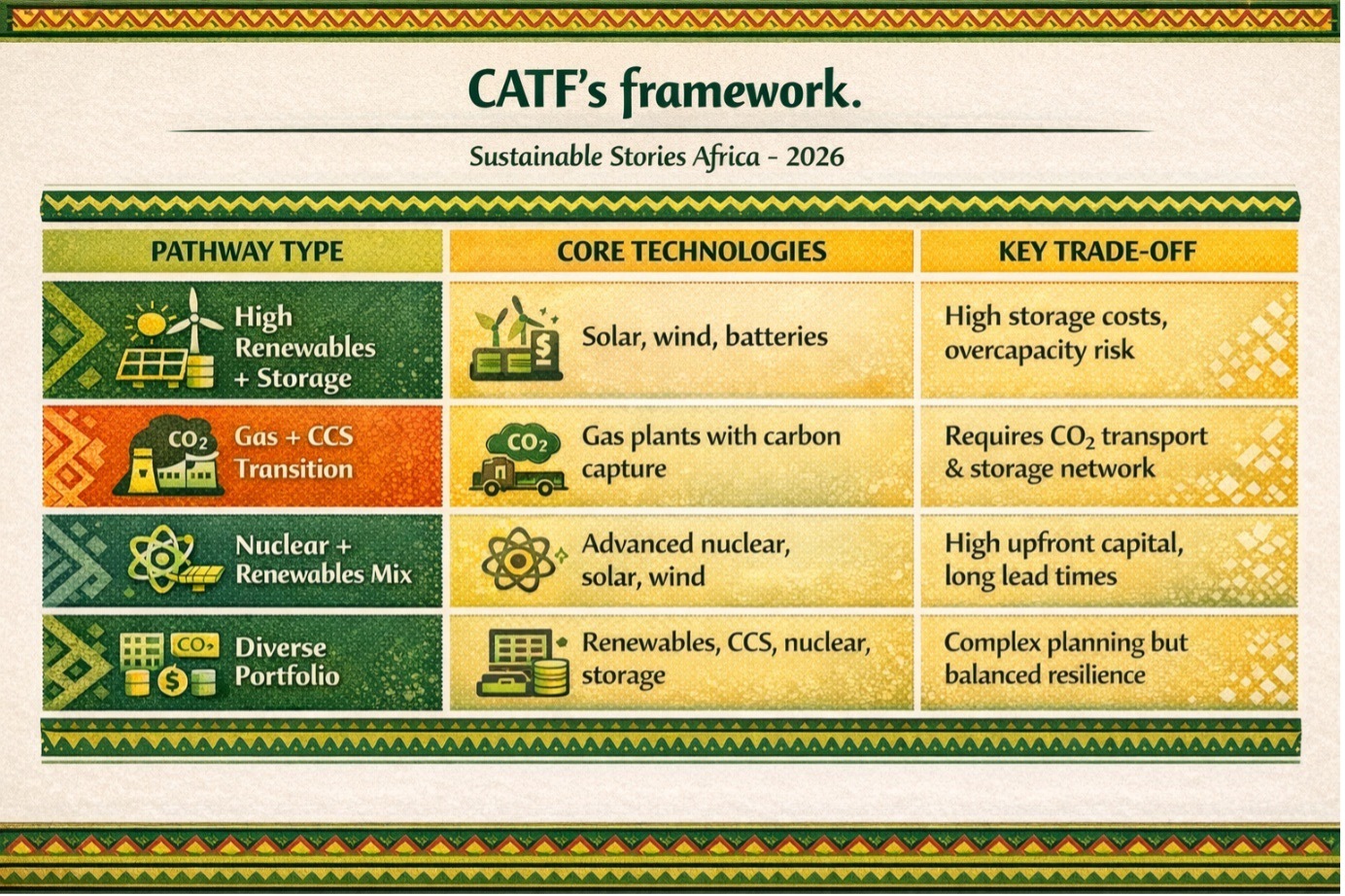
A diversified portfolio consistently shows lower long-term system costs and improved reliability compared to single-technology dominance.
Significantly, the study highlights infrastructure constraints as a major challenge. Transmission expansion and grid modernization are prerequisites across all scenarios.
Without expanded grid capacity, renewable integration will remain limited, and regional balancing impossible.
The report also notes Nigeria’s significant natural gas reserves, among the largest in Africa, which could play a transitional role if paired with CCS to prevent lock-in of unabated emissions.
Reliability, Affordability, Decarbonisation
The opportunity is strategic.
Nigeria’s electricity demand is projected to grow significantly as industrialisation accelerates and distributed generation shifts toward grid integration.
A well-designed net-zero pathway could:
- Reduce long-term electricity costs through diversified supply
- Improve reliability and reduce blackout frequency
- Attract climate-aligned capital
- Position Nigeria as a regional clean energy hub
Advanced nuclear and CCS technologies, while capital-intensive, could anchor firm capacity without emissions volatility. Meanwhile, solar and wind remain critical for low-cost generation during peak production periods.
The modelling suggests that relying exclusively on variable renewables may necessitate excessive overbuild and storage investments, raising consumer tariffs.
Conversely, including firm low-carbon technologies moderates system costs while maintaining emissions targets.
For one of Africa’s largest economy, the stakes extend beyond climate compliance. Energy reliability directly influences GDP growth, industrial competitiveness, and social stability.
Policy Signals Must Align Early
The report concludes that early policy alignment is decisive.
To unlock optimal pathways, Nigeria must:
- Establish clear long-term decarbonisation targets for the power sector.
- Develop regulatory frameworks for CCS and CO₂ storage.
- Assess feasibility and financing structures for advanced nuclear deployment.
- Accelerate grid expansion and transmission investment.
- Strengthen market mechanisms that incentivise firm capacity.
International climate finance and multilateral institutions can play a catalytic role, particularly in de-risking first-of-a-kind projects.
The study does not prescribe a single “silver bullet.” Instead, it argues for optionality. Maintaining multiple technology options reduces system risk and preserves flexibility as costs evolve.
For investors, clarity on regulatory frameworks will determine capital allocation. For policymakers, the message is direct: planning must begin now to avoid stranded assets and reliability crises later.
Path Forward – Diversify, De-Risk, Decarbonise
Nigeria’s optimal pathway to net-zero electricity depends on technological diversity, early infrastructure planning, and firm low-carbon capacity integration.
Policymakers must enable CCS, advanced nuclear feasibility studies, and accelerated grid expansion to preserve system resilience.
By aligning regulatory frameworks with investment certainty, Nigeria can achieve reliability, affordability, and emissions reduction simultaneously, positioning its power sector as a cornerstone of sustainable economic growth.