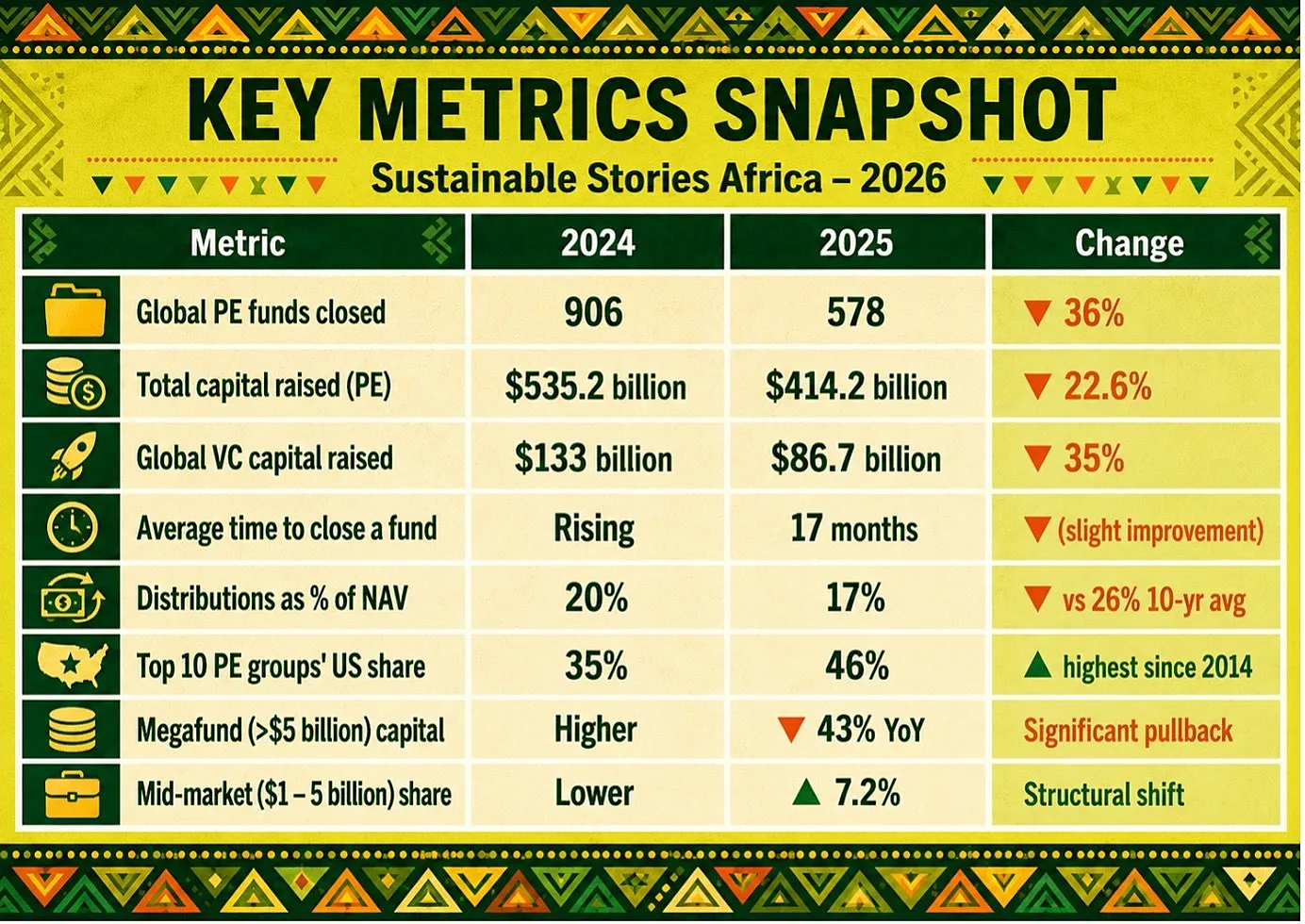
Private equity fundraising closed 2025 at its weakest level since 2020, 578 funds raising $414.2 billion, down sharply from 906 funds and $535.2 billion the year before.
Distributions as a share of net asset value hovered at just 17%, far below the 10-year average of 26%.
For African and emerging-market fund managers, the numbers tell a deeper story: global capital is concentrating in the hands of the largest platforms, leaving smaller, regional and first-time managers increasingly exposed to a structural squeeze that threatens to widen the investment gap across developing economies.
When Capital Retreats to the Summit
The private equity industry closed 2025 facing its most competitive fundraising environment since the 2008 global financial crisis.
Economic volatility, geopolitical tensions and persistent liquidity constraints combined to suppress LP appetite, particularly outside the largest, most established managers.
For investors in Africa and the Global South, this shift carries sharp implications. Private capital flows have long powered infrastructure, financial inclusion, technology and climate investment across the continent.
When global PE tightens, the ripple effects reach Lagos, Nairobi, Johannesburg and Accra.
Development finance institutions and pan-African fund managers must now reckon with a world in which institutional investors are not pulling back from private markets.
They are becoming acutely selective about where, and with whom, they deploy.
Understanding the metrics behind this contraction, what drove it, who it benefits and who it leaves behind, is essential to navigating what comes next.
The Numbers Redefine the Landscape
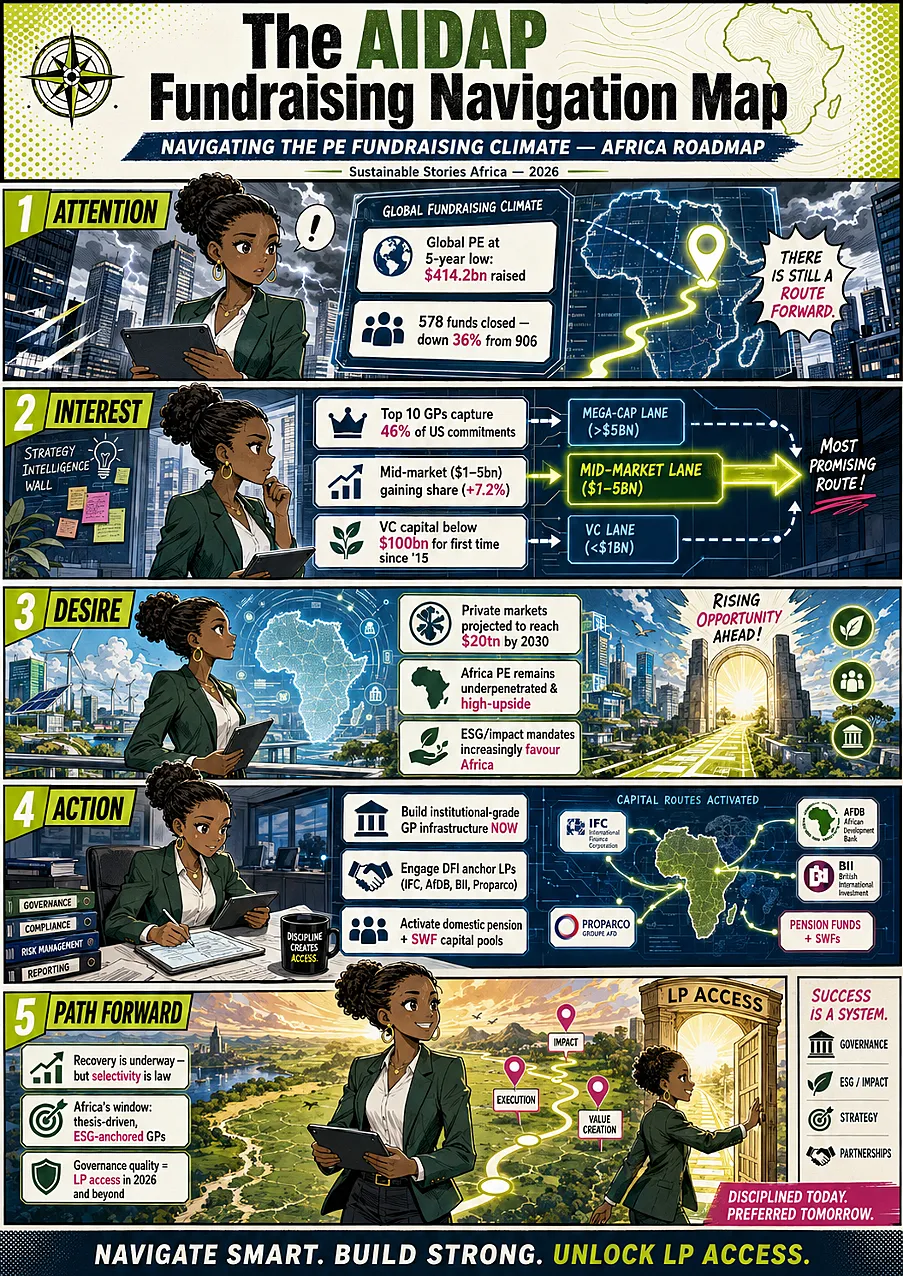
In 2025, global private equity fundraising hit a five-year low. A total of 578 funds closed during the year, raising $414.2 billion, compared with 906 funds and $535.2 billion the previous year.
According to PitchBook's Q4 2025 Global Private Market Fundraising Report. Venture capital mirrored this trend, with global VC capital raised estimated at $86.7 billion as of November 2025, the first time it has fallen below $100 billion since 2015.
These are not merely headline numbers. They represent a structural reconfiguration of who gets access to private capital, and on what terms.
At a time when Africa requires an estimated $194 billion annually to close its infrastructure financing gap alone, a global contraction of this magnitude demands urgent attention.
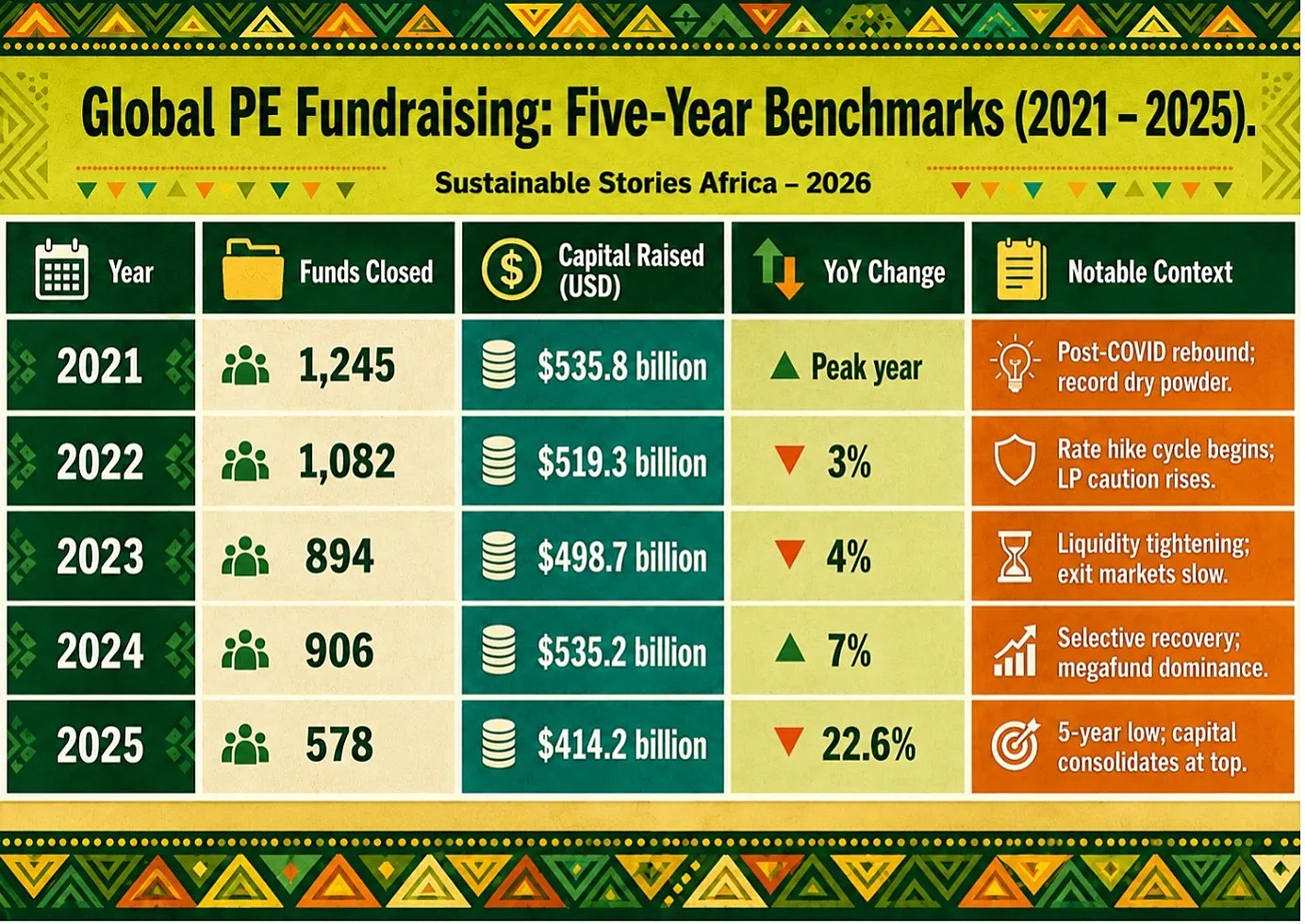
Why It Matters: The 2025 contraction is not cyclical noise; it reflects structural concentration. For African and emerging-market fund managers, understanding the depth and direction of this trend is essential for LP strategy and timing of fund decisions.
Who Won and Who Was Left Behind
Capital in 2025 consolidated decisively at the top. The largest PE platforms, Blackstone, KKR, Bain Capital and Advent International, each raised more than $10 billion.
The top 10 PE groups captured approximately 46% of all US fundraising, a concentration level not seen since 2014, per KPMG's Q4 2025 Pulse of Private Equity report.
For experienced general partners, the picture remained relatively contained: GPs still accounted for 88% of total capital raised.
However, the dynamics beneath the surface were more unforgiving. Megafunds declined sharply; capital raised by vehicles with more than $5 billion fell by 43% year-on-year.
Instead, investors pivoted to mid-market funds between $1 billion and $5 billion, increasing their share of total capital raised by 7.2%. This was especially visible in Europe: the largest fund closed in 2025 raised $4.8 billion, a stark contrast to the $20 billion-plus megafunds from CVC Capital Partners and EQT in prior years.
For African and emerging market managers, the implications are both cautionary and conditional.
The shift toward mid-market vehicles theoretically creates opportunity; however, the criteria for LP confidence have tightened significantly.
Institutional investors are now applying portfolio-construction logic rather than treating individual fund commitments in isolation, raising transparency, governance and reporting requirements to institutional-grade standards from the outset.
VC fundraising told an equally sobering story. Approximately 22% of global VC commitments flowed to just 10 funds; the highest share since 2012, yet those 10 vehicles raised a combined $26.7 billion, down 35% from 2024.
Even as concentration intensified, the number of VC funds launched globally reached a record 7,598 in 2025, highlighting a paradox: more entrants, less capital available for distribution across the field.
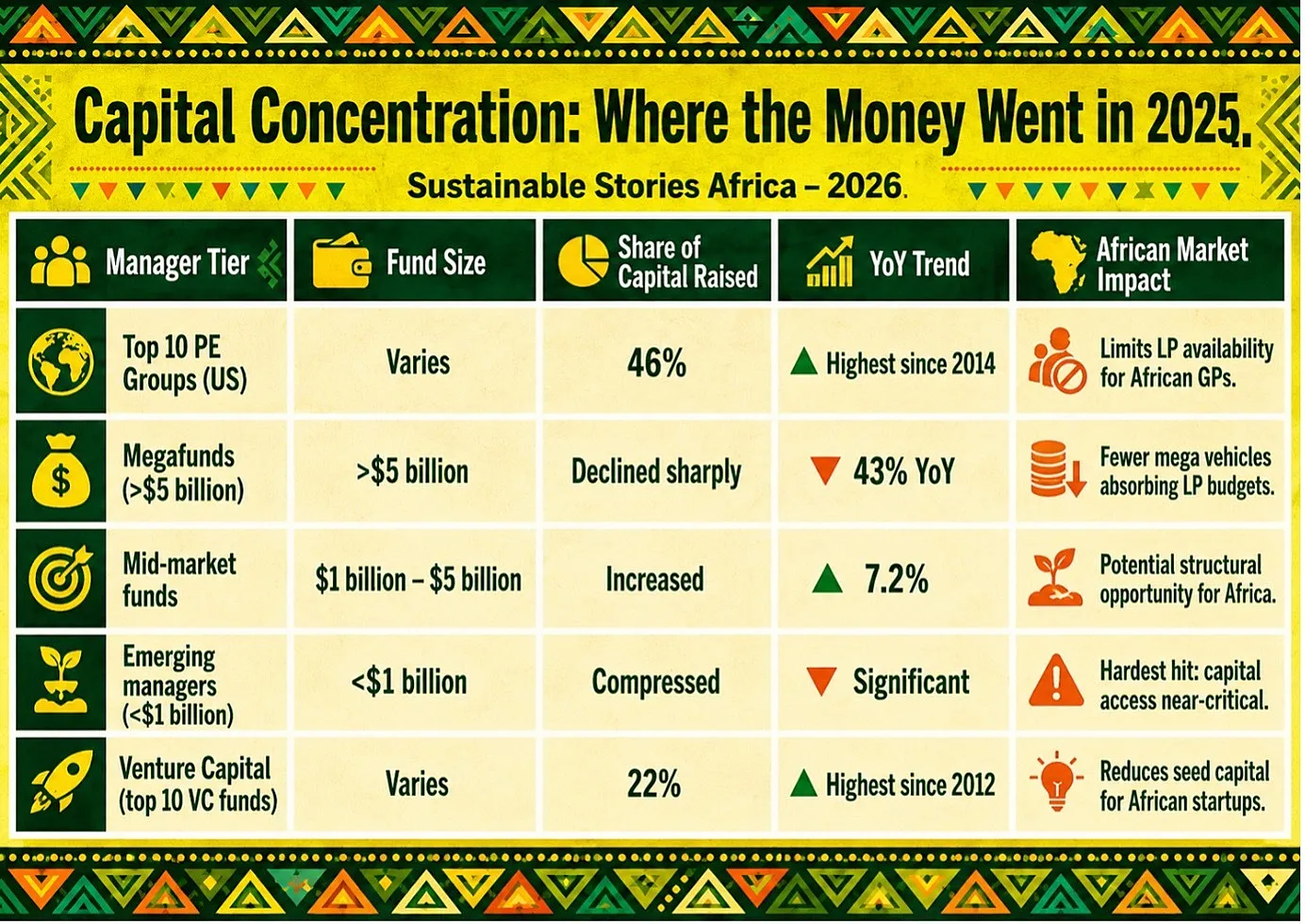
Why It Matters: Bifurcation is accelerating. Capital is gravitating toward the largest, most established platforms. African GPs must build institutional credibility, governance, reporting, and alignment to compete in the mid-market tier where the best opportunity now exists.
What Recovery Looks Like and Why Africa Cannot Wait
Despite the contraction, early signals from 2026 suggest a tentative recovery. Bain & Company's Private Equity Outlook 2026 notes that buyout funds have raised $1.8 trillion since 2022, underscoring sustained long-term appeal.
Cambridge Associates observes that "the worst of the distribution drought in PE is behind us," with cautious optimism returning among institutional investors.
Preqin projects private markets will expand from approximately $13 trillion to over $20 trillion by 2030.
That trajectory, if inclusive, could be transformative for Africa.
The continent's private equity market remains significantly underpenetrated relative to its economic potential.
If global recovery trends translate into renewed appetite for frontier and emerging market allocations, particularly in climate, infrastructure and fintech, African fund managers that have built institutional-grade platforms stand to benefit disproportionately.
The shift in LP preferences toward managers who can "demonstrate consistent execution across cycles" also creates a specific opportunity: African GPs with proven track records in sectors such as agri-finance, clean energy or digital infrastructure may now find a more receptive audience than in the boom years, when scale alone drove decisions.
What Managers, Policymakers and DFIs Must Do Now
For African fund managers, the imperative is clear: build institutional-grade infrastructure before approaching LP conversations. This means robust governance, cybersecurity controls, transparent reporting standards and clear fee alignment.
Emerging managers can no longer afford to build operational credibility after capital commitments; it must precede them.
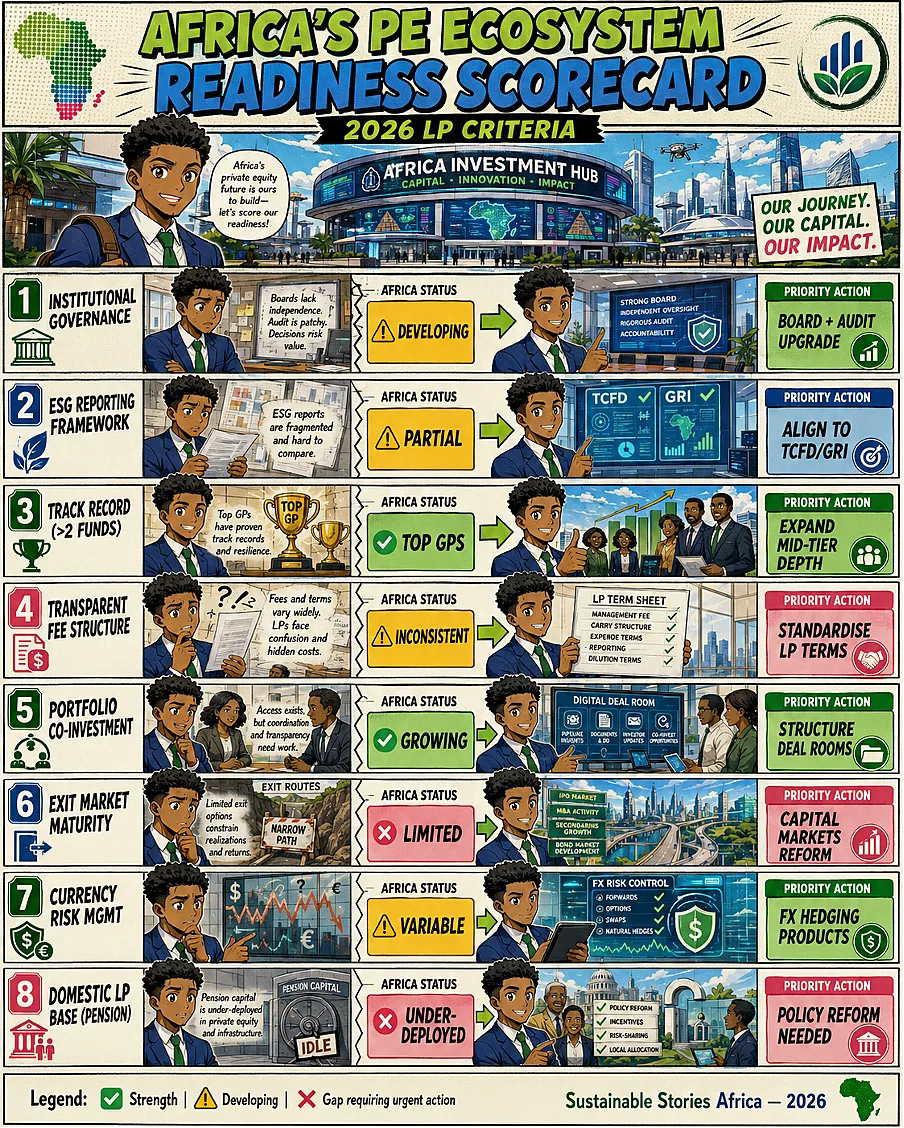
Development finance institutions, such as the IFC, African Development Bank, British International Investment, and Proparco, have a critical role to play as anchor LPs during this period.
Their continued commitment to African and emerging market funds sends market signals that can unlock co-investment from institutional capital, which is risk-averse about frontier markets.
Governments and regional bodies should also accelerate the development of domestic institutional capital, particularly pension funds and sovereign wealth funds, as primary allocators to African PE vehicles.
Nigeria's PENCOM, Kenya's Retirement Benefits Authority, and South Africa's Government Employees Pension Fund represent pools of long-term capital that are chronically under-deployed in African PE.
Policy frameworks that incentivise domestic institutional allocation to African funds can reduce dependence on external LP cycles.
PATH FORWARD – Discipline Defines the Decade Ahead
The 2025 fundraising contraction is not a crisis; it is a recalibration. Private capital will continue to flow toward emerging markets; however, on stricter terms and through more selective channels.
African fund managers who invest now in institutional-quality, including governance, reporting, alignment, and strategy clarity, will be better positioned when LP appetite fully returns.
The window to build is now. African economies need private capital at scale, and the infrastructure of confidence must be built before the next cycle peaks.