Women across the world remain locked out of full economic participation despite decades of legal reform.
The latest global data show that laws supporting gender equality have expanded; however, weak institutions, poor enforcement, and persistent barriers continue to prevent millions of women from translating rights into real economic opportunity.
A new World Bank benchmark reveals that closing these gaps is no longer only a social imperative; it is now a critical economic strategy for growth, productivity, and job creation.
Legal Equality Advances, Enforcement Still Lags
Global momentum to expand women’s economic rights is gaining pace, yet the gap between legal commitments and everyday reality remains stubbornly wide.
A new global assessment finds that while many countries have strengthened laws supporting gender equality, enforcement mechanisms and institutional support systems are failing to translate those laws into real opportunities.
The 2026 edition of the World Bank’s Women, Business and the Law report evaluates how laws, policies, and institutions shape women’s economic participation across 190 economies.
Its findings present a sobering reality: women today enjoy less than two-thirds of the legal rights available to men, and fewer than 5% live in economies approaching full legal equality.
For policymakers confronting slowing growth, demographic pressures, and widening labour shortages, the implications are significant.
Unlocking women’s economic participation may be one of the most powerful drivers of future productivity and inclusive development.
Global Legal Equality Remains Incomplete
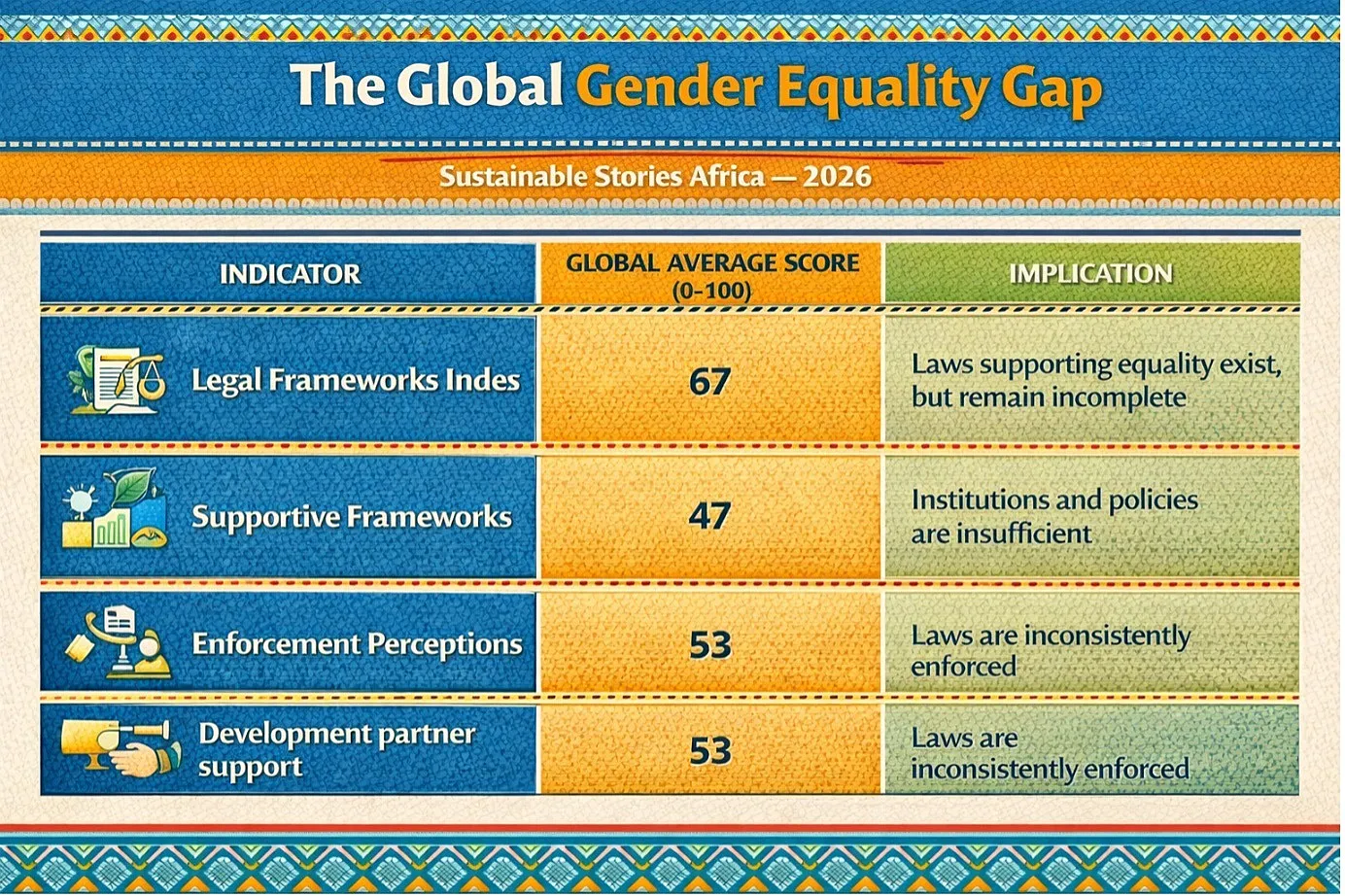
The report shows that the global legal environment supporting women’s economic participation remains uneven and incomplete. On average, economies score 67 out of 100 on the index measuring legal frameworks to support women’s economic rights.
However, the picture worsens when examining implementation.
Supportive frameworks, such as childcare policies, access to justice, and enforcement institutions, score only 47, while enforcement perceptions score 53 globally.
This means that many countries have adopted progressive laws but lack the systems necessary to make them effective.
In practice, women continue to face restrictions affecting:
- Job access and working conditions
- Entrepreneurship and access to finance
- Workplace safety
- Childcare support
- Asset ownership and inheritance
These constraints shape women’s participation across their entire economic life cycle, from education and employment to entrepreneurship and retirement.
Why Gender Equality Is Now An Economic Strategy
Beyond social justice, expanding women’s economic participation is increasingly recognised as a macroeconomic necessity.
Evidence cited in the report highlights that reducing gender gaps in labour force participation could result in a GDP increase of between 15% and 20% in many economies, especially in regions where women face the strongest legal barriers.
- Economies with stronger gender-equal laws also demonstrate measurable economic benefits:
Female labour participation rates are 28 percentage points higher in countries with stronger legal equality frameworks. - Women are more likely to own businesses and participate in firm leadership.
- Political representation among women is significantly higher.
These improvements reflect broader structural gains. Firms become more productive, labour markets allocate talent more efficiently, and innovation accelerates when women can participate fully in economic activity.
For rapidly growing regions such as Sub-Saharan Africa and South Asia, the stakes are particularly high.
These regions are experiencing the largest influx of young women entering the workforce; however, they also maintain some of the strongest legal barriers to women’s economic participation.
The Global Gender Equality Gap
Indicator | Global Average Score (0–100) | Implication |
|---|---|---|
Legal Frameworks Index | 67 | Laws supporting equality exist, but remain incomplete |
Supportive Frameworks | 47 | Institutions and policies are insufficient |
Enforcement Perceptions | 53 | Laws are inconsistently enforced |
Reform Momentum Emerging Worldwide
Despite persistent gaps, reform momentum is building.
Between October 2023 and October 2025, 68 economies enacted 113 legal reforms to expand women’s economic rights.
These reforms focused on several areas:
- Strengthening protection against violence
- Mandating equal pay legislation
- Expanding parental leave policies
- Removing restrictions on women’s employment
- Improving childcare frameworks
Countries including Egypt, Madagascar, Somalia, Oman, Jordan, and the Kyrgyz Republic implemented significant reforms, removing discriminatory labour restrictions and introducing new legal protections for women workers and entrepreneurs.
However, progress remains uneven. The report notes that several economies simultaneously enacted laws that reversed protections for women, underscoring the fragile nature of reform.
PATH FORWARD – Closing The Law-Implementation Gap
Governments must move beyond legislative reform and invest in institutions that ensure women’s rights translate into real opportunities.
Strengthening enforcement systems, expanding childcare infrastructure, and improving access to finance are critical priorities.
Closing the gender equality gap is no longer only a rights issue—it is a growth strategy.
Economies that unlock women’s full participation will gain stronger labour markets, higher productivity, and more inclusive prosperity.