Academic freedom is declining in more countries than it is improving, according to new global data highlighted by Scientific American.
The shift matters because universities shape research, innovation, public policy and democratic accountability.
For Africa and the Global South, the warning is clear: when scholars cannot research, teach or speak freely, societies lose evidence, talent and trust.
Knowledge Systems Are Under Pressure
Academic freedom is deteriorating across much of the world, with new data showing that more countries have recorded meaningful declines than improvements over the past decade.
Scientific American’s latest visual analysis, drawing on the Academic Freedom Index, shows how the ability of scholars to research, teach, exchange ideas and speak freely is changing across countries.
The warning is not abstract. It touches what students learn, what scientists can investigate, what data enters public debate and how societies respond to crises.
The Academic Freedom Index 2026 reports that academic freedom has declined in 50 countries and improved in only nine over the past decade.
The index covers 179 countries and territories, assessing freedoms such as research and teaching, academic exchange, institutional autonomy, campus integrity and cultural expression.
For policymakers, investors and citizens, the message is direct: universities are not only educational centres. They are part of the infrastructure of national resilience.
The Global Retreat From Open Inquiry
Different pressures in different countries are driving the decline.
- In some places, governments interfere with university leadership, research funding or curriculum decisions.
- In others, scholars face censorship, intimidation, travel restrictions, surveillance or professional penalties for controversial work.
The Academic Freedom Index notes that the global decline began around 2012, with setbacks linked to political polarisation, democratic backsliding and rising pressure on public institutions.
While academic freedom remains more protected in many parts of Europe, North America, Latin America, Oceania and parts of Southern and Western Africa, the broader trend is negative.
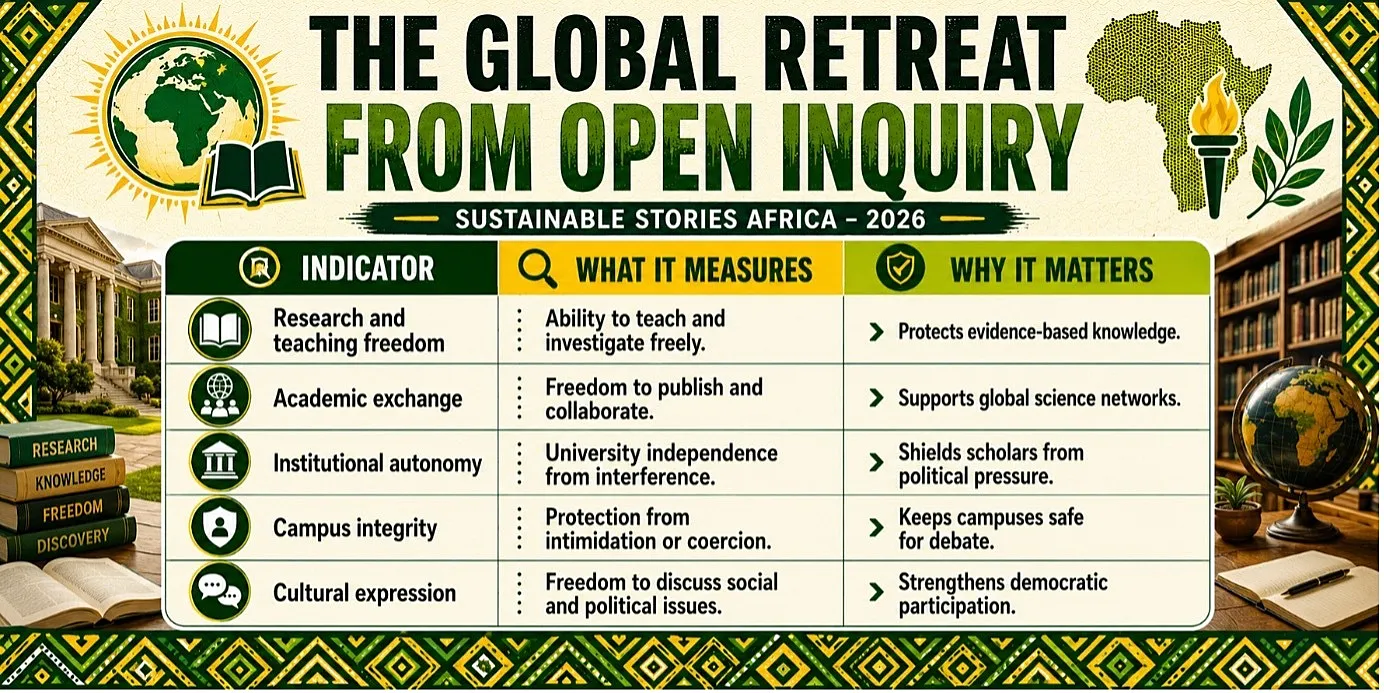
- For a young researcher in Lagos, Nairobi or Accra, academic freedom can determine whether they can publish climate data, question public spending, analyse health failures or challenge misinformation.
- For students, it shapes whether classrooms become spaces of inquiry or spaces of caution.
The concern is not only political. It is economic. Countries that weaken academic freedom risk weakening innovation, talent retention and global research partnerships.
Free Universities Build Stronger Societies
Protecting academic freedom creates practical benefits. It helps governments make better policy, businesses access stronger research, and societies respond faster to health, climate, education and technology risks.
For Africa, this is especially important. The continent needs universities that can test climate adaptation models, study food systems, examine extractive industries, strengthen public health research and support the energy transition without fear or political manipulation.
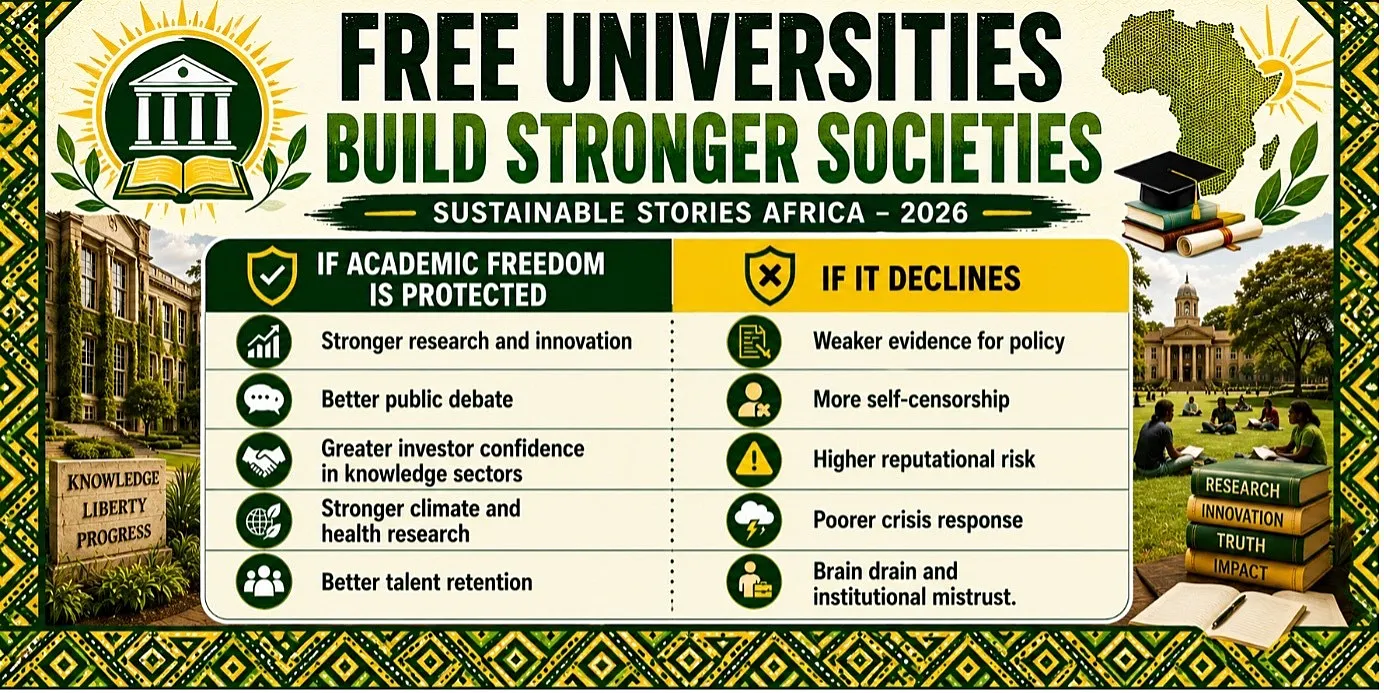
Academic freedom also strengthens ESG outcomes. Good governance depends on reliable evidence. Social progress depends on open debate. Environmental action depends on scientific integrity.
When universities are free, societies gain early-warning systems. When they are constrained, countries may only discover failure after the cost has already become public.
Protect Knowledge As Public Infrastructure
The next step is for governments, universities, funders and civil society to treat academic freedom as a development priority, not a luxury.
- Governments should protect institutional autonomy, avoid politicising research, and create legal safeguards for scholars and students.
- Universities should defend open inquiry while maintaining standards of evidence, ethics and respectful debate.
- Funders should support researchers facing pressure and invest in cross-border academic collaboration.
For African markets, the stakes are immediate. Climate vulnerability, debt sustainability, food insecurity, health systems and digital governance all require independent research.
If scholars cannot ask difficult questions, governments lose the evidence needed to solve difficult problems.
Academic freedom should therefore sit alongside energy security, food security and institutional reform as part of Africa’s resilience agenda.
Path Forward – For Knowledge Resilience
Countries must protect universities as public-interest institutions. That means defending institutional autonomy, safeguarding researchers and ensuring evidence can enter public debate without fear.
For Africa, academic freedom is also an ESG issue. Stronger knowledge systems support better governance, inclusive development and climate resilience.
Protecting scholars protects society’s capacity to think, plan and adapt.
Culled From: See how academic freedom is changing around the world | Scientific American