The African Development Bank has approved a $400 million loan to improve water and electricity utilities across four municipalities in South Africa’s Mpumalanga province.
Disbursements will depend on independently verified results, shifting attention from money spent to services delivered.
For 1.2 million residents, success should mean fewer interruptions, stronger municipal finances and essential infrastructure capable of supporting communities through the region’s energy transition.
$400 Million Targets Services Closest To Citizens
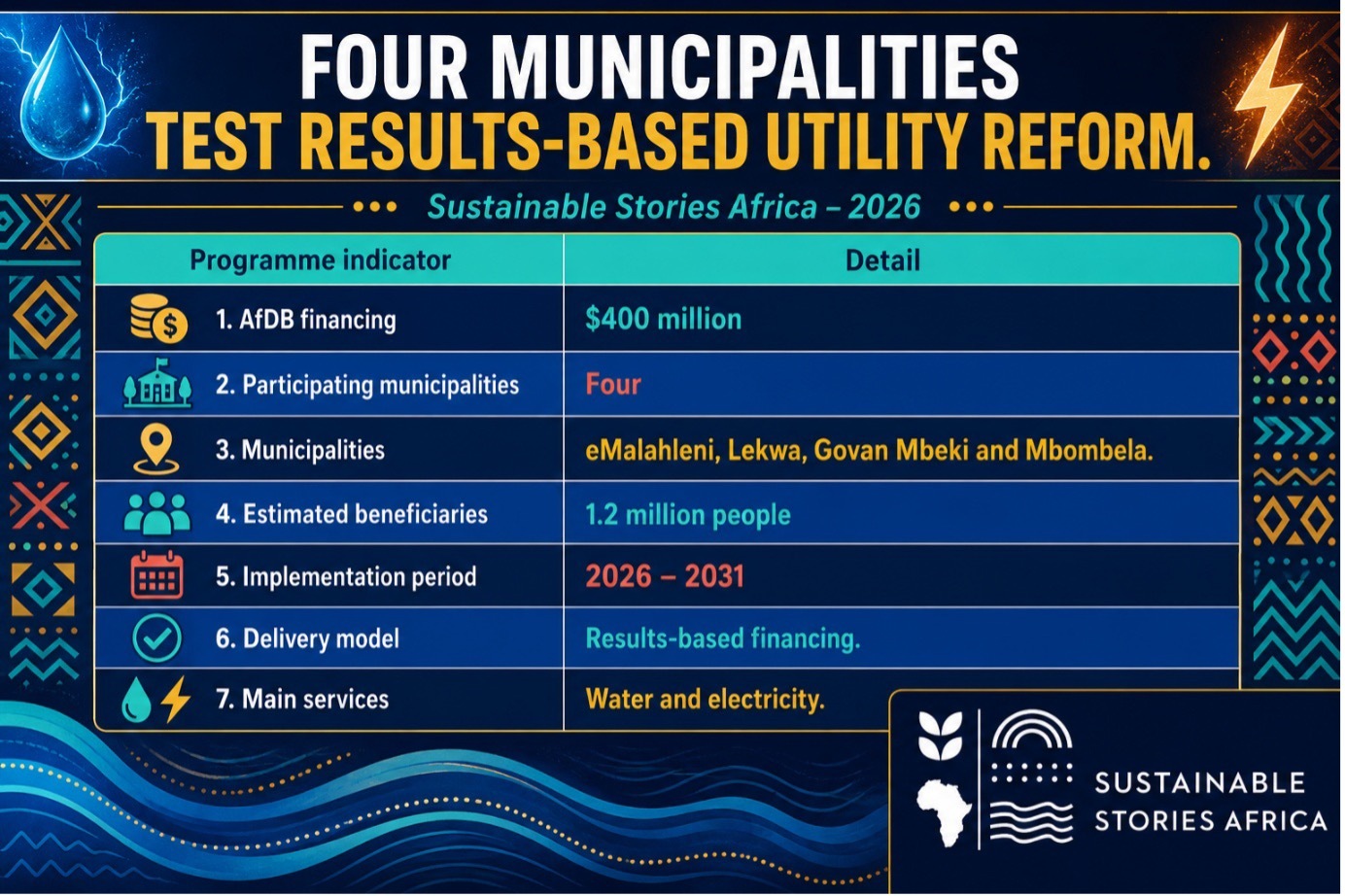
The African Development Bank Group has approved a $400 million loan to overhaul struggling electricity and water utilities in four Mpumalanga municipalities, placing measurable service delivery at the centre of South Africa's municipal reform efforts.
The Mpumalanga Municipal Utility Reform Programme will operate in eMalahleni, Lekwa, Govan Mbeki and Mbombela between 2026 and 2031, benefiting an estimated 1.2 million people.
Unlike a conventional infrastructure loan, disbursements will be linked to independently verified improvements.
Municipalities must demonstrate progress in reducing water and electricity losses, improving revenue collection, rehabilitating infrastructure and strengthening utility management before funding is released, to address why large infrastructure budgets don't always translate into reliable services.
"Financially stronger municipalities are essential for South Africa's long-term development," said AfDB Vice-President Kevin Kariuki, adding that the initiative could model wider municipal reform.
Four Municipalities Test Results-Based Utility Reform
Municipal utilities occupy the final and most visible link between national infrastructure policy and residents.
Their condition determines whether electricity purchased from the grid reaches paying customers and whether treated water arrives without being lost through broken pipes.
In Mpumalanga;
- Ageing infrastructure, weak billing systems, technical losses and limited institutional capacity have placed municipal finances and service delivery under pressure.
South Africa’s National Treasury will be the borrower.
- The Development Bank of Southern Africa will implement the programme under the oversight of the National Treasury and the Department of Cooperative Governance and Traditional Affairs.
Support will also extend to the Inkomati-Usuthu Catchment Management Agency to strengthen integrated water-resource management.
This reflects the reality that municipal water security depends on entire catchments rather than administrative boundaries alone.
The programme is backed by the United Kingdom’s Foreign, Commonwealth and Development Office through a guarantee linked to the Just Energy Transition Partnership.
The UK also provided technical assistance during preparation.
Reliable Services Could Rebuild Local Economies
The most immediate benefits should be practical.
- A household should spend less time preparing for unexplained water interruptions.
- A small restaurant should lose fewer trading hours to electricity failures.
- A clinic should preserve medicines and maintain sanitation without relying on emergency systems.
For municipalities, reduced losses mean more purchased water and electricity becomes billable consumption, creating a reinforcing cycle where improved services encourage payment, stronger revenue supports maintenance, and maintenance reduces failures.
Performance-based contracts will allow private providers to contribute specialist expertise, though clear safeguards are needed to protect affordability and public accountability.
The programme also matters for Mpumalanga's just energy transition. As the province's coal-dependent economy shifts, municipalities will need financially credible utilities to support new industries, renewable projects and jobs.
Without improved local services, investors may avoid affected towns, businesses may relocate, and communities could bear transition costs without their promised benefits.
Accountability Must Travel With Every Dollar
Results-based financing creates stronger incentives, but it is not self-executing.
- The indicators used to trigger disbursements must measure real improvements rather than administrative compliance.
- Municipalities should publish baseline data on infrastructure losses, collection rates, outages, water quality and maintenance backlogs.
Residents must then be able to compare those baselines with annual results.
Independent verification should include physical inspection and community experience, not only documents submitted by contractors.
Procurement information, contract performance and expenditure should be accessible to councillors, civil society and the public.
Technical reform must also address institutional capability.
New meters and repaired pipes will not remain effective if municipalities lack qualified engineers, maintenance budgets, credible billing systems or protection against political interference.
AfDB Director for Renewable Energy and Energy Efficiency, Daniel Schroth, said linking finance to proven results, independent verification and performance-based contracts could accelerate reform while strengthening accountability.
Path Forward – Making Municipal Reform Work Beyond Mpumalanga
The immediate priority is to establish credible baselines, transparent contracts and service targets that residents can independently recognise.
Infrastructure rehabilitation must be matched by stronger billing, maintenance and municipal management.
If the four municipalities reduce losses, improve reliability and protect affordability, Mpumalanga can provide a scalable reform model for South Africa.
That would advance governance, social inclusion and environmental efficiency while ensuring that the just transition improves daily life where government is experienced most directly.