SUSTAINABLE STORIES AFRICA
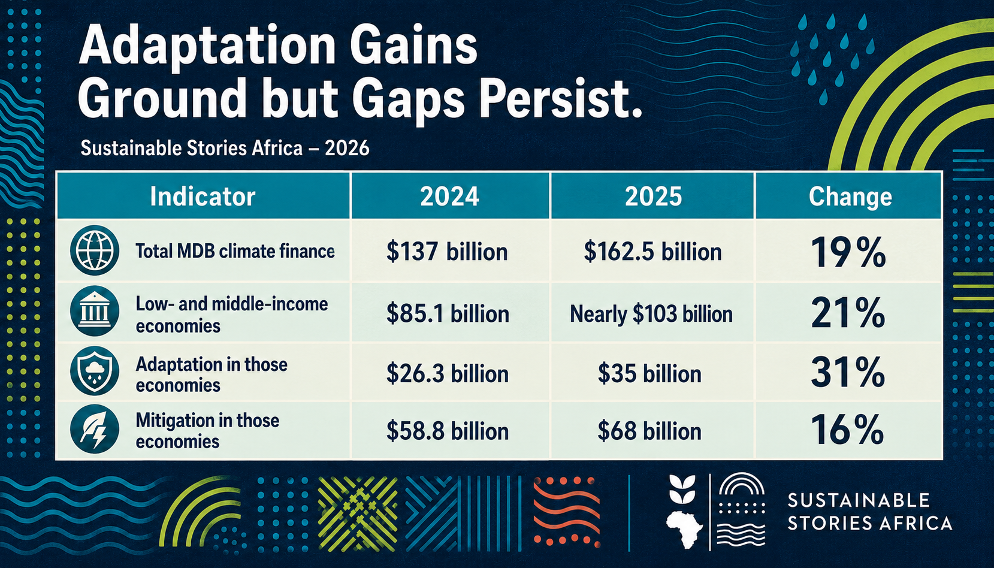
Multilateral development banks delivered a record $162.5 billion in climate finance in 2025, up 19% from the previous year.
Funding for low- and middle-income economies approached $103 billion, with adaptation recording the fastest growth.
However, the World Bank’s withdrawal from its 45% climate-finance target has unsettled confidence just as vulnerable countries most need predictable capital.
Record Funding Meets a Credibility Test
Multilateral development banks committed $162.5 billion to climate finance in 2025, their highest annual total, as lending for low- and middle-income economies rose 21% to almost $103 billion.
The joint report, published on July 13, says the institutions remain on track for their collective 2030 ambitions.
The record arrives, however, less than two weeks after the World Bank retired its target of directing 45% of annual financing to projects with climate co-benefits.
The Bank has consistently supplied close to half of MDB climate finance for developing economies; the change has raised questions about whether system-wide momentum can survive without a clear target from its largest contributor.
For a farmer facing another failed rainy season, or a coastal city rebuilding drainage after floods, the distinction between an “input” and an “outcome” is not academic.
It determines whether resilient seeds, stronger roads and reliable early-warning systems arrive before the next shock.
Adaptation Gains Ground but Gaps Persist
The strongest growth came in adaptation. Finance for resilience in low- and middle-income countries climbed 31% to $35 billion, while mitigation finance rose 16% to $68 billion.
Private capital mobilised alongside MDB operations reached $35 billion in those economies and $80 billion in high-income markets.
Africa received about $18.4 billion of MDB climate finance directed to lower-income markets, behind Latin America and the Caribbean. That allocation matters, but the continental need is far larger: projects must compete with debt-service pressures, limited fiscal space, currency risk and lengthy preparation requirements.
Volume alone, therefore, says little about affordability, speed or who ultimately carries repayment risk.
Consider a secondary city seeking flood protection. The municipality may know which drains, roads, and settlements are most exposed, yet lack the engineering studies, credit profile or foreign-currency revenues required by lenders.
Without early-stage grants and preparation support, a project can remain outside the finance pipeline until disaster makes it unavoidable and more expensive. Closing that gap is as important as increasing the global total.
Predictable Capital Can Protect Development Gains
The record demonstrates what coordinated public finance can achieve. More adaptation funding can protect harvests, water systems and transport links, while guarantees and blended structures can make renewable energy, resilient housing and low-carbon industry investable.
If finance is concessional and locally accessible, it can also create jobs rather than forcing governments to choose between climate resilience and basic services.
The World Bank argues that retiring the percentage target supports a shift from measuring finance inputs to measuring development outcomes.
Its fiscal 2025 data show $50.8 billion with climate co-benefits, 48% of total financing, suggesting immediate delivery has not collapsed.
The doubt concerns what anchors ambition when political priorities and client demand change.
Turn Record Commitments Into Visible Results
MDBs should protect the collective $120 billion annual goal for low- and middle-income countries by 2030, publish institution-level trajectories and disclose grants, concessional loans, guarantees and mobilised private finance separately.
Outcomes must be traced from approval to disbursement and completion.
African governments must strengthen project pipelines and national climate-finance systems, while banks expand local-currency tools, preparation facilities and direct access for cities and local institutions. Investors should be rewarded for measurable resilience and development additionality, not simply for attaching a climate label to conventional finance.
Path Forward – Accountability Must Sustain Climate Finance Momentum
The priority is to preserve the record’s momentum while replacing a retired World Bank input target with equally transparent outcome measures, timelines and independent scrutiny.
For Africa, success means finance that arrives faster, costs less and protects real lives and assets. The $163 billion headline becomes credible only when vulnerable communities can see resilience before the next flood, drought or heatwave.
Culled From: MDB Climate Finance Hits Record $163bn, But World Bank Retreat Raises Doubts