Africa’s critical-minerals opportunity will depend less on deposits alone than on predictable regulation, infrastructure, skills and investable processing projects, according to Burundian researcher Ange-Dorine Irakoze.
The warning comes as competition for cobalt, lithium, graphite, copper, and rare earths intensifies.
Building complete value chains could create skilled jobs and industrial growth, but unstable policies and export-only models risk repeating the continent’s commodity dependence.
Mineral Wealth Alone Will Not Industrialise Africa
Africa's vast critical mineral deposits will not automatically produce a competitive industry unless governments build stable regulatory systems, reliable infrastructure and credible long-term investment conditions, independent Burundian scholar Dr Ange-Dorine Irakoze has said.
"Investors do not finance projects simply because minerals are available. They invest when they see predictable returns over many years," Irakoze told Renewables Rising in a July 16 interview.
Her assessment tempers optimism around Africa's energy-transition role. The continent holds significant cobalt, manganese, graphite, copper, lithium, and platinum-group minerals essential for EVs, batteries, renewable energy networks, and electronics.
However, much of that wealth still leaves as unprocessed ore, with higher-value stages, including refining, component production, and battery manufacturing, completed elsewhere.
"Africa's biggest advantage is not simply that it has critical minerals," Irakoze said. "What makes Africa different is the scale and diversity of its deposits, combined with the timing."
The Opportunity Extends Beyond Raw Exports
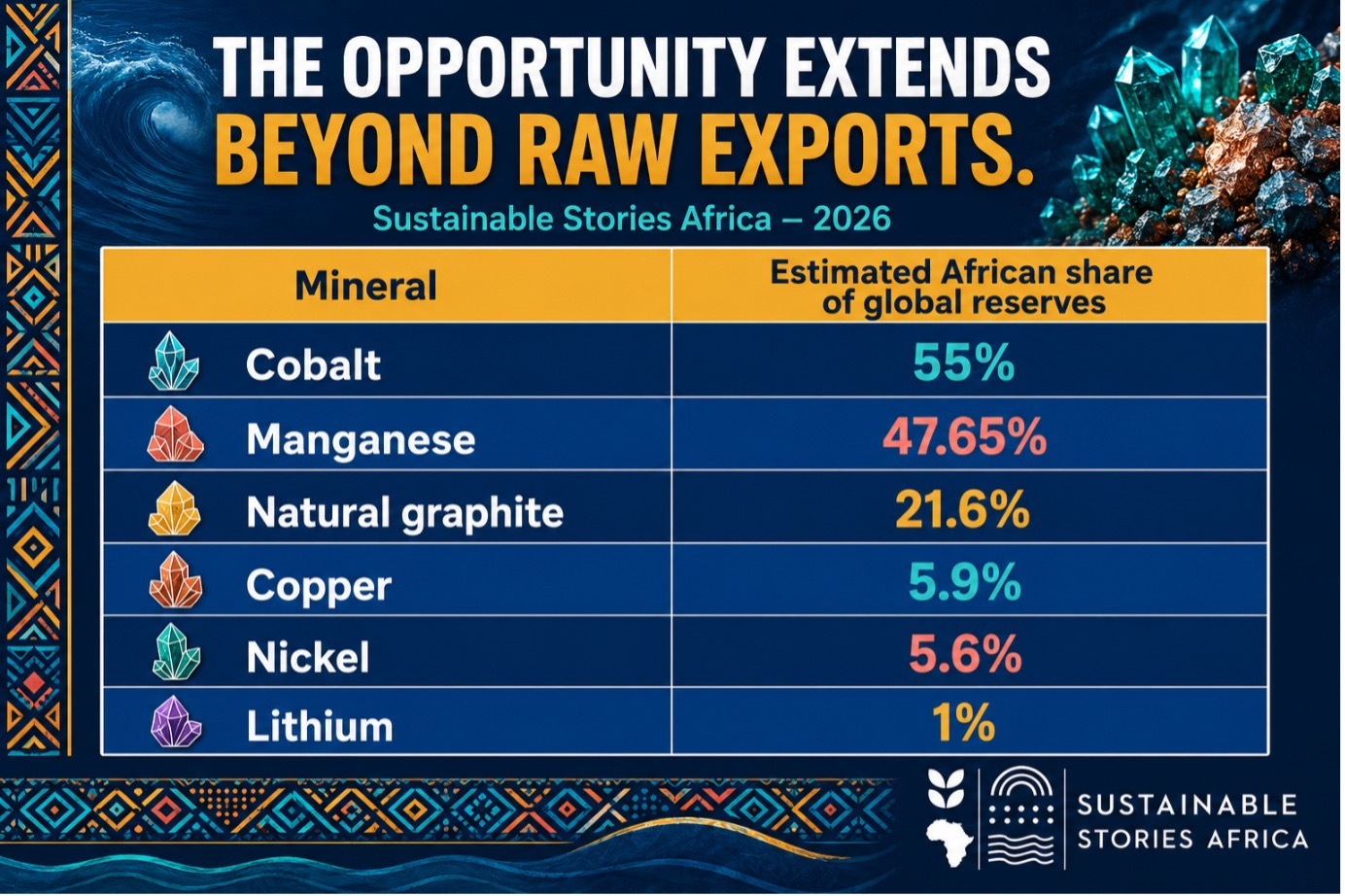
Africa holds an estimated 55% of global cobalt reserves, 47.65% of manganese and 21.6% of natural graphite, according to UN Trade and Development, alongside commercially important copper, nickel and lithium deposits.
- The Democratic Republic of Congo accounted for 74% of global cobalt mine production in 2025.
- Madagascar, Mozambique and Tanzania together hold roughly a quarter of global graphite resources.
- Zambia and Congo anchor copper supply, while lithium projects are emerging in Zimbabwe, Namibia, Mali and Ghana.
Extraction, however, is only the beginning. Processing requires dependable electricity, water, transport, technical expertise and long-term purchase agreements, plus confidence that royalties, licensing and export rules won't shift after billions in capital commitment.
Since processing facilities can take decades to recover investment, Irakoze identifies regulatory certainty as central to attracting capital.
The risks are visible continent-wide: sudden export restrictions may spur local processing but strand production without adequate power or finance, while poorly designed tax incentives can leave governments and communities with limited benefit.
Local Processing Could Transform Mining Communities
A functioning critical-minerals industry could create far more value than an export-focused mining sector.
Refining and manufacturing require engineers, laboratory scientists, machine operators, logistics providers and maintenance companies, offering technical careers beyond the temporary work a raw-material economy typically provides.
Value addition can also strengthen public revenues and reduce exposure to volatile commodity prices.
Rather than exporting graphite alone, countries could produce purified material for battery anodes; copper producers could expand into wire, cables and electrical equipment.
Regional cooperation could let neighbouring countries share infrastructure and aggregate minerals at commercially viable scales.
The global market is creating an opening. The International Energy Agency reported critical-mineral investment fell 9% in 2025 even as supply chains grew more concentrated, with dominant refiners accounting for over three-quarters of refined-supply growth over the previous two years.
Governments and manufacturers seeking diversification will need credible alternatives; Africa can provide them, but only if its projects meet environmental, social, governance and commercial standards.
Governments Must Build Investable Mineral Systems
African governments should begin with transparent geological data, predictable licensing, competitive taxation and contracts that clearly allocate risks and benefits.
- Industrial policy must then connect mining to power, transport, water, skills and regional trade.
- Rather than insisting that every country build a complete supply chain, governments could establish cross-border mineral corridors in which extraction, refining and manufacturing occur where they are most commercially viable.
Development finance institutions can reduce early-stage risks through guarantees, infrastructure finance and technical support.
- International buyers should offer long-term offtake agreements and technology partnerships rather than approaching African countries solely as sources of raw materials.
Communities must be involved before licences are issued.
- Compensation, land rights, water protection, mine closure and benefit-sharing should be enforceable obligations.
- Without social legitimacy, even technically strong projects can face delays, conflict and shutdowns.
Path Forward – Building Value Beyond The Mine Gate
Africa’s priorities are predictable regulation, affordable power, transport links, skilled workers and regional processing strategies.
Governments must align industrial ambitions with commercially credible projects and enforceable ESG safeguards.
The objective should not simply be extracting more minerals. It should be building transparent value chains that create jobs, protect communities and retain more economic value in Africa, turning geological advantage into durable, inclusive industrial development.
Culled From: Q&A: What it takes to build a critical minerals industry